- Festool is a family-run brand within TTS Tooltechnic Systems SE & Co. KG, rather than a public standalone tool company.
- Festool identifies production in Germany and the Czech Republic, but the exact factory and origin of an individual tool still require model-level evidence.
- Festool's premium proposition links tools, guide rails, extraction, 18V batteries and Systainer transport; Tanos and TTS Cleantec are related group operations, not interchangeable product brands.
In this article 17 sections
Festool is part of the family-run TTS Tooltechnic Systems group. Festool's official facts page identifies Festool and Tanos as brands of TTS Tooltechnic Systems SE & Co. KG. Festool GmbH is the operating company behind the power-tool brand, while TTS is the broader group structure.
That answer should not be simplified into “TTS makes every Festool product in Germany.” Festool reports production sites in Germany and the Czech Republic, and related TTS companies support extraction and storage systems. The exact tool, dust extractor, battery, accessory and Systainer can still have different factories, legal entities and warranty routes.
Festool Ownership at a Glance
| Company or relationship | Verified role | Important boundary |
|---|---|---|
| TTS Tooltechnic Systems SE & Co. KG | Family-owned group containing Festool and other operations | The holding group is not the product label or warranty entity for every market |
| Festool GmbH | Core Festool operating company headquartered in Wendlingen, Germany | An operating-company address does not establish each product's origin |
| Festool | Professional power-tool and system brand | The brand is not a separately listed parent company |
| Tanos | TTS brand and company behind the Systainer transport-system business | A Systainer can be used by other brands; that does not transfer Festool ownership |
| TTS Cleantec | Group extraction specialist in Illertissen, Germany | Group production relationship does not make every extractor identical or cross-compatible |
| Festo | Related industrial-automation company with shared historical roots | Festo and Festool are separate current businesses |
| Festool 18V system | Cordless tool and selected extraction platform | Battery voltage alone does not establish compatibility with another brand |
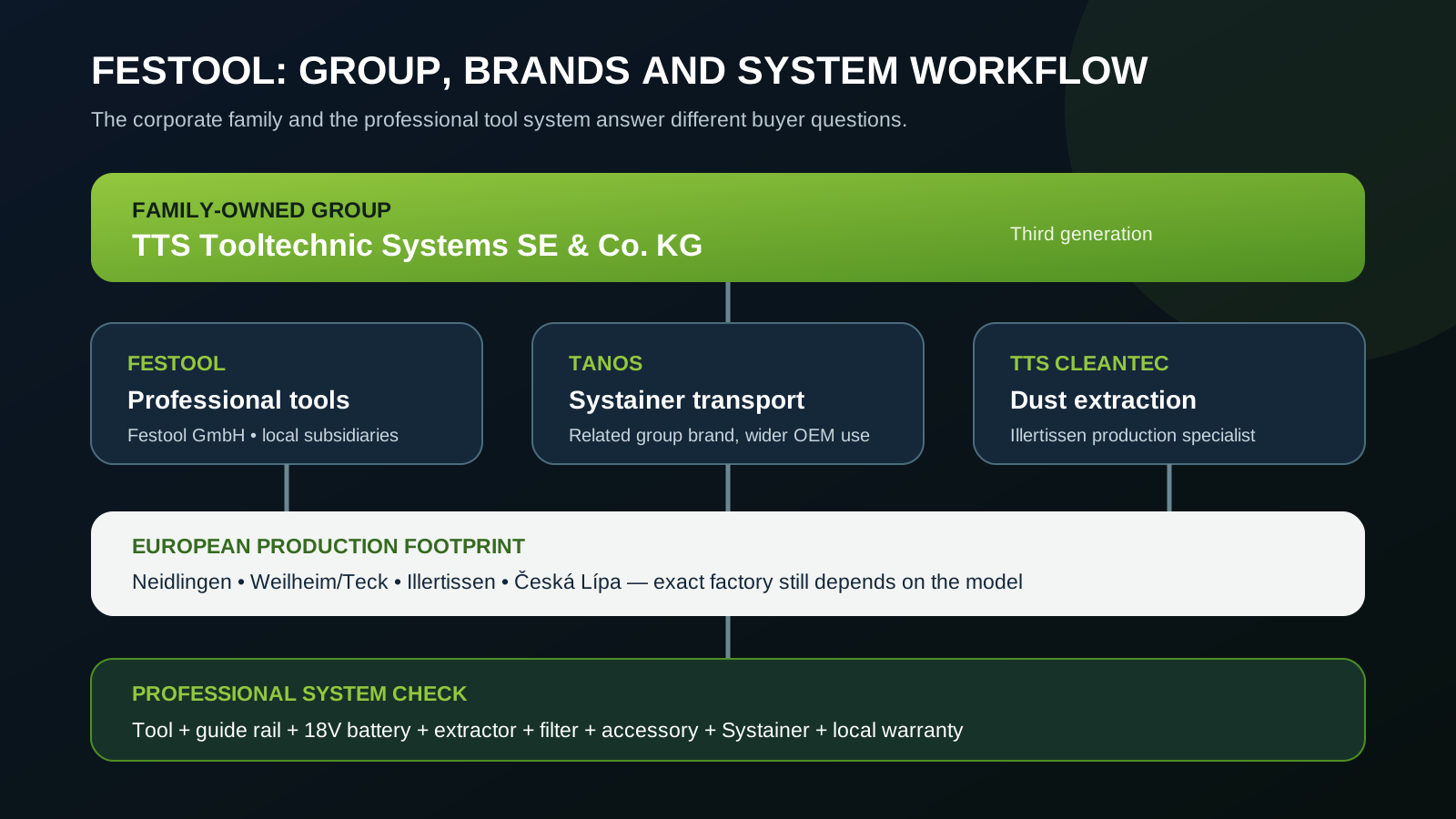
*Festool sits within TTS, but group ownership, factories, storage systems, dust extraction and product warranties remain separate evidence layers.*
What Is TTS Tooltechnic Systems?
TTS Tooltechnic Systems is the family-owned group above Festool. A 2026 TTS leadership announcement describes the group as a third-generation, medium-sized family business with more than 3,000 employees. Festool is its best-known power-tool brand, while the group also includes companies and brands serving extraction, transport and specialized professional applications.
The name “TTS” is not normally the main consumer-facing label on a Festool saw or sander. It is the corporate layer that organizes the businesses. Festool GmbH develops and markets Festool-branded systems, and country subsidiaries or authorized dealers handle sales and service under local terms.
This distinction matters for supplier diligence. A group parent, brand company, factory, importer, dealer and warranty administrator can all be different legal or operational parties. Record the exact entity named in the quote, invoice, declaration and warranty document.
Is Festool Still Family Owned?
Yes. Festool describes itself as a third-generation family company.
Its official family-business page traces the company to Albert Fezer and Gottlieb Stoll. After later generations managed the business, a division of family assets in 2000 placed the Festool brand under Gerda Maier-Stoll. Festool says her daughter Barbara Austel is now chair of the Supervisory Board.
Family ownership does not mean Festool is a single small workshop. The company reports more than 2,700 Festool employees, subsidiaries in 25 countries and presence in 68 countries. TTS reports a still larger group workforce.
Are Festool and Festo the Same Company?
No. They share historical roots but are separate current companies.
Fezer & Stoll was founded in Esslingen in 1925. The name later became Festo. As the businesses evolved, the power-tool operation was spun off as Festool GmbH in 2000, while Festo continued as an industrial-automation company.
The similar names and green visual identities can create confusion, but buyers should not treat Festo automation components and Festool power tools as one product catalogue, battery system or warranty program. Use the full legal entity and product brand in procurement records.
The year 2000 is also important because it marks the current Festool company structure and the move of the Festool headquarters to Wendlingen. It did not erase the brand's earlier Festo product history.
Who Manufactures Festool Tools?
Festool operates its own European production network, supported by related TTS companies and suppliers. The company identifies manufacturing locations in Germany and the Czech Republic.
Festool's official facts page names Neidlingen and Illertissen in Germany and Česká Lípa in the Czech Republic. Its centennial history adds the newer Weilheim/Teck site and explains the different roles: precision-tool production in Neidlingen, extraction production in Illertissen, production in Česká Lípa and manufacturing expansion in Weilheim.
That evidence supports a strong in-house European manufacturing footprint. It does not assign every saw, motor, battery, charger, filter, hose or accessory to one named plant. Product generations and component supply can differ.
For a specific Festool model, verify:
- exact model and regional configuration;
- country-of-origin label;
- manufacturer and importer on the declaration;
- production date or serial number;
- electrical rating and certification;
- authorized dealer and warranty eligibility; and
- factory evidence for large commercial orders.
Where Are Festool Tools Made?
Festool tools are made across multiple European sites, primarily in Germany and the Czech Republic according to the company's current disclosures.
Neidlingen has long been associated with power-tool production and machining. Festool says the site retains machining, tooling, training and motor expertise after assembly-line changes connected with the Weilheim expansion. Česká Lípa is a Czech production location operating to the group's quality standards. Illertissen specializes in extraction technology through TTS Cleantec.
These are group-level facts, not a universal “Made in Germany” claim for every product. A Czech-made Festool product can still be an authentic group product, and a German headquarters address does not prove German manufacture. Always use the exact product label and declaration.
What Does TTS Cleantec Make?
TTS Cleantec is the TTS extraction specialist based in Illertissen, Germany. Festool says the operation develops and produces extraction equipment there and also serves OEM customers.
This relationship helps explain why dust extraction is unusually central to the Festool system. Saws, sanders, routers and other tools are designed around hoses, automatic-start functions, filter categories and mobile dust extractors.
The relationship does not remove product-level checks. A Festool extractor and a third-party OEM unit can come from related expertise while using different specifications, approvals and service routes. The tool, hose diameter, filter class, dust category and market certification should be matched as a complete setup.
What Is Tanos and the Systainer System?
Tanos is the TTS business associated with the Systainer modular storage and transport system. Festool's facts page lists Tanos alongside Festool as a TTS brand, and Festool's history traces the Systainer to 1993.
Systainer cases are part of Festool's workflow proposition, but the format extends beyond Festool. Tanos supplies storage systems used by multiple professional brands and integrates with vehicle and workshop solutions.
Therefore, a compatible case does not prove that the product inside is made, owned or warranted by Festool. Check the product manufacturer separately from the box system.
How the Festool 18V Battery System Works
Festool's current cordless range is organized around an 18V platform. Its centennial history says the system covers roughly 50 products across sawing, drilling, fastening, sanding, extraction and related applications.
The platform is intended to connect mobile professional workflows. Selected tools use one 18V pack, while higher-demand products can use two packs. Compact packs may improve handling, while higher-capacity packs support longer runtime.
Battery compatibility still requires the exact manual. An “18V” label does not make a Festool battery compatible with Bosch, Makita, Milwaukee or another brand. Festool's own cordless generations and special products can also have requirements that are not obvious from voltage alone.
Before buying, match:
- tool model and battery generation;
- battery capacity and recommended application;
- charger and destination-market voltage;
- Bluetooth or automatic-extractor functions where relevant;
- two-battery requirements for higher-output tools; and
- local warranty and registration rules.
For a cleaning-equipment comparison, start with the product's intended task. A tool-connected extractor, a jobsite wet/dry vacuum and a household vacuum require different accessories and service support. The Milwaukee ownership and jobsite-cleaning guide and Shop-Vac manufacturer guide provide two useful points of comparison; shared applications do not imply shared ownership or interchangeable equipment.
Why Dust Extraction Is Central to Festool
Festool's system proposition is strongly connected to dust control. The company traces integrated dust extraction in its sanding machines to the 1930s and highlights extraction development since the 1960s.
The commercial logic is broader than selling a vacuum beside a saw. Guide rails, shrouds, hoses, extractors, filters, abrasives and storage are designed to support a repeatable professional workflow. In woodworking, renovation, painting and surface preparation, this can improve visibility, finish quality and cleanup efficiency.
For World Clean Biz readers, the key is interface verification. A dust extractor must match the tool connection, airflow requirement, filter and dust hazard. Automatic activation and Bluetooth features depend on the specific combination. Local occupational-safety rules remain separate from the brand's marketing claims.
How Does Festool's Warranty Work?
Festool markets a comprehensive after-sales program, often called Warranty all-inclusive, but the benefits vary by country and registration conditions.
Festool's company history says it introduced a free three-year service package in 2013 that included wear parts and theft protection under stated conditions. Current territory-specific warranty documents define eligible products, authorized sales routes, registration periods and claim procedures.
Do not apply a European headline term to a U.S., Asian or cross-border purchase without checking. Warranty coverage may depend on buying from Festool or an authorized dealer in the relevant territory and registering the tool on time.
Keep the dated invoice, serial number, registration confirmation and dealer identity. For business fleets, also confirm loan-tool availability, repair turnaround and long-term parts support.
Is Festool Worth the Premium?
That depends on whether the buyer uses the system advantages.
Festool competes around precision, extraction, accessories, storage, workflow integration and service. A contractor who values guide-rail repeatability, dust control and organized transport may calculate value differently from a buyer seeking the lowest tool-only price.
The comparison should include accessories and switching costs. A premium tool can become inefficient if the correct blades, abrasives, filters or batteries are unavailable locally. Conversely, an integrated setup can reduce setup time, cleanup and rework when the job matches the system.
World Clean Biz treats this as a total-workflow question, not a universal endorsement. Compare the exact application, dealer network, consumables, repair route and lifecycle cost.
What Buyers and Distributors Should Verify
Before relying on a Festool ownership or manufacturing claim, record:
- Group ownership: TTS Tooltechnic Systems and the relevant Festool company.
- Product identity: Exact tool, battery, extractor, accessory and regional SKU.
- Factory evidence: Label, declaration, origin and production period.
- Dealer status: Authorized route in the destination market.
- Battery system: Pack, charger and tool compatibility.
- Dust-control interface: Hose, shroud, filter class and automatic-start function.
- Storage relationship: Festool product versus Tanos/Systainer format.
- Warranty: Country, registration, exclusions and theft terms.
- Consumables: Local availability of blades, abrasives, bags and filters.
- Service: Repair turnaround, parts and cross-border eligibility.
Frequently Asked Questions
Who owns Festool today?
Festool is a family-run brand within TTS Tooltechnic Systems SE & Co. KG.
Is Festool a public company?
No. Festool and the TTS Group are privately held and family owned.
Is Festool owned by Festo?
No. Festool and Festo share historical roots, but they are separate current businesses. Festool GmbH was spun off in 2000.
Is Festool made in Germany?
Festool manufactures in Germany, but it also identifies production in Česká Lípa, Czech Republic. Check the exact model's origin.
Who makes Festool dust extractors?
TTS Cleantec develops and produces extraction equipment in Illertissen for Festool and other customers. Verify the exact model and responsible entity.
Does Festool own Systainer?
Festool and Tanos are related brands within TTS. Tanos operates the broader Systainer business; using a Systainer does not make another product a Festool product.
Are all Festool batteries interchangeable?
No universal assumption is safe. Match the exact Festool tool, battery, charger and generation, especially for higher-demand or two-battery products.
Is Festool mainly for woodworking?
Woodworking is central, but Festool also serves painting, renovation, drywall, surface preparation and other professional trades.
Final Answer
Festool is a family-owned professional tool brand within TTS Tooltechnic Systems. Festool GmbH is the core operating company, while related TTS businesses such as Tanos and TTS Cleantec support storage and extraction capabilities.
Festool has a significant manufacturing base in Germany and the Czech Republic, but the exact origin of an individual tool still requires product-level evidence. Its real differentiation is the connected workflow across precision tools, guide rails, 18V batteries, extraction, accessories and Systainer transport—not ownership alone.
Official Sources
- Festool: Facts and figures, production sites and TTS ownership
- Festool: Family-run ownership
- Festool: Company history from Festo to Festool
- Festool: TTS Group leadership and company structure
- Festool: TTS Cleantec extraction production
- Festool: Warranty terms and conditions