- Hilti is a private company owned by the Martin Hilti Family Trust, not by a public conglomerate or private-equity fund.
- Hilti operates an international production network, but a named group site does not prove the factory or country of origin for every Hilti model.
- Hilti's direct customer relationships, Fleet Management, repair services and Nuron platform are central to its business model and must be checked under the contract and market that apply to the buyer.
In this article 16 sections
Hilti is privately owned by the Martin Hilti Family Trust. Hilti Group's official business-results material says the trust owns the company and supports its long-term continuity. Hilti is therefore neither a publicly listed tool company nor a brand owned by a large U.S. home-improvement retailer.
The ownership answer is only the first layer. Hilti combines construction tools, fasteners, software, engineering support, direct customer relationships, repair services and equipment-as-a-service programs. It also runs manufacturing operations in several countries. None of those facts, by itself, identifies the factory, seller, warranty entity or country of origin for every Hilti product.
Hilti Ownership at a Glance
| Company or relationship | Verified role | Important boundary |
|---|---|---|
| Martin Hilti Family Trust | Private owner of the Hilti Group | The trust is the shareholder, not a tool manufacturer or local warranty office |
| Hilti Aktiengesellschaft | Liechtenstein-based parent company of the group | Parent-company location does not establish product origin |
| Hilti Group | Global construction-technology business | Group disclosures do not allocate every SKU to a factory |
| Local Hilti sales company | Contracts, invoices and supports customers in a stated market | The legal entity and terms vary by country |
| Hilti manufacturing network | Produces tools, components, anchors and other products across several countries | Exact model and production period still require product-level evidence |
| Nuron 22V | Current cordless platform covering tools and selected jobsite cleanup equipment | A battery platform is not a statement of ownership, origin or universal compatibility |
| Tool Fleet Management | Equipment-as-a-service and lifecycle program | Coverage, repair and replacement rights are contractual and market-specific |
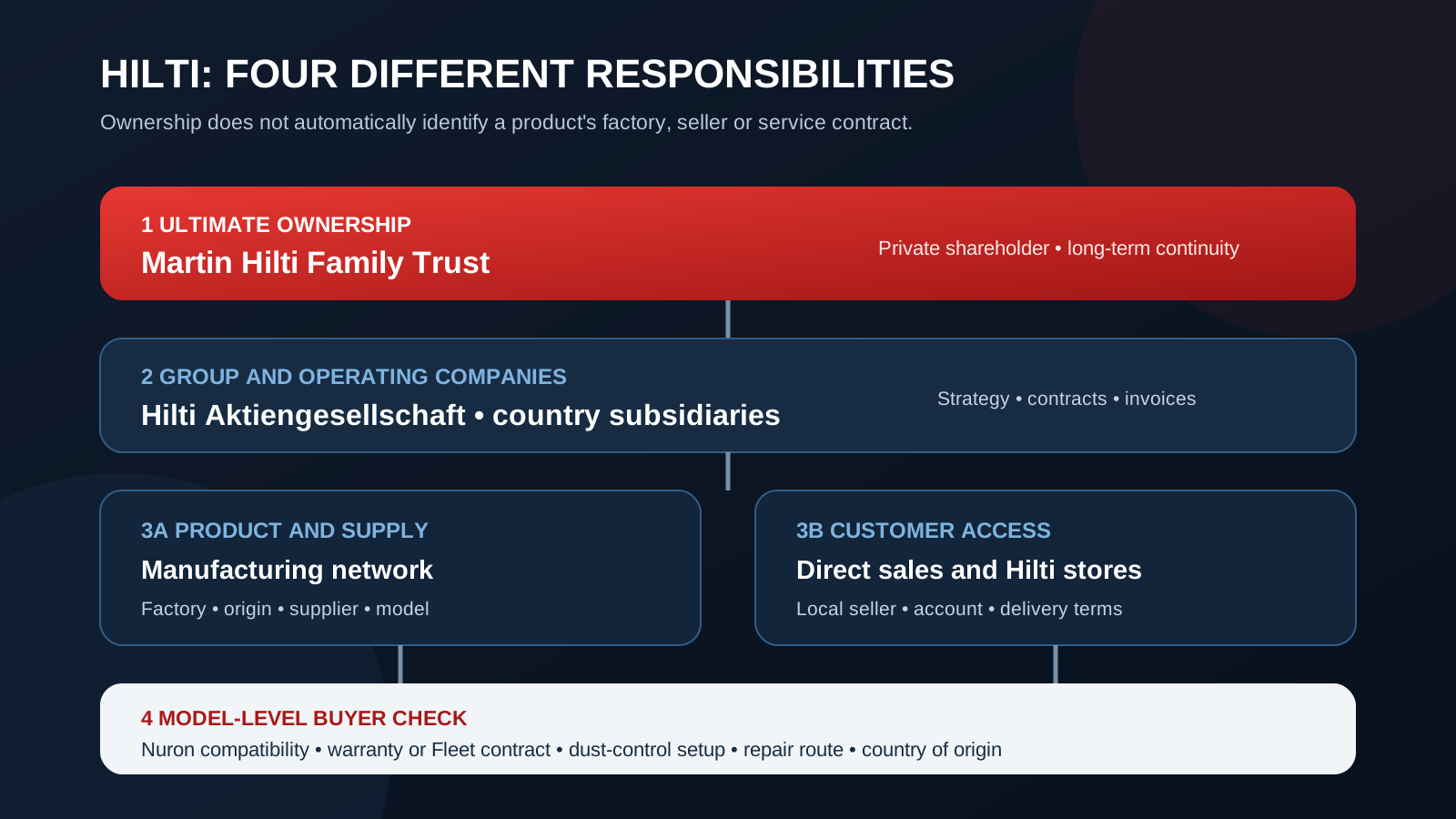
*The Family Trust owns the group. Manufacturing, sales, service and product responsibility still operate through separate facilities, entities and contracts.*
What Is the Martin Hilti Family Trust?
The Martin Hilti Family Trust is the long-term shareholder behind Hilti. Hilti's 2025 business-results release states that the company is privately owned by the trust. Earlier official material says the trust has held all shares since 2000 and all participation certificates since 2008.
That structure helps answer two common questions. First, Hilti is not listed on a stock exchange, so buyers cannot identify a controlling public shareholder from a market-data screen. Second, the company is not simply a founder-named brand sitting inside an unrelated tool conglomerate. The ownership structure was designed to preserve continuity around Martin Hilti's business.
The trust should not be confused with the operating company. It does not manufacture rotary hammers, issue every local invoice or process every warranty claim. Those functions sit within Hilti Aktiengesellschaft, group subsidiaries, manufacturing sites and country organizations.
Who Founded Hilti?
Brothers Martin and Eugen Hilti founded Maschinenbau Hilti OHG in Schaan, Liechtenstein, in 1941. The operation began as a small mechanical workshop. Hilti's history highlights the launch of the DX 100 powder-actuated fastening tool in the 1950s and the TE 17 electro-pneumatic hammer drill in the 1960s as important steps in its development.
The group headquarters remain in Schaan. That continuity explains why Liechtenstein is central to Hilti's corporate identity, but headquarters are not the same as a universal manufacturing origin. A product sold by a Hilti subsidiary in the United States, Europe or Asia can have a different responsible entity and production location.
Is Hilti a Public Company?
No. Hilti is a privately held group controlled by the Martin Hilti Family Trust.
Hilti publishes annual business and sustainability information, but those disclosures do not make its shares publicly traded. The distinction matters when comparing Hilti with Makita, Snap-on or another listed company. A public company has outside shareholders, securities filings and market capitalization. Hilti's trust ownership instead emphasizes continuity and reinvestment within a private structure.
Private ownership also does not make Hilti a small regional manufacturer. Hilti says it has about 34,000 employees and operations in more than 120 countries. Its 2025 interim results described products, systems, software and services for the global construction industry.
Who Manufactures Hilti Tools?
Hilti manufactures within its own international value chain and also works with suppliers. The accurate answer for a particular tool, battery, dust extractor, anchor or accessory still depends on model-level evidence.
Hilti's current careers material identifies manufacturing teams in Austria, China, Germany, Hungary, India, Liechtenstein, Mexico and the United States. Its corporate history also names long-standing plants in Schaan, Thüringen, Kaufering, Strass, Zhanjiang, Shanghai, Kecskemét and Matamoros. These disclosures show that Hilti is more than a brand and sales organization.
They do not prove that every red tool comes from one of those named sites. Product groups can use different factories, group companies, suppliers and component networks. Manufacturing allocations can also change by generation or market.
For an exact Hilti SKU, verify:
- model, serial number and production code;
- country-of-origin label;
- manufacturer and importer named on the product or declaration;
- certification and regulatory files;
- current bill of materials and approved factory for commercial orders; and
- the entity responsible for local warranty and safety actions.
Where Are Hilti Tools Made?
There is no reliable one-country answer for the whole Hilti range.
Hilti has roots, headquarters and manufacturing in Liechtenstein, while its production network extends across Europe, Asia and the Americas. The group's historical plant list and current manufacturing recruitment pages support a multi-country footprint. Hilti's 2025 modern-slavery statement also says it works with roughly 820 core direct suppliers, mainly in Europe and Asia-Pacific, and procures a share of direct purchase volume within the regions where products are sold.
That combination of internal manufacturing and external supply means country-of-origin work must stay at product level. A hammer drill, fastener, battery, insert tool, vacuum or measuring device may not share the same production route.
Hilti's U.S. terms of sale are especially useful because they tell customers how to request country-of-origin information in writing. They also limit authorized origin warranties to designated company personnel. Buyers should use that route instead of relying on marketplace descriptions or a general statement about Hilti's headquarters.
How Hilti's Direct-Sales Model Works
Hilti differentiates itself through direct customer relationships rather than relying only on mass retail.
The group says direct customer contact is a central part of its strategy. Depending on the country, customers may buy through field representatives, Hilti stores, customer service or the Hilti website. That structure gives the company visibility into jobsite applications, tool use, service needs and fleet decisions.
“Direct” does not mean one legal entity serves the entire world. The contracting party, invoice issuer, tax treatment, delivery terms, warranty administrator and repair route still depend on the country and transaction. A global account should document which Hilti entity is responsible in each market.
The model is also different from ownership. A salesperson or store may represent a local subsidiary, while the Martin Hilti Family Trust remains the ultimate shareholder. The direct channel does not prove where a tool was made.
What Is Hilti Tool Fleet Management?
Tool Fleet Management is Hilti's equipment-as-a-service model for professional customers. Instead of treating every tool only as a one-time capital purchase, a fleet contract can combine equipment access with services such as repairs, replacement arrangements, cost visibility and asset management.
Hilti's current U.S. material describes fixed monthly costs, repair and replacement support, and links with ON!Track asset management. Tools on Demand can supplement a fleet for temporary needs in an eligible market.
The buyer must read the actual agreement. “Fleet Management” is not a universal promise that every loss, battery failure or repair is free in every country. Contract duration, theft terms, fair-use rules, service turnaround, early termination, temporary replacement and end-of-term treatment can differ.
For procurement teams, the comparison should include total lifecycle cost and downtime—not only tool price. A strong service model can be valuable, but only when the local response time, inventory and contract rights match the jobsite.
What Is the Hilti Nuron Platform?
Nuron is Hilti's current 22V cordless platform. Hilti positions it as a common system for a wide range of construction applications, including drilling, fastening, cutting, grinding, demolition and selected cleanup equipment.
Current Hilti U.S. material says the platform powers more than 100 tools. Nuron batteries carry onboard data used for tool and battery management when connected with compatible chargers and services. Higher-demand tools can use larger packs or multiple batteries while remaining within the platform.
The “22V” name does not make Nuron compatible with another manufacturer's nominally similar battery. It also does not automatically make every legacy Hilti battery fit every Nuron tool. Match the exact tool, battery, charger and adapter documentation.
For fleets migrating from older Hilti platforms, check:
- which tools must be replaced;
- whether an approved adapter exists;
- charger and electrical-market requirements;
- battery capacity for the application;
- transport and storage rules; and
- Fleet Management treatment of legacy equipment.
Hilti's Cleaning and Dust-Control Connection
Hilti is not a household-cleaning brand, but it is directly relevant to professional dust control and jobsite cleanup.
Concrete drilling, grinding, cutting and demolition create dust at the point of work. Hilti sells dust-removal systems, vacuum cleaners, hollow drill bits and tool-mounted extraction solutions intended to capture debris during those processes. Its SafeSet approach also links drilling and hole cleaning for anchoring applications.
For World Clean Biz readers, this is the important adjacency: the power tool, extraction interface, hose, filter class, dust container, consumables and work method form one system. A powerful tool is not enough if the extractor is incorrectly matched or the filter is unsuitable for the hazard.
Buyers should verify the exact combination and applicable occupational-safety requirements. Marketing language such as “virtually dust-free” is application-dependent and should not replace exposure assessment, approved controls or local regulation.
How Does the Hilti Warranty Work?
Hilti warranty and service terms vary by country, tool and purchasing program.
In the United States, Hilti promotes a tool warranty and repair-cost-limitation structure. Fleet customers may have different repair and replacement treatment through their contract. Consumables, wear, misuse, unauthorized repair and products bought through nonstandard channels may be handled differently.
The local sales entity matters. A U.S. warranty page should not be treated as the contract for a tool purchased in another country. Keep the invoice, serial number, registration or fleet record, repair history and written origin information.
For a cross-border purchase, confirm in writing whether the destination-country Hilti organization will service the item, whether parts are stocked, and whether electrical and certification requirements match the market.
What Buyers and Distributors Should Verify
Before relying on a Hilti ownership or manufacturing claim, record:
- Ultimate owner: Martin Hilti Family Trust.
- Contracting entity: The Hilti company issuing the quote and invoice.
- Product identity: Model, serial number, production date and kit contents.
- Manufacturing evidence: Product label, origin statement, declaration and approved factory.
- Battery system: Nuron or a legacy platform, with exact tool, battery and charger compatibility.
- Sales route: Field sales, store, website or another authorized route.
- Service program: Purchase warranty or Fleet Management contract.
- Dust-control system: Tool-to-extractor interface, filter, hose, consumables and local compliance.
- Repair coverage: Local turnaround, parts, loan tools and exclusions.
- Cross-border status: Certification, voltage, warranty and service eligibility in the destination country.
Frequently Asked Questions
Who owns Hilti today?
The Martin Hilti Family Trust owns Hilti. The company is privately held.
Is Hilti owned by Bosch?
No. Hilti is not owned by Bosch. It is controlled by the Martin Hilti Family Trust.
Is Hilti a German company?
Hilti has important operations and manufacturing in Germany, but the parent group is headquartered in Schaan, Liechtenstein.
Are Hilti tools made in Liechtenstein?
Some Hilti manufacturing occurs in Liechtenstein, but the group has a multi-country production network. Check the exact product's origin evidence.
Does Hilti manufacture its own tools?
Hilti operates its own manufacturing network and also works with suppliers. The manufacturer and factory for a specific SKU still require product-level verification.
What is special about Hilti's business model?
Hilti combines direct customer relationships with tools, engineering support, software, repair services and programs such as Tool Fleet Management.
Is Nuron a 22V system?
Yes. Nuron is Hilti's current 22V cordless platform, but compatibility must be confirmed for the exact tool, battery and charger.
Does Hilti make vacuum cleaners?
Hilti sells professional vacuum and dust-removal equipment for construction applications. It is a jobsite dust-control offer, not a consumer home-cleaning range.
Final Answer
Hilti is a privately held construction-technology group owned by the Martin Hilti Family Trust. The trust protects long-term ownership continuity, while Hilti Aktiengesellschaft and its operating companies manage the global business.
Hilti manufactures through an international network and works with outside suppliers, so no single country describes every tool. Its direct-sales organization, Nuron cordless platform, Fleet Management contracts and dust-control systems are central to the brand's professional positioning. Buyers should verify the exact product's factory, local contracting entity, battery compatibility, warranty and service terms rather than infer them from the Hilti name alone.
Official Sources
- Hilti Group: 2025 business results and Family Trust ownership
- Hilti Group: company history and international production sites
- Hilti Careers: current manufacturing countries
- Hilti Group: 2025 modern-slavery statement and supplier footprint
- Hilti USA: Terms and Conditions of Sales
- Hilti USA: Nuron, Fleet Management and construction workflow
- Hilti USA: Tool warranty