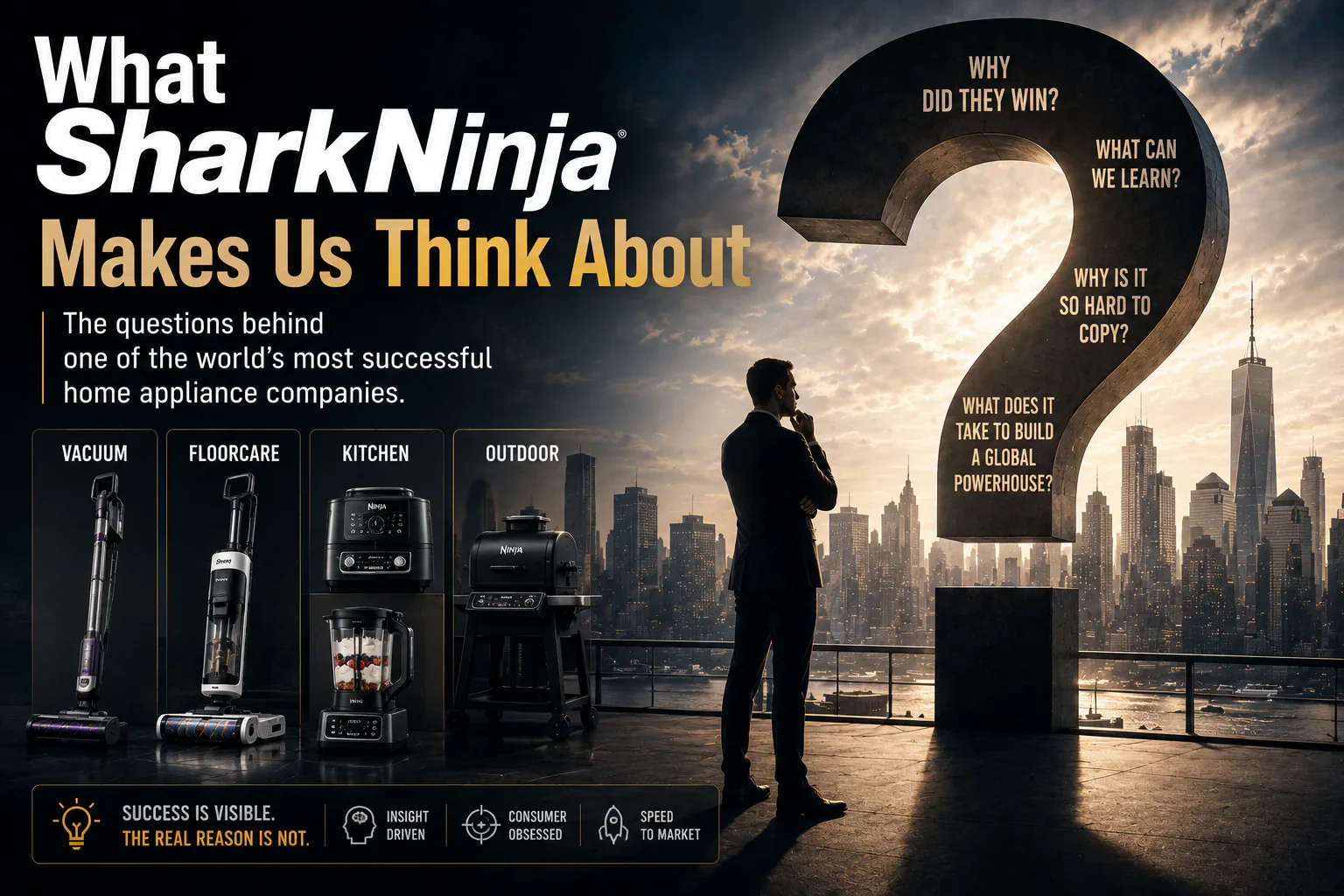
- Shark and Ninja succeeded by occupying different category meanings while sharing group-level capability.
- A single brand might have reduced clarity because cleaning appliances and kitchen appliances carry different consumer associations.
- The comparison offers a useful lens for Chinese companies managing multi-category appliance brands.

When I was sorting out Shark company information a few days ago, I suddenly remembered this issue about the brand.
Shark brand cleaning appliances and Ninja brand kitchen appliances are leading brands in the North American market, occupying 30% of the market share of their respective categories. Regardless of product definition, market sales, and brand communication, these two brands are very successful.
So our question is "If SharkNinja had used the same brand to sell their products, would they have done better than they do now?" This can be compared to the same question "Would Ecovacs and Tineco be better if they used the same brand"?
First, let’s determine what the brand is?
Take the American Marketing Association’s definition as a representative: “A brand is a name, term, symbol, sign, or design, or a combination thereof, used to identify a product or group of products or services, and to differentiate them from those of other competitors.”
The English name of the brand is Brand, which means brand in English. The original meaning is that when Europeans were herding cattle in the early years, they were afraid that their own cattle would be mixed with other people's cattle, so they branded the cattle to distinguish them. After years of development, the branding on cattle has also spread to various industries and turned into various LOGOs.
So it can be seen that the original brand concept in the early days was to differentiate it from others, so when Chinese companies later made brands, they also made various designs and gave them various meanings.
In the early years, I personally was also a supporter of this concept. I wanted to give it 100 lofty meanings in the brand name and LOGO. But when it came to sales, I found that the brands we gave various beautiful visions were just a combination of a few words in the minds of others. This kind of brand is called "white brand" in the eyes of others.
Does that mean that after I spent 100 million on advertising, our white card turned into a brand?
In an era when television was the only channel, as long as a company spent tens of millions to win the CCTV bid, its products could be sold all over the country the next day and become a household name.
I believe that as long as everyone takes a plane at various airports, everyone should be able to see this billboard at the airport.
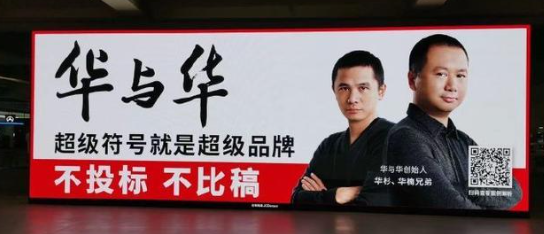
These two people are two brothers from Guizhou, called the Huashan and Huanan brothers. They are China's largest marketing planning company, and they have done many classic cases. If Mixue Bingcheng's "You Love Me, I Love You, Mixue Bingcheng Sweet Honey" which became popular last year, Xibei Youmian Village's "If you have treasures at home, eat Xibei", and the well-known Haidilao brand are all Huayhua's customers.
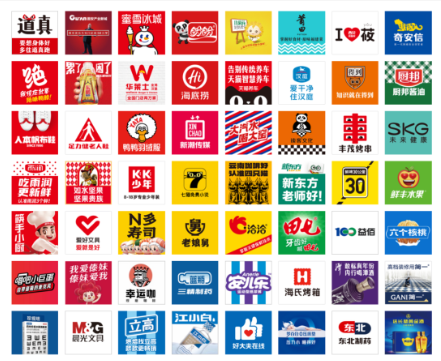
Hua & Hua’s definition of brand:
① A brand is a product and its brand, a trinity of words, products and symbols, one ontology and three persons. ② Enterprises establish brands to help the public discover, purchase, identify, remember, identify, repurchase and spread. ③At the same time, brands also reduce the cost of social supervision of enterprises and are a risk prevention mechanism to protect consumer rights and interests.
Different from traditional brands whose core purpose is to differentiate themselves from other brands, the core of Huayihua's brand definition is "the brand is a promise to consumers, and the purpose of the brand is sales and communication."
If we start from the theory of Hua and Hua, we can see that most brands can only be said to be differentiated from other brands, but if you look at a brand LOGO alone, you cannot tell what product the LOGO represents.
We will not discuss the pros and cons of each brand name design here, otherwise this article would probably take several thousand words.
Here we go back to the original question "If SharkNinja had used the same brand to sell their products, would they have done better than they do now?"
This question can actually be divided into 2 questions:
- Is it better to use the same brand for different categories of products, or is it better to divide them into different brands according to different products?
In different categories, different companies have different practices. Some companies are divided into different brands according to different categories. In the industry, there are Ecovacs and Tineco, Shark and Ninja. There are also Midea, Philips Electrolux, Xiaomi, and Huawei.
Most brands are white brands to consumers at the beginning, and there is no difference. Only after years of investment will a brand gain a certain level of awareness among consumers.
Personally, I prefer to use the same brand in similar categories.
- The reason why a brand becomes a brand is, simply put, continuous investment and exposure. Hua & Hua has a theory that brand investment is uninterrupted investment. Therefore, Hua & Hua has placed advertisements at the airport for more than 10 years, and the photos and slogans used are exactly the same without change. From this aspect, if the advertising cost is fixed, the potential energy invested in one brand will be higher than that of two brands.