- RMB 70 billion is a scenario derived from the prospectus market forecasts and share assumptions, not completed revenue or formal earnings guidance.
- Roborock reported RMB 18.695 billion in 2025 revenue, materially shortening the distance from the 2024 base used in the application proof.
- Reaching the 2029 scenario requires category expansion, overseas channel control and sustained market-share gains while managing tariffs and service costs.
In this article 8 sections
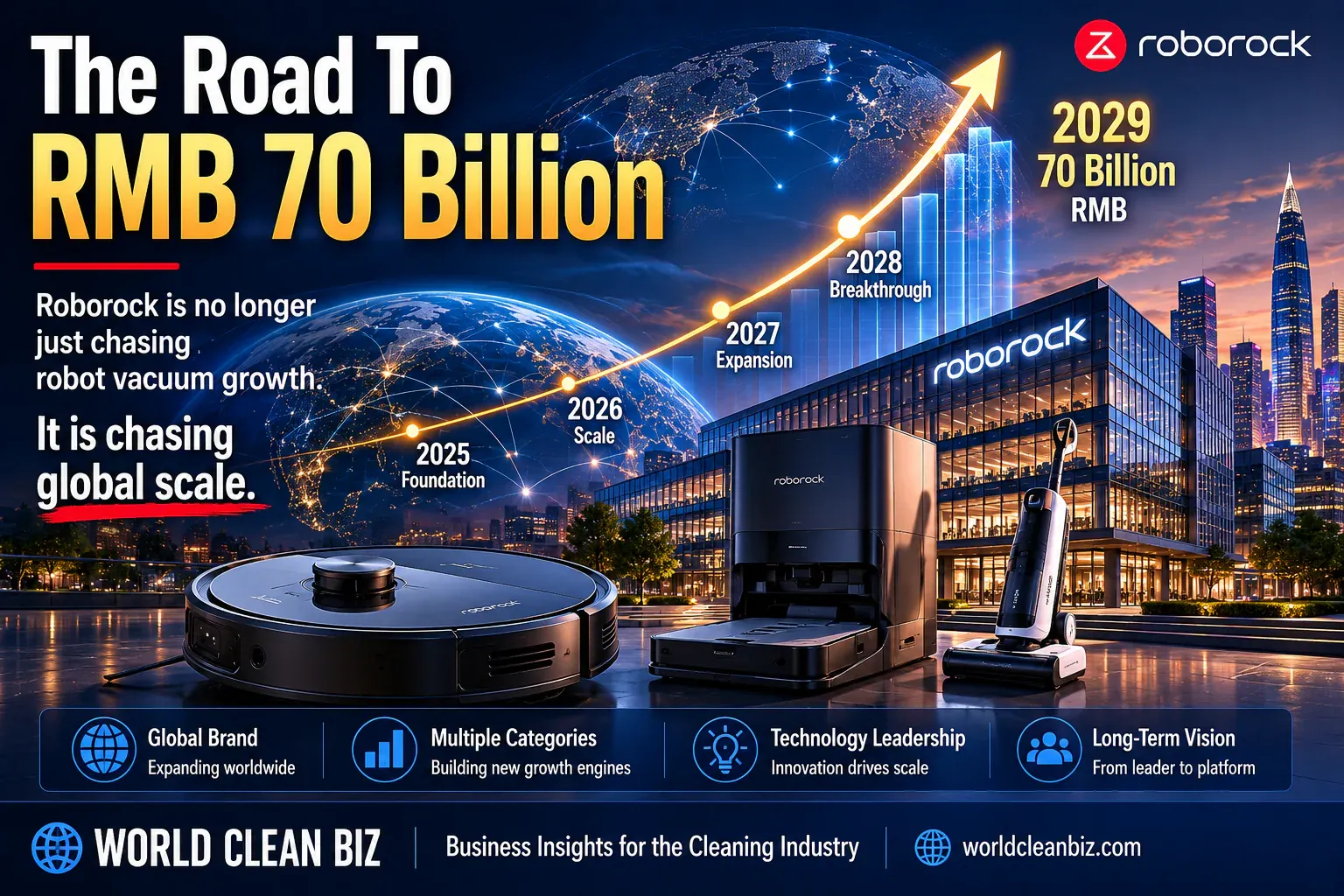
Roborock’s Hong Kong application documents made an unusually ambitious growth scenario visible. Using the market forecasts and share assumptions disclosed in the draft application proof, annual revenue approaching RMB 70 billion by 2029 becomes mathematically possible.
That figure needs a clear boundary. It is not Roborock’s current revenue, and it should not be presented as guaranteed management guidance. The Hong Kong document is an application proof in draft form, while several market-size and market-share figures are attributed to commissioned industry research.
The 2024 base was already substantial
Roborock reported revenue of approximately RMB 11.9 billion in 2024, up from around RMB 6.6 billion in 2022. The application proof separates the business into robot vacuums and newer intelligent cleaning categories, including wet-dry vacuums and washer-dryers.
The document says Roborock sold about 3.5 million robot vacuums in 2024, generating approximately RMB 10.89 billion. Wet-dry vacuums and washer-dryers contributed roughly 619,000 units and RMB 1.07 billion.
Overseas markets had already become larger than the domestic business. The application material reports approximately RMB 6.38 billion of overseas revenue and RMB 5.53 billion in China for 2024. Overseas gross profit was about RMB 3.43 billion, implying a gross margin close to 53.7%; China gross profit was around RMB 2.57 billion, or approximately 46.5%.
These figures show why international expansion matters to the 2029 scenario. Growth outside China adds revenue and can improve the product mix, but it also brings tariffs, regional inventory, marketing, returns and service costs.
2025 changed the starting point
Roborock’s official 2025 results subsequently reported revenue of RMB 18.695 billion, an increase of 56.51% from 2024. By the first quarter of 2026, revenue reached RMB 4.227 billion, up 23.31% year on year.
The RMB 70 billion scenario therefore no longer represents nearly six times the latest annual revenue. It would require approximately 3.7 times Roborock’s 2025 revenue over four years. That remains demanding, but it is a different task from the one implied by the 2024 base.
The prospectus assumes both category growth and share gains
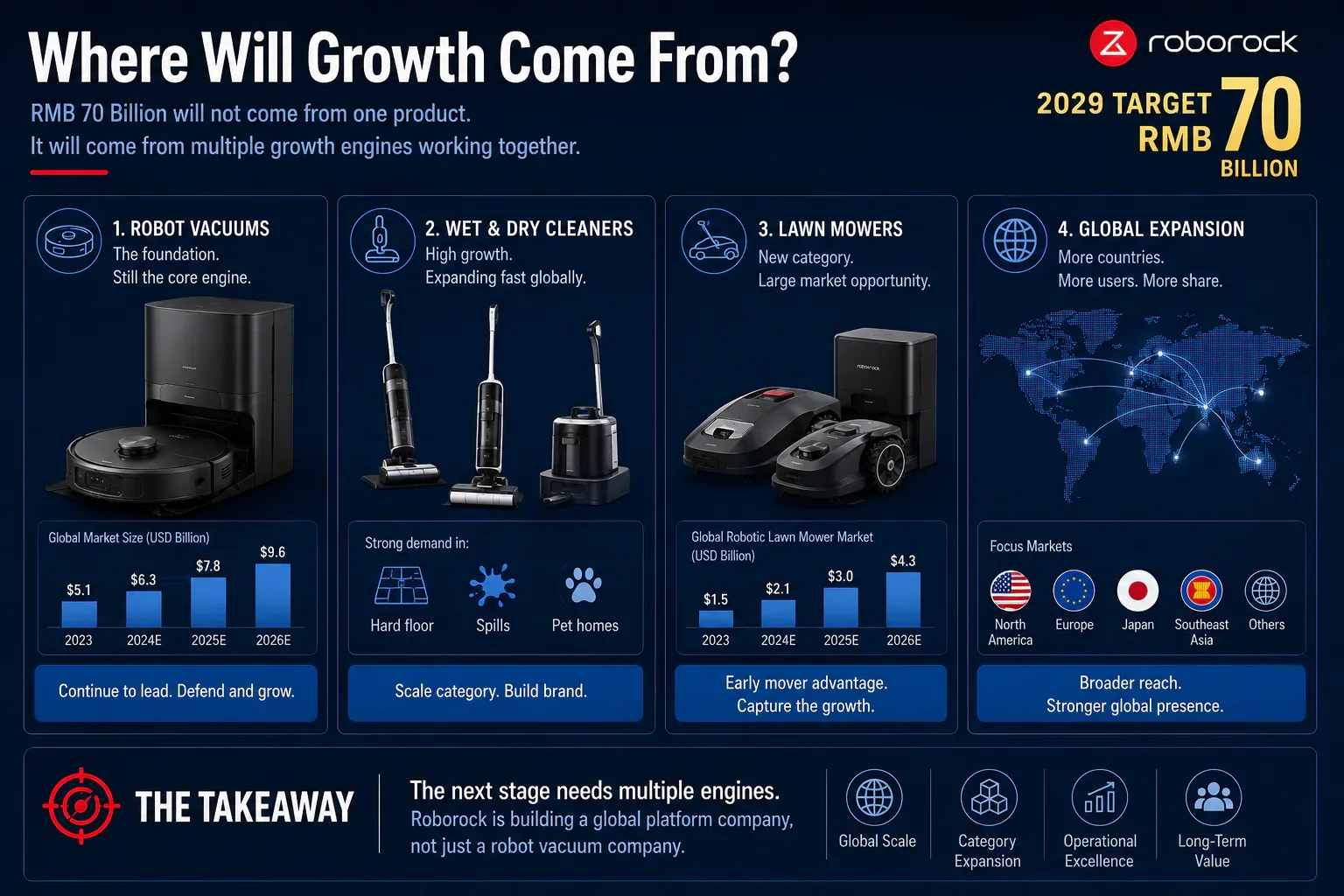
The application proof cites an industry forecast in which the global smart-cleaning-appliance market expands from approximately USD 15.1 billion in 2024 to USD 41.4 billion in 2029. Within that total, robot vacuums rise from about USD 9.3 billion to USD 25.2 billion, while wet-dry vacuums increase from approximately USD 3.6 billion to USD 11.8 billion.
Roborock’s disclosed 2024 share of the broader smart-cleaning market was about 12.3%. The scenario behind the RMB 70 billion headline assumes that the company can participate in the category’s expansion and take a materially larger share.
The document also describes Roborock as the leading global robot-vacuum brand in 2024 by both gross merchandise value and sales volume, based on CIC research. Regional positions varied: the company was strong in Germany and South Korea but still faced larger competitors in markets including China and the United States.
Market leadership at the global level therefore does not remove the need for country-level execution. Retail access, pricing, product configuration, warranty expectations and brand awareness differ by market.
Direct sales can lift control and increase operating burden
The 2024 channel split in the application material was approximately RMB 4.95 billion of direct sales and RMB 6.96 billion through distributors.
Moving selected markets from distribution toward direct operation can give Roborock more control over pricing, inventory, customer data and brand presentation. It can also retain more gross profit inside the group. The trade-off is that Roborock must absorb functions previously carried by distributors: warehousing, retailer relationships, local marketing, returns, spare parts and after-sales service.
Changing a distributor is not a simple margin improvement. Departing partners can take retailer relationships and category knowledge to competing brands. A direct model only creates durable value when the company can replace those capabilities locally.
The tariff figure has a date and product boundary
The application proof discussed a combined U.S. tariff burden of 55% for relevant China-origin products at the time covered by the document, consisting of a base tariff and additional measures. That figure should not be treated as a permanent rate for every Roborock product or shipment.
Tariff treatment depends on origin, classification, entry date and current U.S. policy. Buyers and distributors should verify the customs classification and origin of the exact SKU rather than copying a group-level statement into landed-cost calculations.
New categories must become meaningful businesses
Robot vacuums still supplied most of Roborock’s 2024 revenue. Wet-dry floorcare had grown, but it was not yet large enough to carry the 2029 scenario by itself.
Roborock has since moved into washer-dryers and robotic lawn mowers. The company introduced the RockMow and RockNeo mower ranges in 2025 and announced its North American mower entry at CES 2026. These products show that Roborock is applying navigation, perception and automation beyond the indoor floor.
Category entry is only the first step. Lawn care creates a different dealer, installation and service burden. Major appliances require delivery, installation and a longer repair cycle. Each new category can enlarge revenue, but it can also dilute the operating efficiency that made Roborock successful in robot vacuums.
What has to go right by 2029
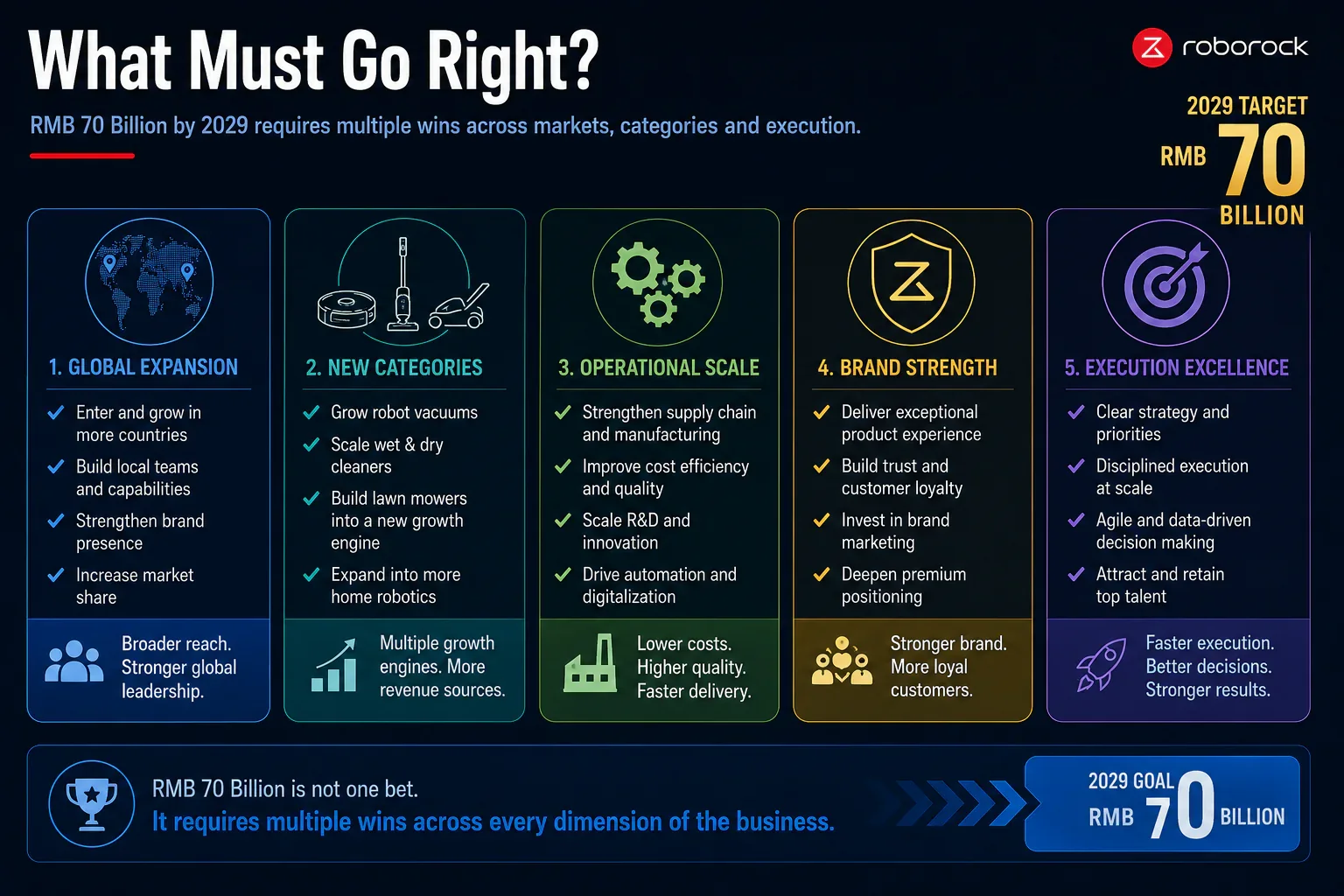
Five conditions sit behind the RMB 70 billion scenario:
- The global category forecast must broadly hold. A large part of the implied growth comes from expansion of robot vacuums and wet-dry cleaning, not share gains alone.
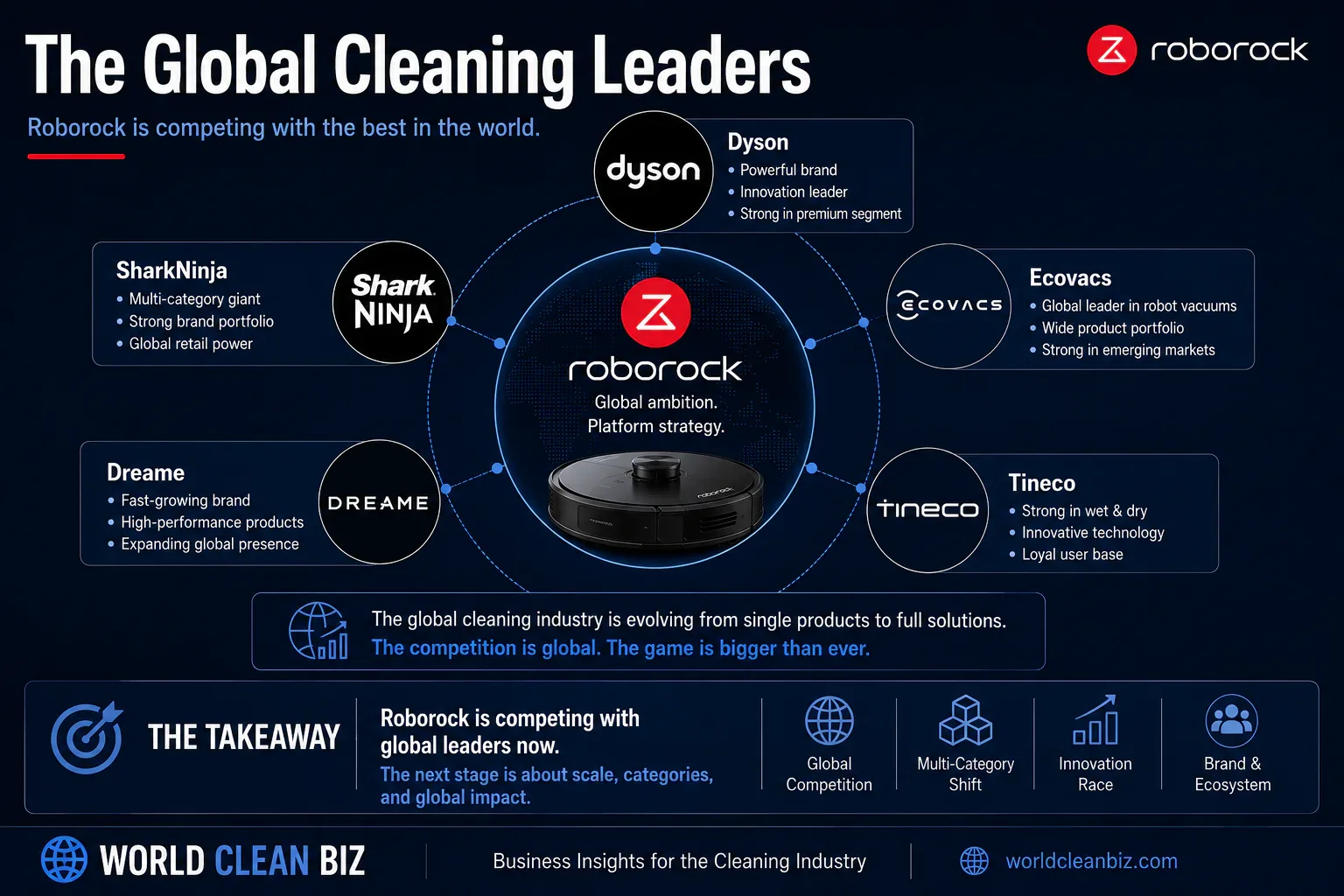
- Roborock must keep gaining share. Competitors including ECOVACS, Dreame, Narwal, iRobot and Xiaomi will not stand still.
- Overseas direct operations must remain efficient. Revenue growth can be offset by retailer fees, advertising, returns, inventory and service costs.
- New categories must scale. Mowers, washer-dryers and other products need repeatable distribution and support rather than one-season launches.
- Trade and supply-chain exposure must stay manageable. Tariffs, product origin and regional compliance can change the economics of individual markets.
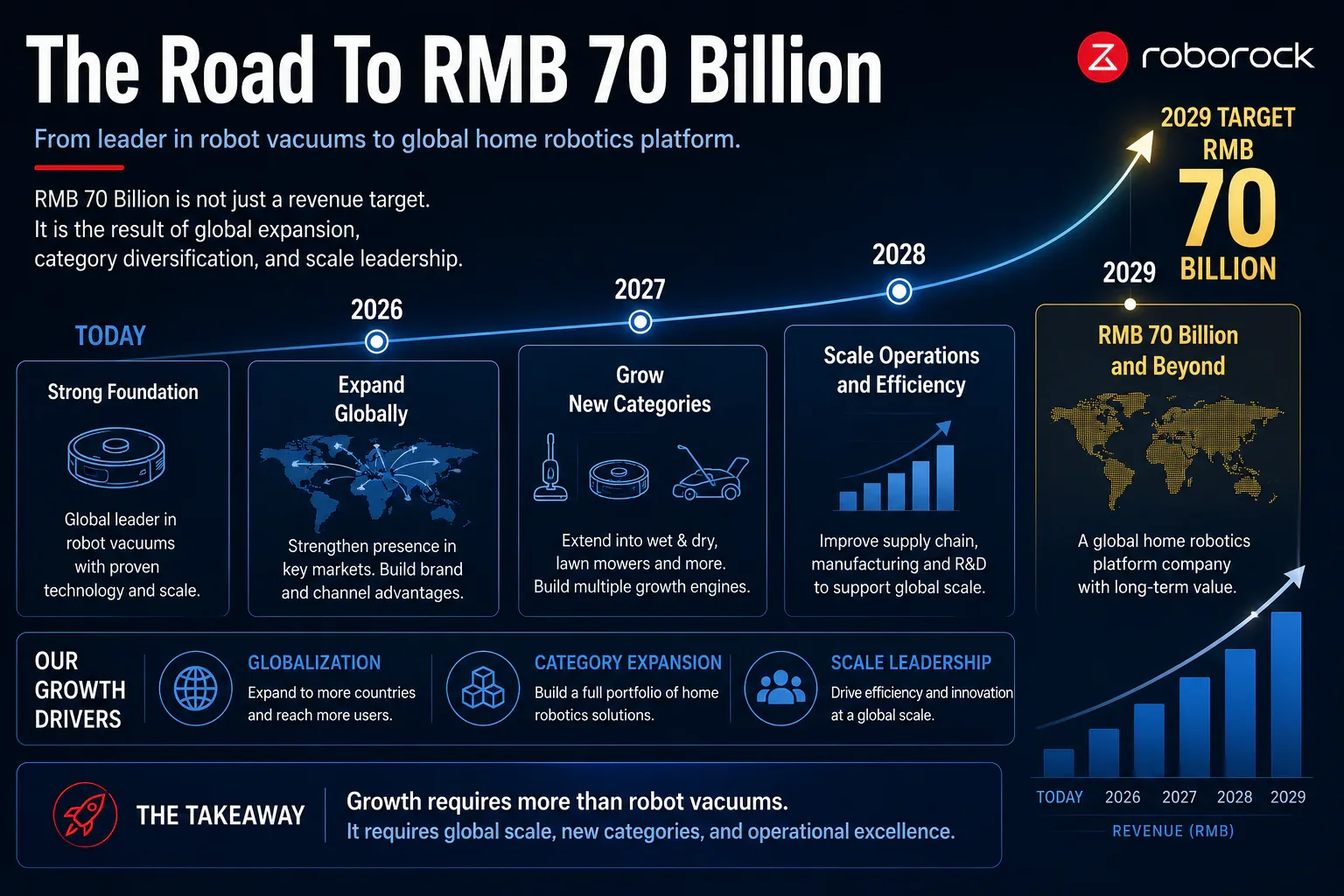
Roborock’s 2025 growth makes the headline less remote than it appeared from the 2024 figures. It does not remove the execution risk. RMB 70 billion by 2029 would require Roborock to become a broader global appliance and robotics company while preserving the product speed and organizational efficiency of its robot-vacuum business.
Readers can use the World Clean Biz Roborock brand profile for the company’s ownership, manufacturing and channel boundaries, and compare its outdoor expansion with Dreame and ECOVACS.
Sources
- Beijing Roborock Technology Co., Ltd. application proof — Hong Kong Exchanges and Clearing, December 31, 2025. The document is a draft application proof and is subject to change.
- Roborock reports 2025 and first-quarter 2026 results — Roborock Newsroom, April 22, 2026.
- Roborock introduces RockMow and RockNeo — Roborock Newsroom, September 4, 2025.
- Roborock announces North American mower entry at CES 2026 — Roborock Newsroom, January 6, 2026.