- LDROBOT expanded from sensors and navigation into ANTHBOT robotic mowers.
- Mower revenue reached RMB 201 million in the first half of 2026 while the company's loss widened.
- The planned SABO acquisition offers access to a European dealer network, subject to closing conditions.
In October 2026, LDROBOT signed an agreement to acquire SABO, the German garden equipment company.
SABO has spent years building its name in European garden equipment stores. For LDROBOT, the attraction also lies in the network behind it: more than 1,400 specialist retailers. Acquisition announcement
LDROBOT needs a network like that because it is selling robotic lawn mowers of its own in Europe.
A few years ago, the company mainly supplied lidar and navigation systems for other companies’ robots. When those machines reached consumers, the names on their packaging belonged to its customers. Now LDROBOT wants consumers to remember its own brand: ANTHBOT.
The journey from a sensor inside a machine to a mower in the garden has taken LDROBOT further than it first imagined.
The company’s founders, Zhou Wei and Guo Gaihua, have known each other for years.
In 2007, Zhou was a student at Huazhong University of Science and Technology. He and his teammates from the university’s robotics club won a Chinese robot soccer championship. Guo, an older student he met at the university, shared his interest in robotics.
After the competition, companies began asking them to work on research projects. In 2012, they founded INMOTION in Shenzhen and made self-balancing vehicles. Five years later, they started again, establishing LDROBOT. University alumni report
LDROBOT initially made companion and educational robots. But during development, the founders found that while a machine could follow instructions, it struggled to understand its surroundings.
Zhou later recalled that this led them to ask whether they could first solve the problem of how a robot perceives its environment. LDROBOT turned to sensors and algorithms, giving other robots the ability to perceive and navigate. Interview with Zhou Wei
Their timing was good.
Robot vacuums were moving from random cleaning to planned routes. Machines needed to recognize rooms, build maps and decide where to go. For many manufacturers, developing lidar and navigation systems from scratch was difficult, creating an opening for outside suppliers.
Around 2019, LDROBOT and Yiwei Semiconductor were both active in the market. Yiwei supplied navigation chips, algorithms and solutions; LDROBOT entered with lidar and navigation systems. Both sought robot makers that needed outside technical support.
As the market for finished robots grew, so did LDROBOT. Financial information disclosed before its listing shows revenue of RMB 277 million in 2023, RMB 467 million in 2024 and RMB 748 million in 2025.
Sensors accounted for RMB 435 million of 2025 revenue, and algorithm modules for another RMB 172 million. Together they made up more than 80% of the total. LDROBOT listing financial information
A supplier’s growth, however, remains tied to its customers. When their machines sell well, LDROBOT usually benefits. When they demand lower prices, switch suppliers or develop technology themselves, it feels the pressure.
At the other end of the supply chain, finished-product brands face a much larger market.
Roborock is hard to ignore. It started with robot vacuums, built its own brand and expanded globally. It did not make the transition from component supplier, but its growth showed many technology companies what might be possible with a brand of their own.
A complete machine sells for far more than a lidar sensor. With the right products, distribution and brand, a company has the chance to generate much greater revenue and potentially command a different valuation.
There have been industry rumors that LDROBOT also developed a robot vacuum of its own in its early years, before the project ceased to move forward. For LDROBOT, that business presented an unavoidable issue: robot vacuum makers were the same companies buying its lidar and navigation systems.
Robotic mowers offered another opening.
In an interview on the day of its listing, Zhou described a changing market. Some older mowers needed a boundary wire buried around the lawn; newer machines were beginning to use sensing technology to recognize their surroundings and build maps.
A robot moving from the living room to the lawn faces a more complicated environment. But it still needs to determine where it is, what lies ahead and how to move. Those are problems where LDROBOT’s years of technical experience can be put to work.
Robotic mowers were also some distance from its existing robot vacuum business. In my view, that gave LDROBOT a way into finished products while reducing direct competition with its existing customers in robot vacuums.
The boundary will not necessarily remain so clear. Robot vacuum companies including Roborock, Ecovacs and Dreame are also entering robotic mowers, and many have their own navigation capabilities. At the same time, smaller manufacturers still need outside technology. As LDROBOT supplies the industry and sells its own machines, the relationship between customer and competitor may become more complicated.
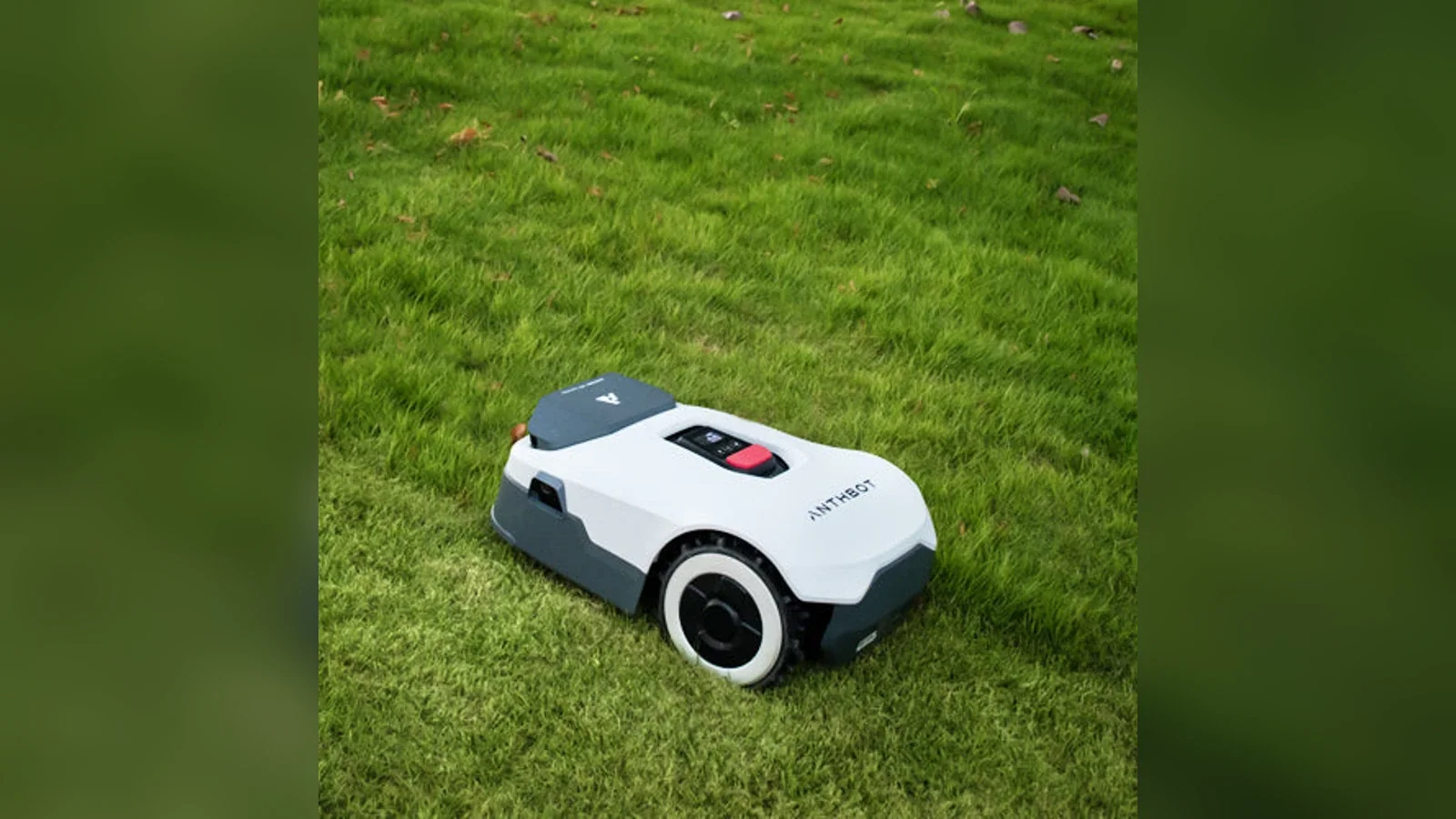
*ANTHBOT Genie. Image: ANTHBOT.*
LDROBOT named its mower brand ANTHBOT. The company says it completed the development and mass production of three product generations from 2024 to 2026.
Its financial reports show how quickly the business is growing.
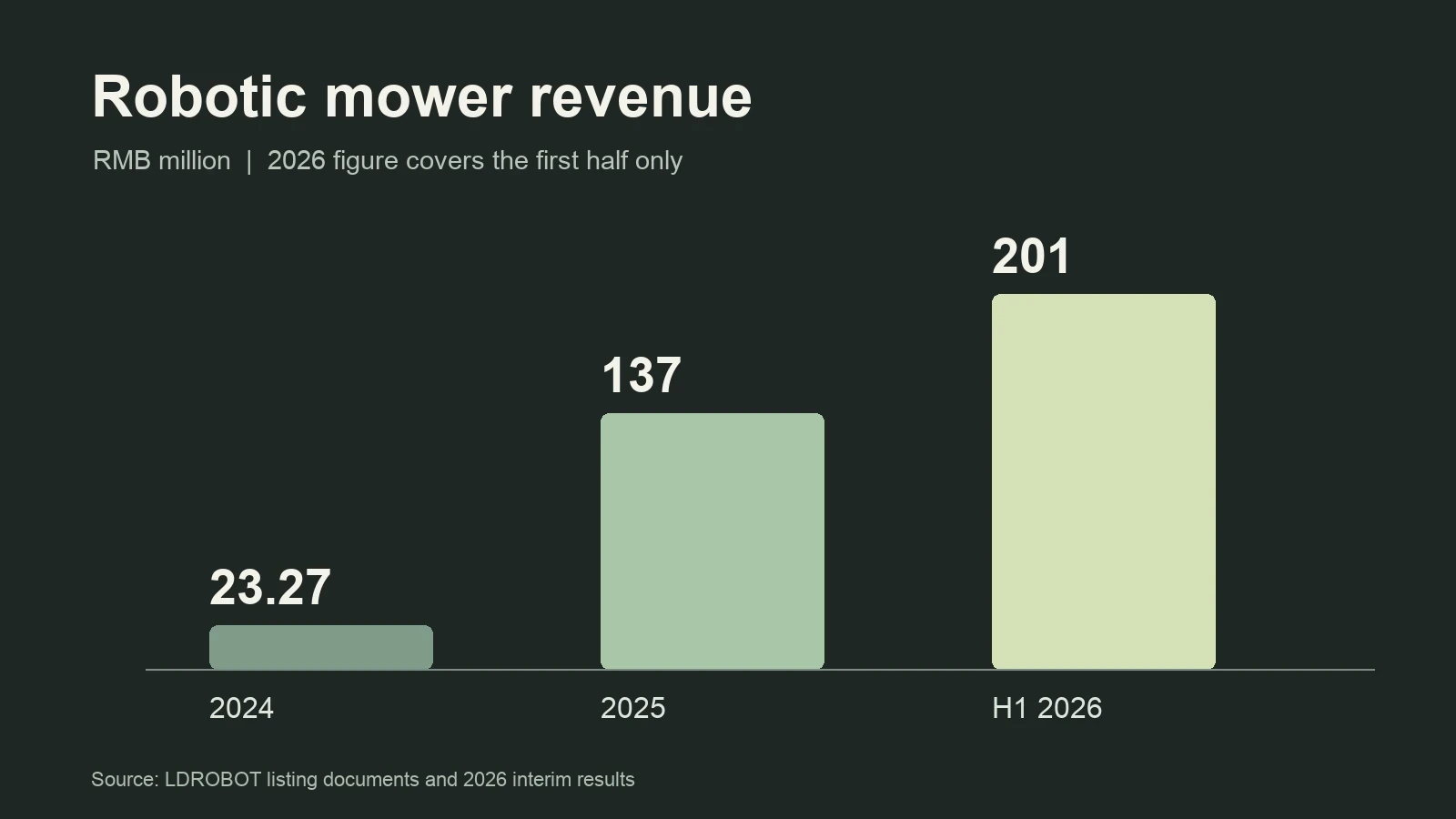
Robotic mower revenue rose from about RMB 23.27 million in 2024 to RMB 137 million in 2025, or 18.3% of annual revenue.
In the first half of 2026, mower revenue reached RMB 201 million, already exceeding the previous full year and accounting for 38.4% of the total.
The established businesses grew much more slowly. Sensor revenue was RMB 206 million, down 9.6% year on year; algorithm modules brought in RMB 103 million, up 31.2%. Together, the two came to about RMB 309 million, roughly flat with a year earlier.
Total first-half revenue rose 35.2% to RMB 523 million, with robotic mowers providing most of the growth. LDROBOT 2026 interim results
The cost of building a brand has risen alongside revenue.
Sales and marketing expenses reached RMB 81 million in the first half of 2026, up from RMB 36.2 million a year earlier. The company attributed the increase in part to online platform commissions, brand promotion and sales team expenses.
Gross margin improved from 25.4% to 28.8%, but the loss for the period widened from RMB 13.78 million to RMB 42.10 million. After excluding share-based payments and listing expenses, the adjusted net loss was RMB 15.51 million, compared with an adjusted net profit of about RMB 2.18 million a year earlier.
The machines sell for more, but the company also has more to do. LDROBOT once delivered its lidar and systems to customers. Now it must make consumers aware of ANTHBOT, find ways to sell it and provide service when a machine has a problem.
The listing brought in funds. At the end of June 2026, the company held about RMB 721 million in cash and cash equivalents. Operating activities used approximately RMB 66.5 million in cash during the first half.
A few months later, LDROBOT agreed to acquire SABO.
The total transaction amount is capped at €6 million: €1 million for the shares and up to €5 million in capital for SABO. It remains subject to closing conditions.
One of SABO’s most valuable assets for LDROBOT is the dealer network it has built in Europe. Robotic mowers need installation, maintenance and repair. A store familiar with local customers can sell a machine and continue to support it afterward.
Those relationships do not mean ANTHBOT will automatically enter every store. Dealers will have to decide whether the products suit their customers, whether parts can be supplied on time and who will handle problems.
SABO faces pressures of its own. According to unaudited figures in the announcement, its revenue fell from about €22.60 million in 2024 to €18.24 million in 2025. Even if the deal closes, LDROBOT will still have to bring together the products, teams and dealer relationships.
LDROBOT’s lidar once traveled into homes hidden inside other companies’ machines. Today, robotic mowers bearing the ANTHBOT name have begun to enter European gardens.
In the future, LDROBOT hopes people will remember more than the sensor inside the machine. It wants them to remember the brand on the outside.