Industry2026-06-09115 min read

iRobot 2018 Annual Report

A reading of iRobot’s 2018 annual report, covering Roomba, Braava, revenue growth, strategy and competitive risk.

By Denny You

Key Points
  • iRobot’s 2018 report shows strong Roomba-led growth before the later intensification of robot vacuum competition.
  • The company was already planning diversification beyond Roomba through Braava, Terra and adjacent consumer robots.
  • Patent protection, supply chain diversification and global competition were central risks even during a strong performance year.
iRobot 2018 Annual Report

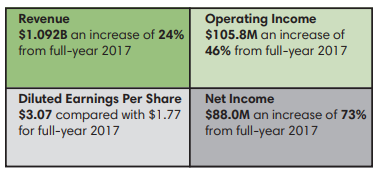
2018 Financial Performance Highlights Our performance as a company in 2018 was very strong. We exceeded full-year expectations for revenue growth and profitability after raising our expectations twice during the year and saw substantial demand for our Roomba i7 and i7+ products. In addition, we announced the planned 2019 introduction of a new category of robot, the iRobot Terra, an autonomous lawn mower. We continue to focus on the diversification of our product offerings, and supply chain and manufacturing diversification for longer term production stability, as well as on driving growth of non-Roomba products.

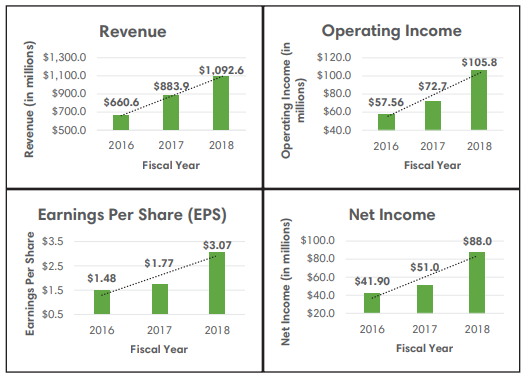
Revenue $1.092B an increase of 24% from full-year 2017 Operating Income $105.8M an increase of 46% from full-year 2017 Diluted Earnings Per Share $3.07 compared with $1.77 for full-year 2017 Net Income $88.0M an increase of 73% from full-year 2017 Notice of Annual Meeting of Stockholders and iRobot 2019 Proxy Statement 25 Historical Financial Performance Our financial performance over the last three years has been very strong. The performance below demonstrates our focus on delivering shareholder value.

iRobot 2018 Annual Report image 2

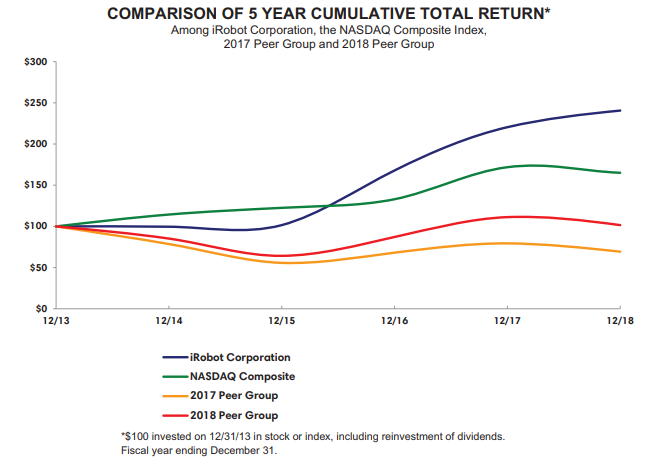
The graph below compares the cumulative 5-Year total return provided to shareholders on iRobot Corporation’s common stock relative to the cumulative total returns of the NASDAQ Composite index and two customized peer groups of fourteen companies in 2017 and sixteen companies in 2018. The individual companies are listed in footnotes 1 and 2 below. An investment of $100 (with reinvestment of all dividends) is assumed to have been made in our common stock, in each index and in each of the peer groups on 12/31/2013 and its relative performance is tracked through 12/31/2018. (1.) The fourteen companies included in the company’s 2017 peer group are: 3D Systems Corp, Dolby Laboratories Inc., Faro Technologies Inc., Fitbit Inc., GoPro Inc., Harmonic Inc., Logitech International Sa, Nautilus Inc., NETGEAR Inc., Novanta Inc., Plantronics Inc., TiVo Corp, Trimble Inc. and Universal Electronics Inc. (2.) The sixteen companies included in the company’s 2018 peer group are: 3D Systems Corp, Brooks Automation Inc., Coherent Inc., Dolby Laboratories Inc., Faro Technologies Inc., Fitbit Inc., Garmin Ltd, GoPro Inc., Logitech International Sa, NETGEAR Inc., Novanta Inc., Plantronics Inc., TiVo Corp, Trimble Inc., Ubiquiti Networks Inc. and Universal Electronics Inc.

iRobot 2018 Annual Report image 3
iRobot 2018 Annual Report image 4

------------------

Overview

iRobot Corporation ("iRobot" or the "Company" or "we") is a leading global consumer robot company that designs and builds robots that empower people to do more both inside and outside of the home. The Company's consumer robots help people find smarter ways to clean and accomplish more in their daily lives. iRobot's portfolio of solutions features proprietary technologies for the connected home and advanced concepts in cleaning, mapping and navigation, human-robot interaction, and physical solutions. Leveraging this portfolio, iRobot's engineers are building an ecosystem of robots to empower the smart home. For more than 25 years, we have been a pioneer in the robotics and consumer products industries. Since our founding in 1990, we have expertise developed in the disciplines necessary to design and build durable, high performance and cost-effective robots through the close integration of software, electronics and hardware. Our core technologies serve as reusable building blocks that we adapt and expand to develop next-generation and new products, reducing the time, cost and risk associated with product development. Our significant expertise in consumer needs, robot design, engineering and smart home technologies and trends positions us to capitalize on the growth we expect in the market for robotbased consumer products. Over the past seventeen years, we have sold more than 25 million consumer robots worldwide. During 2016, we took several steps to become more focused on our well-established consumer robot business in order to capitalize on the substantial opportunities available to us within consumer markets. 2016 was a pivotal year for iRobot as we exited our non-consumer businesses to focus solely on products for the home. In the second quarter of 2016, we completed the sale of our defense and security business and exited the remote presence business. These actions were taken to solidify our position as the leader in diversified consumer robots and to focus on key technologies, with an emphasis on software, that allow our robots to more effectively understand the homes in which they operate. During 2017, we expanded our global operations with the acquisition of two of our major distributors in Japan and Europe. On April 3, 2017, we closed the acquisition of the iRobot-related distribution business of Sales On Demand Corporation ("SODC") based in Tokyo, Japan for approximately $16.6 million in cash.

Overview

iRobot Corporation ("iRobot" or the "Company" or "us" or "we") is a leading global consumer robotics company that designs and builds robots that enable people to do more in and around the home. The Company's consumer robots help people find smarter ways to clean and get more done in their daily lives. iRobot's solutions portfolio includes proprietary technologies for the connected home and advanced concepts for cleaning, mapping and navigation, human-robot interaction, and physical solutions. Leveraging this portfolio, iRobot's engineers are building an ecosystem of robots to support the smart home.

We have been a pioneer in the robotics and consumer products industries for more than 25 years. Since our founding in 1990, we have developed the subject expertise required to design and build durable, high-performance and cost-effective robots through the tight integration of software, electronics and hardware. Our core technologies serve as reusable building blocks that we adapt and extend to develop the next generation and new products, thereby reducing the time, cost and risk associated with product development. Our significant expertise in consumer demand, robotics design, engineering and smart home technologies and trends positions us to capitalize on the growth we expect in the robotic consumer products market. Over the past seventeen years, we have sold more than 25 million consumer robots worldwide.

In 2016, we took several steps to increase focus on our well-established consumer robotics business in order to take advantage of the substantial opportunities available to us in the consumer market. 2016 was a critical year for iRobot as we exited the non-consumer business to focus on home products. In the second quarter of 2016, we completed the sale of our defense and security business and exited our telecommuting business. These actions were designed to solidify our position as a diversified consumer robotics leader and focus on key technologies, with an emphasis on software that enables our robots to more effectively understand the homes they operate. In 2017, we expanded our global presence by acquiring two major distributors in Japan and Europe. On April 3, 2017, we acquired the iRobot-related distribution business of Sales On Demand Corporation ("SODC"), headquartered in Tokyo, Japan, for approximately $16.6 million in cash.

On October 2, 2017, we closed the acquisition of our largest European distributor, Robopolis SAS ("Robopolis"), a French company, for a final purchase price, following adjustments for working capital pursuant to the agreement with Robopolis, of $169.4 million in cash, net of acquired cash of $38.0 million. This provides us more direct control of 75% of our global revenue through a direct presence in countries including Austria, Belgium, France, Germany, Japan, the Netherlands, Portugal and Spain. In 2018, iRobot sold more than $1 billion in consumer robots. In the third quarter of 2018, iRobot introduced the Roomba i7 and i7+ in the U.S., robot vacuums that remember a home's floor plan and clean specific rooms by name. customers to clean specific rooms in the home. Using Imprint™ Smart 5 Mapping, the Roomba i7+ learns the home's floor plan, giving customers total control to choose which rooms to clean and when. When the Roomba i7+ robot vacuum is finished cleaning, it empties its own dust bin into the Clean Base™, which holds 30 bins of dirt, allowing customers to forget about vacuuming for weeks at a time. The Roomba i7 and i7+ further extend our product ecosystem, bringing a new level of intelligence and automation to robot vacuums with the ability to learn, map and adapt to a home's floor plan. In the third quarter of 2018, we also introduced the Roomba e5 in the U.S., a highly-featured product at a more accessible price, to our lineup. $1,092.6 million, which represents a 23.6% increase from 2017 revenue of $883.9 million. Domestic revenue grew $108.4 million, primarily as a result of strong sales of the Roomba 900 and 600 series robots, as well as the significant investments in advertising media and national promotions. International revenue grew by $100.2 million in 2018 with increases in most markets. Our financial performance in 2019 will be driven by our continued focus as a leading global consumer robots company. Our strategy is to maintain Roomba’s leadership in the robot vacuum segment while positioning the Company as a strategic player in the emerging smart home. We expect growth to be driven by: • deeper household penetration of Roomba globally; • broader roll out of the Roomba i7 and i7+ which were launched in the U.S. in 2018; • continued investment in innovation to extend our technology and product leadership; • further adoption of Braava products through targeted marketing programs; and • introduction of additional new products mid-year in 2019.

On October 2, 2017, after adjusting working capital in accordance with the agreement with Robopolis, we acquired our largest European distributor, Robopolis SAS ("Robopolis"), a French company, for $169.4 million in cash, net acquisition cash of $38 million. This allows us to directly control 75% of global revenues by operating directly in countries such as Austria, Belgium, France, Germany, Japan, the Netherlands, Portugal and Spain. In 2018, iRobot sold more than $1 billion in consumer robots. The company leveraged incremental investments in R&D and launched new products in 2018. In the third quarter of 2018, iRobot launched the Roomba i7 and i7+ robot vacuum cleaners in the U.S. that remember a home's floor plan and clean specific room names. The Roomba i7+ ushered in a new era of consumer robots, allowing customers to clean specific rooms in their homes.

With Imprint™ Smart 5 Mapping, Roomba i7+ understands the home's floor plan, giving customers complete control over selecting which rooms to clean and when. When the Roomba i7+ robot vacuum is finished cleaning, it empties its own bin into the Clean Base™, which holds 30 bins of dirt, allowing customers to forget about vacuuming for weeks at a time. Roomba i7 and i7+ further expand our product ecosystem for robot vacuums cleaner brings a new level of intelligence and automation, with the ability to learn, map and adapt to a home's floor plan. In the third quarter of 2018, we also launched Roomba e5 in the United States, a more affordable, high-performance product. In the fourth quarter of 2018, we also launched Roomba in markets outside the United States ahead of the holiday season e5. Our total revenue in 2018 was $1,092.6 million, an increase of 23.6% from 2017 revenue of $883.9 million.

Domestic revenue increased $108.4 million, primarily due to strong sales of Roomba 900 and 600 series robots, as well as significant investments in advertising media and national promotions. International revenue increased $100 million in 2018 with growth in most markets. Our continued focus as the world's leading consumer robotics company will drive our financial performance in 2019. Our strategy is to keep Roomba in the robot vacuum leadership in the cleaner segment, while positioning the company as a strategic player in the emerging smart home. We expect growth to be driven by the following factors:

•Higher global household penetration rate;

• Wider rollout of the Roomba i7 and i7+ launched in the U.S. in 2018;

• Continue to invest in innovation to expand our technology and product leadership;

•Further adoption of Braava products through targeted marketing programs;

•More new products to be launched in mid-2019.

----------

Strategy

In 2002, iRobot created the home robot cleaning category with the introduction of its Roomba vacuuming robot. Today, we are a global enterprise that has sold more than 25 million consumer robots worldwide. iRobot’s success in driving adoption of connected Roomba robots has created a unique opportunity to extend consumer value in the home and expand our business. Our long-term strategy is to increase the penetration of our products in existing markets, expand current products into new markets, and develop and launch new products into current and new markets. We estimate household penetration of iRobot products to be 11% in the U.S. and in the single digits globally. We believe that the current trend towards smart home and product integration provides us with a significant opportunity for product revenue growth. As our customer base grows, iRobot plans to create an ecosystem of connected robots designed to integrate with other devices. This ecosystem will create greater possibilities for new features and capacities and empower the smart home. Global expansion is a key component of our strategy. Our pursuit of product leadership, through targeted investment in key technologies and capabilities, coupled with our investments in furthering our global brand and targeted marketing initiatives, allows us to continue to maintain our leadership position in the robot vacuum segment despite increasing competition. Our acquisitions of distributors in Japan and Europe furthered this strategic objective.

strategy

In 2002, iRobot launched the Roomba vacuum robot, creating the home robot cleaning category. Today, we are a global company, having sold more than 25 million consumer robots worldwide. iRobot's success in driving adoption of connected Roomba robots creates a unique opportunity to expand consumer value in the home and expand our business. Our long-term strategy is to increase the penetration of our products in existing markets, expand existing products into new markets, and develop and launch new products into current and new markets. We estimate household penetration of iRobot products at 11% in the United States and in the single digits globally. We believe that current trends in smart homes and product integration provide us with significant opportunities for product revenue growth.

As our customer base continues to grow, iRobot plans to create an ecosystem of connected robots designed to integrate with other devices. This ecosystem will create greater possibilities for new features and capabilities and power the smart home. Global expansion is an important part of our strategy. Our relentless pursuit of product leadership through targeted investments in key technologies and capabilities, as well as our investment in advancing global brands and targeted marketing activities, allows us to continue to maintain our position in the robotics vacuum. leading position in the cleaner segment despite increasing competition. Our acquisition of distributors in Japan and Europe furthers this strategic goal.

----------------

To successfully execute our 2019 plan and drive revenue diversification and significant revenue growth beyond 2019, we plan to continue to make investments in our business during the year. These investments are expected to help iRobot achieve the following goals: • Continue to strengthen our marketing capabilities globally and accelerate worldwide consumer adoption of Roomba to maintain our market-leading position in robot vacuums; • Continue to develop our wet floor care business to generate a material, secondary revenue stream; • Launch iRobot Terra, an autonomous robotic lawn mower that will re-invent the robotic lawnmower category with state-of-the-art mapping and navigation technology. In 2019, iRobot plans to make Terra available for purchase in limited quantities in Germany and for beta testing in the U.S.; • Scale our infrastructure to support global operations and connected products; Form 10-K 6 • Explore, develop and grow adjacent non-floor care consumer robot products that can generate meaningful diversified revenue streams; and • Make continued operational improvements that can Key reduce product and operating costs. pillars of our strategy include: Technology: As a leading global consumer robotics company, iRobot must develop and maintain best-in-class technology in the areas of cleaning, mapping and navigation. In 2019, iRobot plans to take steps towards expanding its product lines with new products that will deliver innovative solutions to improve cleaning performance, efficiency and ease-of-use. Mapping and navigation continues to be the core focus for iRobot. Consumer robots that can map and are spatially aware create a unique and differentiating opportunity to grow consumer value. Brand: iRobot enjoys consistently high brand awareness and high purchase intent in major markets around the world. Along with high awareness, consumers consider the iRobot brand and our products to be premium, innovative and of high quality. These favorable impressions come as a result of the millions of consumers around the world who own iRobot products and an even greater number who are aware of the brand through advertising and the positive word-of-mouth from existing owners. Portfolio: Our strategy includes building a portfolio of investments, including physical platforms, digital and data capabilities, to diversify across domestic and foreign markets and deliver a steady progression of innovation and growth over time. To achieve this, we plan to focus on developing digital, data and physical products that continue to leverage connectivity and spatial intelligence to deliver meaningful benefits to users.

In order to successfully execute our 2019 plan and drive revenue diversification and significant revenue growth beyond 2019, we plan to continue investing in our business during the year. These investments are expected to help iRobot achieve the following goals:

•Continue to strengthen our global marketing capabilities and accelerate global consumer adoption of Roomba to maintain our market leadership in robot vacuums;

•Continue to grow our wet floor care business to generate a significant secondary revenue stream;

•Introducing iRobot Terra, an autonomous robotic lawn mower that will reinvent the robotic lawn mower category using state-of-the-art mapping and navigation technology.

In 2019, iRobot plans to purchase Terra in bulk in Germany and conduct beta testing in the United States;

• Expand our infrastructure to support global operations and connected products; Form 10-K 6

• Explore, develop and grow adjacent non-floor care consumer robotics products that can generate meaningful diversified revenue streams;

• Continuously improve operations and reduce product and operating costs. Key pillars of our strategy include: Technology: As the world's leading consumer robotics company, iRobot must develop and maintain best-in-class technologies in the fields of cleaning, mapping and navigation.

In 2019, iRobot plans to take steps to expand its product line with new products that offer innovative solutions to improve cleaning performance, efficiency and ease of use. Mapping and navigation remain iRobot's core focus. Consumer robots that are capable of mapping and are spatially aware create a unique and differentiated opportunity to add consumer value. Brand: iRobot enjoys consistently high brand awareness and high purchase intention in key markets around the world. In addition to high awareness, consumers perceive the iRobot brand and our products to be of high quality , innovative and high quality. These positive impressions come from millions of consumers around the world who own iRobot products and many more who know the brand through advertising and positive word-of-mouth from existing owners. Portfolio: Our strategy includes building a portfolio including physical platforms, digital and data capabilities to diversify across domestic and foreign markets and achieve stable innovation and growth over time. To achieve this, we plan to focus on developing digital, data and physical products that continue to leverage connectivity and spatial intelligence to bring meaningful benefits to users.

In 2018, we launched Roomba i7 and i7+, introducing Imprint™ Smart Mapping, a smart mapping technology that allows users to control which rooms are cleaned and when. This new intelligence platform enables rapid-paced innovation to continuously deliver new intelligence-based feature sets to iRobot consumers. The initial set of features enables the connected robots to communicate with consumers to help optimize their personal cleaning experience. The intelligence platform is focused on personalization, learning and prediction. Customers can now be informed when specific maintenance is needed, make suggestions on personalized cleaning schedules and optimize charging. Talent: Our employees are the most important driver of who we are. Our success, diversity and reputation as developers of great talent make us an attractive employer to the top talent all over the world. Talent recruitment and retention continues to be at the core of what we accomplish as we map out our culture and work towards achieving our vision. We are also growing our company to meet organization needs by strategically investing in our employees around the globe.

In 2018, we launched Roomba i7 and i7+ with Imprint™ Smart Mapping, a smart mapping technology that allows users to control which rooms are cleaned and when. This new smart platform enables fast-paced innovation, continuously delivering new intelligence-based feature sets to iRobot consumers. The initial feature enables the connected robot to communicate with consumers to help optimize their personal cleaning experience. The smart platform focuses on personalization, learning and prediction.

Now, customers can get notifications when specific maintenance is needed, make recommendations on personalized cleaning schedules and optimize charging. Talent: Our people are our most important driver. Our success, diversity and reputation as a developer of great talent make us an attractive employer of top talent around the world. As we develop our culture and work towards our vision, talent acquisition and retention remain core to our achievements. We also grow our company by strategically investing in our people around the world to meet organizational needs.

----------

Technology

In 2016, iRobot narrowed its focus to the consumer market and made increased, but disciplined investments in advancing mapping and navigation, and user interaction including cloud and app development and cleaning efficacy. From the launch of Braava jet, to the introduction of a lower cost Visual Simultaneous Localization and Mapping, or vSLAM, solution in Roomba 960, these strategic investments in technology had an immediate impact on product diversification, performance and market expansion. In 2017, we introduced two new connected products to the product portfolio bringing the advantages of cloud connectivity to more consumers. With the iRobot HOME App, we also delivered our robots’ maps directly to our customers through the launch of post-mission cleaning maps. In 2018, we introduced three new connected products including a new intelligence platform with the ability to learn, map and adapt to a home’s floor plan, as well as empty its own dust bin into the Clean Base. We believe the improved performance of our connected robots, and the data sourced from our maps, will accelerate new product development and digital partnerships for the smart home. We plan to continue to leverage opportunities, enabled by our growing connected product portfolio, to invest in developing technologies and interfaces for our products to provide a convenient and personalized user experience.

technology

In 2016, iRobot expanded its focus to the consumer market and made incremental but disciplined investments in advancing mapping and navigation as well as user interaction, including cloud and app development and cleaning efficacy. From the launch of Braava jets to the introduction of Roomba 960's low-cost visual simultaneous localization and mapping or vSLAM solution, these strategic investments in technology have had a direct impact on product diversity, performance and market expansion.

In 2017, we introduced two new connected products to our portfolio, bringing the benefits of cloud connectivity to more consumers. Through the iRobot HOME app, we also offer robot maps directly to our customers by initiating post-mission cleaning maps.

In 2018, we launched three new connected products, including a new smart platform capable of learning, mapping and adapting to a home's floor plan, as well as emptying its own bins to a cleaning base. We believe the improved performance of our connected robots and data from our maps will accelerate new product development and digital partnerships for the smart home. We plan to continue to capitalize on the opportunities presented by our growing connected product portfolio, investing in developing the technology and interfaces for our products to deliver a convenient and personalized user experience.

From robotic vacuum cleaning to mopping and lawn lawn care, we are dedicated to developing market-leading solutions that provide compelling value to customers worldwide. From our customers' perspective, the core value of our robots is the ability to efficiently and effectively perform a physical mission - the task for which that robot was initially purchased. In addition, we focus on features that allow the robots to perform longer, without consumer interaction. Our goal is to deliver maximum autonomy and effectiveness of the mission.

Building on our efforts to drive enhanced user experiences, we deployed new connectivity and cloud infrastructure through AWS. We made this investment that allows us to expand our connected products globally, increase access to valuable cloud services and applications to support future product features and integrate with other devices in the smart home.

iRobot plans to continue to identify additional ways to advance the smart home experience through a broader understanding of home spaces through Roomba's spatial awareness of the home. 7 From robotic vacuum cleaning to mopping and lawn care, we are committed to developing market-leading solutions that deliver compelling value to customers around the world. From a customer's perspective, the core value of our robots is the ability to perform physical tasks efficiently - The task for which the robot was initially purchased. Additionally, we focused on features that allow the robot to perform for longer periods of time without consumer interaction. Our goal is to provide maximum autonomy and effectiveness for the task.

-------------

Products

We sell various products that are designed for use in and around the home. Our current consumer products are focused on both indoor and outdoor cleaning applications. We believe our consumer products provide value to our customers by delivering a better way to clean and by freeing people from repetitive home cleaning tasks. To ensure the continued acceptance of our robots, we will continue to invest in technology necessary to further improve their capabilities. The opportunity for robots working together to accomplish multiple tasks with little intervention from the user is expected to be a significant step forward. Consumers can already use third party integration software to operate Roomba. We believe the mapping and spatial awareness capabilities of our consumer robots will play an important role in allowing other smart devices in the home to more seamlessly work together and advance the next-generation smart home. We currently offer multiple Roomba floor vacuuming robots at varying price points ranging from approximately $299 to $1,099 based upon features and performance characteristics. Roomba's design allows it to clean under toe kicks, beds and other furniture, resulting in cleaner floors since the Roomba can access more of the floor than standard upright vacuum cleaners. In addition, Roomba eliminates the need to manually vacuum for many users - it cleans automatically upon the push of a button or through scheduling.

Products

We sell a variety of products designed for use inside and outside the home. Our current consumer products are focused on indoor and outdoor cleaning applications. We believe that our consumer products provide value to our customers by providing better ways to clean and freeing people from repetitive home cleaning tasks. To ensure we continue to receive acceptance of our robots, we will continue to invest in the necessary technology to further enhance their capabilities. The opportunity for robots to work together to complete multiple tasks with minimal user intervention is expected to be an important step forward. Consumers can already use third-party integrated software to operate Roomba.

We believe the mapping and spatial awareness capabilities of our consumer robots will play an important role in allowing other smart devices in the home to work together more seamlessly and advance the next generation of smart homes. We currently offer a variety of Roomba floor vacuum robots ranging in price from $299 to $1,099 based on functionality and performance features. Roomba is designed to be able to clean toes, beds, and other furniture, resulting in cleaner floors because Roomba can vacuum more than a standard upright vacuum. cleaner gets more into the floor. Plus, Roomba eliminates the need for manual vacuuming for many users—it cleans automatically with the push of a button or by scheduling.

In 2018, we launched several new robot vacuums: • Roomba i7 brings a new level of intelligence and automation to robot vacuums with the ability to learn, map and adapt to a home’s floor plan; • Roomba i7+ includes all the features of i7 plus the ability for the robot to empty its own bin into the Clean Base with Automatic Dirt Disposal. This brings a level of automation that allows users to forget about vacuuming for weeks at a time; and • Roomba e5 is an affordable, highly-featured product which includes WiFi connectivity, intelligent navigation with Dirt Detect technologies and iRobot’s dual multi-surface rubber brushes. In addition to the newly launched products, we continue to offer an assortment of other robot vacuum offerings. The Roomba 900 series robots help keep floors cleaner throughout the entire home with intelligent visual navigation and iRobot HOME App control with wireless connectivity. The Roomba 800 series robots offer our AEROForce technology which incorporates brushless, counter-rotating extractors that amplify suction for superior performance over bristle brushes, while requiring less maintenance than previous Roomba models. The Roomba 600 series robots offer a three-stage cleaning system which thoroughly vacuums every section of the floor multiple times, as well as an improved brush design enabling the robot to better handle fibers like hair, pet fur, lint and carpet fuzz. We currently offer the Braava family of automatic floor mopping robots designed exclusively for hard-surface floors. These robots provide a different cleaning approach than ours Roomba products. The Braava robots, priced at $199 and $299, automatically dust and damp mop hard-surface floors using popular cleaning cloths or our specially designed reusable microfiber cloths, and include a special reservoir that dispenses liquid throughout the cleaning cycle to keep the cloth damp. Braava jet works with Braava jet Cleaning Pads to tackle a range of hard-floor cleaning jobs, from hard floor washerping and damp sweeping to simple dusting. Our Mirra Pool Cleaning Robot is used to clean residential pools and removes debris as small as two microns from pool floors, walls and stairs. Mirra is brought to market under the iRobot brand through a relationship with Aquatron, Inc., which develops and manufactures the pool cleaning robots. In 2019, we plan to capitalize on the incremental investments we made in 2017 and 2018 with the introduction of Terra, and additional new products midyear 2019. In January 2019, we announced Terra, an autonomous lawn mower that we believe will revolutionize the robotic lawnmower category with state-of-the-art mapping and navigation technology. Terra Form 10-K 8 mows like people do, intelligently navigate the yard and cutting efficiently in systematic rows. We plan to make Terra available in limited quantities for purchase in Germany and for beta testing in the U.S. in 2019.

In 2018, we launched several new robot vacuum cleaners:

• Roomba i7 brings a new level of intelligence and automation to robot vacuums, capable of learning, mapping and adapting to a home’s floor plan;

• Roomba i7+ includes all the features of the i7, plus the ability for the robot to empty its own bin into a cleaning base with automatic dirt handling. This brings a level of automation that allows users to forget about vacuuming for weeks at a time; and

•Roomba e5 is an affordable, powerful product that includes WiFi connectivity, smart navigation with dirt detection technology, and iRobot’s dual multi-sided rubber brushes. In addition to the newly launched products, we continue to offer a variety of other robot vacuum cleaner products. Roomba 900 series robots help the entire home keep floors clean with smart visual navigation and iRobot HOME App control with wireless connectivity.

Roomba 800 Series robots feature our AEROForce technology, which features a brushless, counter-rotating extractor that amplifies suction power over bristle brushes while requiring less maintenance than previous Roomba models. Roomba The 600 Series robots offer a three-stage cleaning system that can thoroughly vacuum every section of the floor multiple times, as well as an improved brush design that allows the robots to better handle fibers such as hair, pet fur, lint, and carpet lint. We currently offer the Braava series of automatic floor mopping robots designed specifically for hard surface floors.

These robots offer a different cleaning approach than Roomba products. The $199 and $299 Braava robots automatically clean and mop hard floor floors using popular cleaning cloths or our specially designed reusable microfiber cloths, and include a special reservoir that distributes liquid throughout the cleaning cycle to protect the cloth from moisture.

Braava jets are used with Braava jet cleaning pads to handle a variety of hard floor cleaning jobs, from hard floor washerping and damp sweeping to simple dusting. Our Mirra pool cleaning robots are used to clean residential pools and remove debris as small as 2 microns from pool floors, walls and stairs.

Mirra enters the market under the iRobot brand through a partnership with Aquatron, Inc., which develops and produces pool cleaning robots. In 2019, we plan to leverage the incremental investments we made in 2017 and 2018 to introduce Terra, along with additional new products in mid-2019. In January 2019, we announced Terra, an autonomous robotic lawn mower that we believe will revolutionize the robotic lawn mower category with state-of-the-art mapping and navigation technology. The Terra Form 10-K 8 mows like a human, navigates the yard intelligently and cuts effectively in the system rows. We plan to purchase a limited number of Terra in Germany and beta test it in the US in 2019

--------

Strategic

Alliances In addition to our internal technology development, we leverage relevant robotic technologies through licensing, acquisitions, venture investments and/or other partnerships. These strategic alliances are an important part of our product development, advanced research and distribution strategies. We rely on strategic alliances to provide technology and complementary product offerings to drive market adoption of our robotic products. We seek to form relationships with organizations that can provide best-in-class technology or market advantages for establishing iRobot technology. users with a more intuitive and personalized smart home experience. Sales and Distribution Channels We sell our consumer products through distributor and retail sales channels, as well as our online store. For the fiscal years ended December 29, 2018, December 30, 2017, and December 31, 2016, sales to non-U.S. customers accounted for 48.7%, 48.8%, and 51.2% of total revenue, respectively. years ended December 29, 2018 and December 30, 2017, the Company generated 17.3% and 13.5% of total revenue from one of its retailers (Amazon), respectively. For the fiscal year ended December 31, 2016, the Company generated 12.9%, 12.3% and 10.4% of total revenue from SODC, Robopolis, and Amazon, respectively. In April In 2017, the Company acquired the iRobot-related distribution business of SODC, and in October 2017, the Company acquired Robopolis. In the United States and Canada, we sell our consumer products primarily through a network of national retailers. Certain smaller domestic retail operations are supported by distributors to whom we sell our products directly. Germany, Netherlands, Portugal and Spain. In support of sales in the United States, Canada, Japan and the seven European countries previously serviced by Robopolis, we maintain in-house sales, marketing and product management teams.

strategy

Alliances In addition to internal technology development, we leverage relevant robotics technologies through licensing, acquisitions, venture capital and/or other partnerships. These strategic alliances are an important part of our product development, advanced research and distribution strategies. We rely on strategic alliances to provide technology and complementary products to drive market adoption of our robotics products. We seek to form partnerships with companies that can build Establish relationships with organizations where iRobot technology provides best-in-class technology or market advantage. This includes expanding collaborations with other smart home technologies that can leverage the spatial understanding of our products to provide end users with a more intuitive and personalized smart home experience. Sales and Distribution Channels We sell our consumer products through distributors and retail channels and through our online store.

Sales to non-U.S. customers accounted for 48.7%, 48.8% and 51.2% of total revenue for the fiscal years ended December 29, 2017, December 30, 2017 and December 31, 2016, respectively. For the fiscal years ended December 29, 2017 and December 30, 2017 For the fiscal year ended December 31, 2016, the Company accounted for 12.9%, 12.3%, and 10.4% of total revenue from SODC, Robopolis, and Amazon, respectively. In April 2017, the Company acquired SODC's iRobot-related distribution operations, and in October 2017, the Company acquired Robopolis. In the United States and Canada, we sell our consumer products primarily through a national network of retailers. Certain smaller domestic retail operations are supported by dealers through which we sell our products directly. Through the acquisitions of SODC and Robopoli s, iRobot now directly serves retailers in Japan and countries previously served by Robopolis, including Austria, Belgium, France, Germany, the Netherlands, Portugal and Spain. To support sales in the United States, Canada, Japan and the seven European countries previously served by Robopolis, we maintain in-house sales, marketing and product management teams.

In China, retailers are serviced by two local distributors. Due to the special needs of this market, we maintain a local sales, marketing and product team to support the distributors, manage the local marketing plan and meet product needs. Throughout the rest of the world, our products are sold primarily through a network of in-country distributors who resell to retail stores in their respective countries. These distributors are supported by our international sales and product marketing team. Our retail and distributor networks are our primary distribution channels for our products. We have established valuable databases and customer lists that allow us to target directly those consumers most likely to purchase a new robot or upgrade. With Wi-Fi connectivity across Roomba 690 and higher models, iRobot can more directly provide customer support via the iRobot HOME App implemented. In addition, connectivity enables us to provide direct marketing material and push new features/fixes to robots in the field. We believe we maintain a close connection with our customers in each of our markets, which provides an enhanced position from which to improve our distribution and product offerings. Customer Service and Support We also provide ongoing Customer Service and Support customer service and support. Consumer customer service representatives, the majority of whom are employees of outsourced service organizations or our distribution partners, are extensively trained on the technical intricacies of our consumer products. Because of the connected nature of our new robot technology, our customer service representatives are able to access robot information remotely to identify issues and behaviors relevant in troubleshooting and address customer questions and concerns. Marketing and Brand We market our consumer robots to end-user customers through our extensive network of retail partners with the support of our sales and marketing teams as well as in collaborations with in-country distributors. In addition, we sell directly to consumers through iRobot’s e-commerce channels around the world. For consumers seeking information about our products, the iRobot website showcases our brand, allows consumers to learn more about our Roomba and Braava products, including the latest product innovations, and enables direct-to-consumer sales. The website also plays an important after-sales role for owners seeking spare parts and accessories, as well as a location for useful FAQ’s and trouble-shooting solutions.

In China, retailers are served by two local distributors. Due to the special needs of this market, we maintain local sales, marketing and product teams to support distributors, manage local marketing plans and meet product demand. In other parts of the world, our products are sold primarily through a network of domestic distributors who resell to various retail stores in countries. These distributors are supported by our international sales and product marketing teams. Our retail and distribution network is the primary distribution channel for our products. We have built valuable databases and customer lists that allow us to directly target consumers most likely to purchase a new robot or upgrade. By Roomba 690 and above models implement Wi-Fi connectivity, iRobot can The HOME app provides more direct customer support. In addition, connectivity allows us to provide direct marketing materials and roll out new features/fixes for robots in the field. We believe that we maintain close contact with our customers in each market, providing a better position to improve our distribution and product offerings. Customer Service and Support We also provide ongoing customer service service and support. Consumer customer service representatives, most of whom are employees of outsourced services organizations or our distribution partners, receive extensive training on the technical intricacies of our consumer products. Due to the connected nature of our new bot technology, our customer service representatives are able to remotely access bot information to identify issues and behaviors related to troubleshooting and resolve customers' Questions and Concerns. Marketing and Branding We market our consumer robots to end-user customers through an extensive network of retail partners, with support from our sales and marketing teams and in collaboration with domestic distributors. Additionally, we sell products directly to consumers through iRobot’s e-commerce channels around the world. For consumers seeking information about our products For consumers, the iRobot website showcases our brand and allows consumers to learn more about our Roomba and Braava products, including the latest product innovations, and enables direct-to-consumer sales. The website also provides important after-sales service for owners seeking spare parts and accessories, as well as a location for helpful FAQs and troubleshooting solutions.

9 Our marketing strategy is to drive consumer awareness and interest in Roomba robot vacuums and Braava robot mops. Our sales and marketing expenses represented 19.3%, 18.3% and 17.4% of our total revenue in 2018, 2017 and 2016, respectively. We expect to continue to invest in national advertising, consumer and industry trade shows, direct marketing and public relations to further build brand awareness. In 2017, iRobot launched our first ever Braava national television advertising campaign in the U.S., and category revenue grew 65% in 2017 over full-year 2016. In 2018, the momentum generated by this campaign continued driving U.S. revenue growth. We have built a trusted, recognized brand by providing high-quality robots. Customer word-of-mouth has been a significant driver of our brand's success to date. iRobot owner loyalty encourages repurchase, and positive customer experiences inspire others to adopt our products. Our products marketing, public relations and consumer service efforts fuel this wordof-mouth momentum. In April 2017, we acquired SODC, launching four new iRobot offices in Japan. In October 2017, we acquired our largest European distributor, Robopolis, launching new iRobot offices in seven countries, including Austria, Belgium, France, Germany, Netherlands, Portugal and Spain. These acquisitions afford us greater control and consistency in our approach to all market activities including sales, marketing, branding, channel relationships and customer service. Our Manufacturing core competencies are the design, development and marketing of robots. Our manufacturing strategy is to outsource non-core competencies, such as the production of our robots, to third-party entities skilled in manufacturing. By relying on the outsourced manufacture of our robots, we can focus our engineering expertise on the design of robots and associated technologies. Manufacturing a new product requires a close relationship between our product designers and the manufacturing organizations. Using multiple engineering techniques, our products are introduced to the selected production facility at an early development stage and the feedback provided by manufacturing is incorporated into the design before tooling is finalized and mass production begins. As a result, we believe that we can significantly reduce the time required to move a product from its design phase to mass production deliveries, with improved quality and yields. We outsource the manufacturing of our consumer products to three contract manufacturers, each of which manufactures our robots at a single plant in Southern China. In addition, one of our contract manufactures plans to begin partial production outside of China beginning in 2019. Our production processes give us the capacity to produce up to 20,000 robots a day, helping us to meet demand for peak seasons. Under our agreements with our contract manufacturers, manufacturers supply us with specified quantities of products that align with demand forecasts that we establish based upon historical trends and analysis from our sales and product management functions. Research and Development We believe that our future success depends upon our ability to continue to develop new products and product accessories, and enhancements to and applications for our existing products. For the years ended December 29, 2018, December 30, 2017 and December 31, 2016, our research and development expenses were $140.6 million, $113.1 million and $79.8 million, or 12.9%, 12.8% and 12.1% of revenue, respectively. We intend to continue our investment in research and development to respond to and anticipate customer needs, and to enable us to introduce new products over the next few years that will continue to address our existing and adjacent market sectors.

Our marketing strategy is to increase consumer awareness and interest in Roomba robot vacuums and Braava robotic mops. Our sales and marketing expenses accounted for 19.3%, 18.3% and 17.4% of total revenue in 2018, 2017 and 2016, respectively. We expect to continue investing in national advertising, consumer and industry trade shows, direct marketing and public relations to further enhance brand awareness. In 2017, iRobot launched our first Braava national television advertising campaign in the U.S., and category revenue in 2017 was up 65% compared to all of 2016. In 2018, the momentum generated by the campaign continued to drive U.S. revenue growth. We have built a trusted, recognized brand by delivering high-quality robots. Customer word-of-mouth has been a significant driver of our brand's success to date. iRobot owner loyalty encourages repurchase, and positive customer experiences inspire others to adopt our products. Our marketing, public relations and consumer service efforts drive this word-of-mouth momentum.

In April 2017, we acquired SODC and launched four new iRobot offices in Japan. In October 2017, we acquired Robopolis, Europe's largest distributor, launching new iRobot offices in seven countries: Austria, Belgium, France, Germany, the Netherlands, Portugal and Spain. These acquisitions give us greater control and consistency across all market activities , including sales, marketing, branding, channel relations and customer service. Manufacturing Our core competencies are the design, development and marketing of robots. Our manufacturing strategy is to outsource non-core competencies (such as the production of our robots) to third-party entities in the manufacturing field. Relying on the outsourced manufacturing of our robots, we can Our engineering expertise focuses on the design of robotics and related technologies. Manufacturing new products requires close relationships between our product designers and manufacturing organizations. Using a variety of engineering techniques, our products are introduced into selected production facilities in the early development stages and manufacturing is brought to the forefront before tooling is finalized and volume production begins. Feedback from suppliers is incorporated into the design. As a result, we believe we can significantly reduce the time required to move products from the design stage to volume production delivery, while improving quality and yield. We outsource the manufacturing of our consumer products to three contract manufacturers, each of which produces our robots at a factory in southern China.

In addition, one of our contract manufacturers plans to begin partial production outside of China beginning in 2019. Our production processes enable us to produce up to 20,000 robots per day, helping us meet peak season demand. Under our agreements with contract manufacturers, manufacturers provide us with specified quantities of products that are consistent with our demand forecasts established based on analysis of historical trends and our sales and product management functions. Research and Development We believe that our future success depends on our continued development of new products and products product accessories capabilities, as well as enhancements and applications of our existing products. For the years ended December 29, 2017, December 30, 2017, and December 31, 2016, our research and development expenses were $146.0 million and $113.1 million, respectively. billion and $79.8 million, or 12.9%, 12.8% and 12.1%. We intend to continue investing in research and development to respond to and anticipate customer needs and enable us to introduce new products in the coming years that continue to address our existing and adjacent market segments

Our research and development is conducted by teams dedicated to particular projects. Our research and development efforts are primarily located at our headquarters in Bedford, Massachusetts and our office in Pasadena, California. Competition The market for robots is highly competitive, rapidly evolving and subject to changing technologies, shifting customer needs and expectations and the likely increased introduction of new products. A number of established companies have developed or are developing robots that will compete directly with our product offerings, and many of our competitors have significantly more financial and other resources than we possess. Our competitors include consumer electronics companies. Form 10-K 10 such as Samsung, LG, Xiaomi, Cecotec and Shark, traditional floor cleaning brands with robotic offerings such as Dyson, Bissell and Hoover; and firms primarily focused on robotic cleaning such as Ecovacs and iLife. While we believe many of our customers purchase our Roomba floor vacuuming robots and Braava mopping robots as a supplement to, rather than a replacement for, their traditional vacuum cleaners and wet floor cleaning methods, we do compete in some cases with providers of traditional cleaning products. We believe that the principal competitive factors in the market for robots include product features, performance for the intended mission, cost of purchase, total cost of system operation, including maintenance and support, ease of use, integration with existing equipment, quality, reliability, customer support, brand and reputation. Our ability to remain competitive will depend to a great extent upon our ongoing performance in the areas of product development and customer support. We cannot provide assurance that our products will continue to compete favorably or that we will be successful in the face of increasing competition from new products and enhancements introduced by existing competitors or new companies entering the markets in which we provide products. Intellectual Property We believe that our continued success depends in large part on our proprietary technology, the technical competence and ability of our employees to continue to innovate. The ownership of intellectual property rights is an important factor in our business. This includes patents, copyrights, trademarks, service marks, trade dress and other forms of intellectual property rights in the U.S. and a number of foreign countries.

Our research and development is conducted by teams dedicated to specific projects. Our research and development efforts are primarily located at our headquarters in Bedford, Massachusetts and offices in Pasadena, California. Competition The robotics market is highly competitive and rapidly evolving, with ever-changing technology, changing customer needs and expectations and the potential for increased new product launches.

Many established companies have developed or are developing robots that compete directly with our products, and many of our competitors have financial and other resources that far exceed what we have. Our competitors include consumer electronics companies Form 10-K 10 such as Samsung, LG, Xiaomi, Cecotec and Shark, traditional floor cleaning brands such as Dyson, Bissell and Hoover and other robotic products; the Company's primary focus is robotic cleaning such as Ecovacs and iLife.

While we believe many of our customers purchase our Roomba floor robot vacuums and Braava robot mops as traditional vacuum cleaners and wet floor cleaning methods complement, rather than replace, and we do compete in certain circumstances with traditional cleaning product suppliers. We believe that the primary competitive factors in the robotics market include product functionality, performance on intended tasks, acquisition cost, total cost of operating the system including maintenance and support, ease of use, integration with existing equipment, quality, reliability, customer support, brand and reputation. Our ability to remain competitive depends in large part on our continued performance in product development and customer support. We cannot guarantee that our products will continue to maintain a competitive advantage, Or we will succeed in the face of increasing competition from new products and enhancements introduced by existing competitors or new companies entering the markets in which we offer our products. Intellectual Property We believe that our continued success depends in large part on our proprietary technology, technical capabilities and the ability of our employees to continue to innovate. Ownership of intellectual property is an important element of our business. This includes patents, copyrights, trademarks, service marks, trade dress and other forms of intellectual property in the United States and many countries. The Company currently holds a substantial number of patents and has filed numerous other patent applications.

As of December 29, 2018, we held 460 U.S. patents, more than 800 foreign patents, additional design registrations, and more than 500 patent applications pending worldwide. While our U.S. patents will begin to expire in 2022, no single intellectual property right is solely responsible for protecting our products. We will continue to file and prosecute patent (or design registration, as applicable) applications when and where appropriate to attempt to protect our rights in our proprietary technologies. We also encourage our employees to continue to invent and develop new technologies so as to maintain our competitiveness in the marketplace. It is possible that our current patents, or patents which we may later acquire, may be successfully challenged or invalidated in whole or in part. It is also possible that we may not obtain issued patents for our pending patent applications or other inventions we seek to protect. In that regard, we sometimes permit certain intellectual property to lapse or go abandoned under appropriate circumstances. that are patentable, or that any patent issued to us may not provide us with any competitive advantages, or that the patents of others will harm or altogether preclude our ability to do business. Our registered U.S. trademarks include iRobot and its stylized logo, Roomba, NorthStar, Create, iAdapt, Aware, Home Base, Looj, Braava, Braava jet, AeroForce, Better Together, Mirra, vSLAM and Virtual Wall. Our marks iRobot, Roomba, Braava, Braava jet, Virtual Wall, and certain other trademarks, have also been registered in selected foreign countries. Our means of protecting our proprietary rights may not be adequate, and our competitors may independently develop technology that is similar to ours. Legal protections afford only limited protection for our technology. use information that we regard as proprietary. Some of our competitors seek to compete primarily through aggressive pricing and low-cost structures while infringing on our intellectual property. In 2017, we initiated a multiparty litigation at the U.S. International Trade Commission ("ITC") as well as in federal district court in Massachusetts based on claims of patent infringement. In November 2018, the ITC issued a Notice of Final Determination confirming that U.S. Patent No. 9,038,233 is valid and infringed, and that the infringing products for bObsweep, Inc., bObsweep USA, Hoover, and Shenzhen Silver Star Intelligent Technology Co., Ltd. should be barred from importation into the United States. Prior to the issuance of the Final Determination, iRobot entered into confidential settlements with Shenzhen Zhiyi Technology Co. Ltd. d/b/a iLife, Micro-Star International, Black & Decker, and Matsutek. There is no guarantee that we will prevail on other patent infringement claims against third parties. Third parties may also design around our proprietary rights, which may render our protected products less valuable, if the design around is favorably received in the marketplace. In addition, if any of our products or the technology underlying our products is covered by third-party patents or other intellectual property rights, we could be subject to various legal actions. We cannot assure you that our products do not infringe patents held by others or that they will not in the future. We have received in the past communications from third parties relating to technologies used in our 11 various robot products that have alleged infringement of patents or violation of other intellectual property rights. Some of these allegations have resulted in actions filed against iRobot in foreign jurisdictions. In response to these communications, we have contacted these third parties to convey our good faith belief that we do not infringe the patents in question or otherwise violate those parties' rights. we will defend iRobot against the allegations. We cannot assure you that we will not receive further correspondence from these parties, not be subject to additional allegations of infringement from others, and cannot assure you that iRobot will prevail in any ongoing or subsequently filed actions.

As of December 29, 2018, we held 460 U.S. patents, more than 800 foreign patents, additional design registrations and more than 500 patent applications worldwide. While our U.S. patents will begin to expire in 2022, no single intellectual property is solely responsible for protecting our products. We will continue to file and prosecute patent (or applicable design registration) applications when and where appropriate to protect our Rights in proprietary technology. We also encourage our employees to continue to invent and develop new technologies to maintain our competitiveness in the marketplace. Our existing patents or patents that we may later obtain may be successfully challenged or invalidated in whole or in part. We may also be unable to obtain issued patents for our pending patent applications or other inventions that we seek to protect. In this regard, we sometimes allow certain intellectual property rights to expire or be abandoned in appropriate circumstances.

We also may not develop patentable patented products or technologies in the future, or any patents issued to us may not provide us with any competitive advantage, or the patents of others may impair or completely preclude our ability to do business. Our registered U.S. trademarks include iRobot and its stylized logo, Roomba, NorthStar, Create, iAdapt, Aware, Home Base, Looj, Braava, Braava jet, AeroForce, Better Together, Mirra, vSLAM and Virtual Wall. Our trademarks iRobot, Roomba, Braava, Braava jet, Virtual Wall and certain other trademarks are also registered in select foreign countries

Litigation may be necessary to enforce our intellectual property rights, to protect our trade secrets, to determine the validity and scope of the proprietary rights of others, or to defend against claims of infringement or invalidity, misappropriation, or other claims. Any such litigation could result in substantial costs and diversion of our resources. Moreover, any settlement of or adverse judgment resulting from such litigation could require us to obtain a license to continue to use the technology that is the subject of the claim, or otherwise restrict or prohibit our use of the technology. required licenses may not be available to us on acceptable terms, if at all. If we attempt to design around the technology at issue or to find another provider of suitable alternative technology to permit us to continue offering applicable software or product solutions, our continued supply of software or product solutions could be disrupted or our of new or enhanced software or products could be significantly delayed. Seasonality Historically, we have experienced higher revenue in the second half of the year compared to the first half of the year due in large part to seasonal holiday demand. In 2018, In 2017 and 2016, our second-half consumer product revenue represented 59.4%, 60.2% and 57.5% of our annual consumer product revenue, respectively. We have also experienced higher selling and marketing expenses in the second half of the year compared to the first half of the year due to increase marketing campaigns to support seasonal holiday demand. 63.3%, 61.3% and 57.4% of our annual selling and marketing expense, respectively. Regulations Our business requires compliance with a variety of laws and regulations in the United States and abroad regarding privacy, data protection, and data security. In particular, we are subject to numerous U.S. federal, state, and local laws and regulations and foreign laws and regulations regarding privacy and the collection, sharing, use, processing, disclosure, and protection of personal information and other user data. In addition, the global nature of our business operations also creates various domestic and foreign regulatory challenges and subject us to laws and regulations such as the U.S. Foreign Corrupt Practices Act, or FCPA, the U.K. Bribery Act, and similar anti-bribery and anti-corruption laws in other jurisdictions. Our products are also subject to U.S. export controls, including the U.S. Department of Commerce’s Export Administration Regulations and various economic and trade sanctions regulations established by the Treasury Department’s Office of Foreign Assets Controls.

Litigation may be necessary to enforce our intellectual property rights, protect our trade secrets, determine the validity and scope of the proprietary rights of others, or defend against assertions of infringement or invalidity, misappropriation or other claims. Any such litigation could result in substantial expense and diversion of resources. In addition, any settlement or adverse judgment resulting from such litigation may require us to obtain a license to continue to use the technology that is the subject of the claim, or otherwise limit or prohibit our use of the technology. We may not be able to obtain any required licenses, if any, on acceptable terms. If we try to surround ourselves with relevant technology to be designed or other providers of suitable replacement technology to allow us to continue to provide applicable software or product solutions, the continued supply of our software or product solutions may be interrupted or our introduction of new or enhanced software or products may be significantly delayed. Seasonality from history Look, our second half revenue increased compared to the first half due to seasonal holiday demand. In 2018, 2017 and 2016, our second half consumer products revenue represented 59.4%, 60.2% and 57.5% of our annual consumer products revenue, respectively.

Our sales and marketing expenses in the second half of the year also increased compared to the first half due to increased marketing activities to support seasonal holiday demand. In 2018, 2017 and 2016, our second half sales and marketing expenses accounted for 10% of our annual sales and marketing expenses, respectively. of 63.3%, 61.3% and 57.4%. Regulations Our operations are required to comply with various U.S. and foreign laws and regulations regarding privacy, data protection and data security. In particular, we are subject to numerous U.S. federal, state and local laws and regulations regarding privacy and personal information and their The collection, sharing, use, processing, disclosure and protection of other user data are subject to foreign laws and regulations. In addition, the global nature of our business operations also creates various domestic and foreign regulatory challenges and subjects us to laws and regulations, such as the U.S. Foreign Corrupt Practices Act, the FCPA, the UK Bribery Act and similar anti-bribery and anti-corruption laws of other jurisdictions. Our products are also subject to U.S. export controls, including the Export Administration Regulations of the U.S. Department of Commerce and various economic and trade sanctions regulations established by the Office of Foreign Assets Control of the Department of the Treasury.

The laws in each of these areas - in particular those related to data privacy - are continually changing and evolving in unpredictable ways. New laws and regulations in any of these areas, as well as compliance with these laws (and their derivatives) may have an adverse effect on our business. If we fail to comply with these laws, we may be subject to significant liabilities and other penalties. We are also subject to international and U.S. federal, state, and local laws and regulations designed to protect the environment, regulate energy efficiency and to regulate the discharge of materials into the environment. We believe that our policies, practices, and procedures are properly designed to prevent unreasonable risk of environmental damage and associated financial liability. To date, environmental control regulations have not had a significant adverse effect on our overall operations. Prior to our divestiture of the defense and security business unit in April 2016, we were subject to various government regulations, including various U.S. federal government regulations as a contractor and subcontractor to the U.S. federal government. We continue to subject remain to certain of these regulations only as they pertain to matters related to our operation of the defense and security business unit prior to our completion of the sale of this business. Employees As of December 29, 2018, we had 1,032 full-time employees. Approximately 31% of our employees are based outside of the United States. None of our employees in the United States are represented by a labor union. In certain foreign subsidiaries, labor unions or workers’ councils some of our employees. 10-K 12 Available Information We were incorporated in California in August 1990 under the name IS Robotics, Inc. and reincorporated as IS Robotics Corporation in Massachusetts in June 1994. We reincorporated in Delaware as iRobot Corporation in December 2000. We also maintain iRobot Securities Corporation, a Massachusetts corporation, to invest our cash balances on a short-term basis. Our website address is www.iRobot.com. Our Annual Report on Form 10-K, Quarterly Reports on Form 10-Q, Current Securities Reports on Form 8-K and amendments to those reports filed or furnished pursuant to Section 13(a) or 15(d) of the Securities Exchange Act of 1934 are available free of charge through the investor relations page of our website as soon as reasonably practicable after we electronically file such material with, or furnish it to, the Securities and Exchange Commission. Alternatively, these reports may be accessed at the SEC’s website at www.sec.gov.

Laws in every area - especially those related to data privacy - are constantly changing and evolving in unpredictable ways. New laws and regulations in any of these areas and compliance with these laws (and their derivatives) could adversely affect our business. If we fail to comply with these laws, we may be subject to significant liability and other penalties. We are also subject to international and U.S. federal, state and local laws. There are laws and regulations that are intended to protect the environment, regulate energy efficiency and regulate the discharge of materials into the environment. We believe that our policies, practices and procedures are appropriately designed to prevent unreasonable risks of environmental harm and related financial liabilities. To date, environmental control regulations have not had a material adverse effect on our overall operations.

Prior to our divestiture of the Defense and Security business segment in April 2016, we were subject to various government regulations, including as a contractor and subcontractor to the U.S. federal government. We continue to be subject to certain provisions of these regulations as they relate to the operations of our Defense and Security business segment prior to the completion of our sale of this business. Matters Related. Employees As of December 29, 2018, we had 1,032 full-time employees. Approximately 31% of our employees were from outside the United States. None of our employees in the United States are represented by a union. At certain foreign subsidiaries, unions or workers' committees represent some of our employees. We believe that we maintain good relationships with our employees. Form 10-K 12 Available Information We were incorporated in California in August 1990 under the name IS Robotics, Inc. and re-incorporated in Massachusetts as IS Robotics Corporation in June 1994. We re-incorporated in Delaware as iRobot Corporation in December 2000. We conduct business and maintain multiple subsidiaries in the United States and abroad, including operations in Austria, Belgium, China, France, Germany, Hong Kong, Japan, the Netherlands, Portugal, Spain and the United Kingdom. We also maintain iRobot Securities, a Massachusetts securities company. Corporation's short-term investment cash balance. Our website is [www.iRobot.com] (http://www.iRobot.com). Our annual report on Form 10-K, quarterly reports on Form 10-Q, current reports on Form 8-K and amendments to reports filed or furnished pursuant to Section 13(a) or 15(d) of the Exchange Act Filing. We will make these materials available free of charge through the Investor Relations page of our website as soon as reasonably practicable after we electronically file or furnish such materials to the SEC 1934. Alternatively, these reports may be viewed on the SEC's website [www.sec.gov] (http://www.sec.gov).

----------

ITEM 1A. RISK FACTORS

We operate in a rapidly changing environment that involves a number of risks, some of which are beyond our control. This discussion highlights some of the risks which may affect future operating results. These are the risks and uncertainties we believe are most important for you to consider. Additional risks and uncertainties not presently known to us, which we currently deem immaterial or which are similar to those faced by other companies in our industry or business in general, may also impair our business operations. If any of the following risks or uncertainties actually occurs, our business, financial condition and operating results would likely suffer. We operate in an emerging market, which makes it difficult to evaluate our business and future prospects. Robots represent a new and market. Accordingly, our business and future prospects are difficult to evaluate. We cannot accurately predict the extent to which demand for consumer robots will increase, if at all. You should consider the challenges, risks and uncertainties frequently encountered by companies using new and unproven business models in rapidly evolving markets. our consumer market; • attract and retain customers of our consumer robots; • attract and retain engineers and other highly-qualified personnel; and • expand our product offerings beyond our existing robots. If we fail to successfully address these and other challenges, risks and uncertainties, our business, results of operations and financial condition would be materially harmed. timely manner, or if the consumer robot market does not achieve broad market acceptance. We primarily derive our revenue from consumer robot sales.

Item 1A. Risk Factors

We operate in a rapidly changing environment that involves many risks, some of which are beyond our control. This discussion highlights some of the risks that could affect future operating results. These are the risks and uncertainties that we believe are most important to you. There are other risks and uncertainties that we currently believe are not present, which we believe are similar to those faced by other companies in our industry or business or that may also affect our business operations. If any of the following risks or uncertainties actually occur, factors, our business, financial condition and results of operations could be affected. We operate in emerging markets, which makes it difficult for us to evaluate our business and future prospects. Robots represent an emerging market. Therefore, our business and future prospects are difficult to evaluate. We cannot accurately predict the extent, if any, growth in consumer demand for robots. You should consider the challenges, risks and uncertainties often encountered by companies using new and unproven business models in rapidly evolving markets. These challenges include our ability to:

•Generate sufficient revenue and gross margin to maintain profitability;

•Gain and maintain market share in our consumer markets;

•Attract and retain our consumer robotics customers;

•Attract and retain engineers and other highly qualified personnel;

• Expand our offerings beyond existing robots. If we fail to successfully address these and other challenges, risks and uncertainties, our business, operating results and financial condition will be materially harmed. Our business currently relies solely on our consumer robots and our sales growth and operating results will be negatively affected if we are unable to enhance our current consumer robots or develop new consumer robots at competitive prices or in a timely manner, or if the consumer robot market does not achieve broad market acceptance. We generate revenue primarily from consumer robot sales.

For the foreseeable future, we expect that our revenue will be derived solely from sales of consumer robots in general, and home floor care products in particular. Accordingly, our future success depends upon our ability to further penetrate the consumer home care market, to enhance our consumer current products and to develop and introduce new consumer products offering enhanced performance and functionality at competitive prices. The development and application of new technologies involves time, substantial costs and risks. Our inability to achieve significant sales of our newly introduced robots, or to enhance, develop and introduce other products in a timely manner, or at all, would materially harm our sales growth and operating results. Even if consumer robots gain wide market acceptance, our robots may not adequately address market requirements and may not continue to gain market acceptance. which could negatively impact our results of operations and cause our market share to decline. A number of companies have developed or are developing robots that will compete directly with our product offerings. Many current and potential competitors have substantially greater financial, marketing, research and manufacturing resources than we possess, and there can be no assurance that our current and future competitors will not be more successful than us. We also face competition from manufacturers of lower-cost devices, which may further drive down the average selling price in the marketplace for floor cleaning products. Moreover, while we believe many of our customers purchase our floor cleaning products vacuuming robots as a supplement to, rather than a replacement for, their traditional vacuum cleaners, we also compete in some cases with providers of traditional vacuum cleaners. The global market for robots is highly competitive, rapidly evolving and subject to changing technologies, shifting customer needs and expectations and the likely increased introduction of new products.

For the foreseeable future, we expect that our revenues will be generated solely from the sale of consumer robots, specifically household floor care products. Therefore, our future success depends on our ability to further penetrate the consumer home care market, enhance our current consumer products, and develop and launch new consumer products that provide enhanced performance and functionality at competitive prices. The development and application of new technologies involves time, substantial costs and risks. Our inability to achieve substantial sales of newly launched robots sales, or the inability to enhance, develop and introduce other products in a timely manner or at all, which would materially harm our sales growth and operating results. Even if consumer robots achieve broad market acceptance, our robots may not be able to adequately meet market demand and may not continue to gain market acceptance. If robots in general or our robots do not achieve broad market acceptance, we may not be able to achieve the levels of growth we anticipate and our revenues and operating results will be affected.

We face intense competition from other robot suppliers, including diversified technology suppliers, as well as competition from suppliers that offer substitute products, which could negatively impact our operating results and cause our market share to decline. Many companies have developed or are developing robots that compete directly with our products. Many existing and potential competitors have products that are better than ours. additional financial, marketing, research and manufacturing resources, and there can be no assurance that our current and future competitors will not be more successful than us. We also face competition from low-cost equipment manufacturers, which may further reduce the average selling price in the floor cleaning products market. In addition, while we believe that many of our customers purchase our floor vacuuming robots as traditional vacuums We also compete with traditional vacuum cleaner suppliers in some cases. The global robot market is highly competitive and evolving rapidly, influenced by changes in technology, customer needs and expectations, and new product launches.

Our ability to remain competitive will depend to a great extent upon our ongoing performance in the areas of product development and customer support. In the event that the robot market expands further, we expect that competition will intensify as additional competitors enter the market and current competitors expand their product lines. Companies competing with us may introduce products that are competitively priced, have increased performance or functionality, or incorporate technological advances that we have not yet developed or implemented. Increased competitive pressure could result in a loss of sales or market share or cause us to lower prices for our products, any of which would harm our business and operating results. Some of our competitors may aggressively discount their products and services in order to gain market share, which could result in pricing pressures, reduced profit margins, lost market share, or a failure to grow market share for us. In addition, new products may have lower selling prices or higher costs than legacy products, which could negatively impact our gross margins and operating results. We cannot assure you that our products will continue to compete favorably or that we will be successful in the face of increasing competition from new products and enhancements introduced by existing competitors or new companies entering the markets in which we provide products. Our failure to compete successfully could cause our revenue and market share to decline, which would negatively impact our results of operations and financial condition. If we fail to enhance our brand, our ability to expand our customer base will be impaired and our operating results may suffer. We believe that developing and maintaining awareness of the iRobot brand is critical to achieving widespread acceptance of our existing and future products and is an important element in attracting new customers. Furthermore, we expect the importance of global brand recognition to increase as competition develops. customers do not perceive our products to be of high quality, our brand and reputation could be harmed, which could adversely impact our financial results. In addition, brand promotion efforts may not yield significant revenue or increased sufficient revenue to offset the additional expenses incurred in building our brand. Maintaining, protecting, and enhancing our brand may require us to make substantial investments, and these investments may not be successful. If we fail to successfully maintain, promote, and position our brand and protect our reputation, or if we incur significant expenses in this effort, our business, financial condition and operating results may be adversely affected.

Our ability to remain competitive depends largely on our continued performance in product development and customer support. If the robotics market expands further, we expect competition to intensify as other competitors enter the market and current competitors expand their product lines. Companies that compete with us may introduce products with competitive prices. products that offer enhanced competitiveness, performance or functionality, or contain technological advances that we have not yet developed or implemented. Increased competitive pressure could result in a loss of sales or market share or cause us to lower product prices, which could harm our business and operating results. Some of our competitors may aggressively discount their products and services. to gain market share, which could result in pricing pressure, lower profit margins, lower market share or our failure to increase market share. In addition, new products may be sold at lower prices or cost less than traditional products, which may negatively impact our gross margins and results of operations. We cannot assure you that our products will continue to be competitive advantage, or our success in the face of increased competition from new products and enhancements introduced by existing competitors or new companies entering the markets where we offer our products. Our failure to successfully compete could result in a decline in our revenues and market share, which would negatively impact our results of operations and financial condition.

If we fail to enhance our brand, our ability to expand our customer base will be harmed and our results of operations may suffer. We believe that developing and maintaining awareness of the iRobot brand is critical to achieving broad acceptance of our existing and future products and is an important factor in attracting new customers. Additionally, as competition develops, we expect that the importance of global brand recognition will increase. If customers do not perceive our products to be of high quality, our brand and reputation may be harmed, which may could have a negative impact on our financial results. Additionally, branding efforts may not generate a substantial amount of revenue or increase revenue sufficient to offset the additional expenses incurred in building our brand. Maintaining, protecting and enhancing our brand may require us to make significant investments, which may not be successful. If we fail to successfully maintain, promote and position our brand and protect our reputation, or if we incur significant expenses in this effort, our business, financial condition and results of operations may be adversely affected.

Any efforts to expand our product offerings beyond our current markets may not succeed, which could negatively impact our operating results. Efforts to expand our product offerings beyond our current markets may not succeed and may divert management resources from existing operations and require us to commit significant financial resources to an unproven business, either of which could significantly impair our operating results. quarter-to-quarter due to a number of factors, which may lead to volatility in our stock price. Our quarterly revenue and other operating results have varied in the past and are likely to continue to vary significantly from quarter-to-quarter in the future. • costs and availability of labor and raw materials; • costs of freight; • changes in our rate of returns for our consumer products; • our ability to introduce new products and enhancements to our existing products on a timely basis; and • warranty costs associated with our consumer products. We cannot be certain that our revenues will grow at rates that will allow us to maintain profitability during every fiscal quarter, or even every fiscal year. We base our current and future expense levels on our internal operating plans and sales forecasts, including forecasts of holiday sales for our consumer products. A significant portion of our operating expenses, such as research and development expenses, certain marketing and promotional expenses and employee wages and salaries, do not vary directly with sales and are difficult to adjust in the short term. sales shortfall during a fiscal quarter, and in particular the fourth quarter of a fiscal year, could have a disproportionate effect on our operating results for that quarter or that year. Because of quarterly fluctuations, we believe that quarter-to-quarter comparisons of our operating results are not necessarily meaningful. Moreover, our operating results may not meet expectations of equity research analysts or investors. If this occurs, the trading price of our common stock could fall substantially either suddenly or over time. We depend on single source manufacturers, and our reputation and results of operations would be harmed if these manufacturers fail to meet our requirements. We currently depend largely on several single source contract manufacturers for the manufacture of certain of our products.

Any efforts to expand our products beyond current markets may not be successful, which may negatively affect our operating results. Efforts to expand our products beyond current markets may not be successful and may divert management resources from existing operations and require us to devote significant financial resources to unproven businesses, both of which may significantly harm our operating results. Additionally, efforts to expand beyond existing markets may never result in new products gaining market acceptance, generating additional revenue or becoming profitable.

Form 10-K 14 Our financial results tend to vary significantly from quarter to quarter due to a variety of factors, which may cause our stock price to fluctuate. Our quarterly revenue and other operating results have varied significantly in the past and may continue to vary significantly in the future. These fluctuations may be due to numerous factors, including:

•The size, timing and mix of orders placed by retail stores and dealers for our consumer robots;

•The product mix we sold during the period;

• disruptions in supply of our products from our manufacturers;

• Supply chain disruptions due to severe weather, workforce disruptions or other factors beyond our control;

•seasonality of sales of our products;

•Timing of new product launches;

•Unexpected expenses incurred when introducing new products;

•The cost and availability of labor and raw materials;

•Shipping charges;

•Changes in returns on our consumer products;

•Our ability to promptly introduce new products and enhancements to existing products;

• Warranty costs associated with our consumer products. We cannot be certain whether our revenues will grow at a rate that sustains profitability each fiscal quarter or even each fiscal year. We base current and future expense levels on our internal operating plans and sales forecasts, including holiday sales forecasts for our consumer products A significant portion of our operating expenses, such as research and development expenses, certain marketing and promotional expenses and employee wages and salaries, are not directly distinct from sales and are difficult to adjust in the short term. Therefore, if sales in a quarter are lower than our expectations, we may not be able to reduce operating expenses in that quarter.

Accordingly, sales shortfalls in a fiscal quarter, particularly in the fourth quarter of a fiscal year, could have a disproportionate impact on our operating results for that quarter or year. Due to quarterly fluctuations, we believe that quarter-to-quarter comparisons of our operating results are not necessarily meaningful. Additionally, our operating results may not satisfy equity research analysts or investors. expectations. If this occurs, the trading price of our common stock may decline significantly, either suddenly or over time. We rely on single-source manufacturers, and if these manufacturers fail to meet our requirements, our reputation and operating results will be harmed. We currently rely primarily on several single-source contract manufacturers to produce certain of our products.

All contract manufacturers for our current robots are currently located in China. These manufacturers supply substantially all of the raw materials and provide all facilities and labor required to manufacture our products. If these companies were to terminate their arrangements with us or fail to provide the required capacity and quality on a timely basis, we would be unable to manufacture our products until replacement contract manufacturing services could be obtained or volume transferred to an alternative manufacturing partner, each of which is a costly and time-consuming process. We cannot assure you that we would be able to establish alternative manufacturing arrangements on acceptable terms or in a timely manner. Our reliance on these contract manufacturers involves certain risks, including the following: • lack of direct control over production capacity and delivery schedules; • lack of direct control over quality assurance, manufacturing yields and production costs; • lack of enforceable contractual provisions over the production and costs of consumer products; • risk of loss of inventory while in transit; to add additional manufacturing resources may be significantly delayed and thereby create disruptions in production of our products. 15 Any interruption in the manufacture of our products would be likely to result in delays in shipment, lost sales and revenue and damage to our reputation in the market, all of which would harm our business and results of operations. In addition, while our contract obligations with our contract manufacturers in China are typically denominated in U.S. dollars, changes in currency exchange rates could impact our suppliers and increase our prices. If we fail to maintain or increase consumer robot sales through our distribution channels, our operating results would be negatively impacted. We do not have long-term contracts regarding purchase volumes with any of our retail partners.

All contract manufacturers for our existing robots are currently located in China. These manufacturers supply substantially all raw materials and provide all facilities and labor required to manufacture our products. If these companies were to terminate their arrangements with us or fail to provide the required capacity and quality on a timely basis, we would be unable to produce our products until alternative contract manufacturing services can be obtained or transferred to an alternative manufacturing partner, which is a costly and time-consuming process. We cannot assure you that we will be able to establish alternative manufacturing arrangements on acceptable terms or on a timely basis.

Our reliance on these contract manufacturers involves certain risks, including the following:

•Lack of direct control over production capacity and delivery schedules;

•Lack of direct control over quality assurance, manufacturing yields and production costs;

•Lack of enforceable contractual provisions for the production and cost of consumer goods;

•Risk of inventory loss during transportation;

•Risks associated with international business, including unexpected changes in legal and regulatory requirements, changes in tariffs and trade policies, risks related to the protection of intellectual property and political and economic instability;

• There is a risk that our attempts to add additional manufacturing resources may be significantly delayed, resulting in disruption to production of our products.

Any disruption in the manufacturing of our products could result in shipping delays, lost sales and revenue and damage to our reputation in the marketplace, all of which would harm our business and operating results. In addition, while our contractual obligations with our Chinese contract manufacturers are generally denominated in U.S. dollars, changes in currency exchange rates could affect our suppliers and increase our prices. If we fail to maintain or increase consumer robot sales through our distribution channels, our operating results will be negatively affected. We do not have long-term contracts with any retail partners regarding purchase volumes.

As a result, purchases occur on an order-by-order basis, and the relationships, as well as particular orders, can generally be terminated or otherwise materially changed at any time prior to delivery, by our retail partners. addition, during recent years, various retailers, including some of our partners, have experienced significant changes and difficulties, including consolidation of ownership, increased centralization of purchasing decisions, restructuring, bankruptcies and liquidations. These and other financial problems of some of our retailers increase the risk of extending credit to these retailers. to collect amounts related to previous purchases by that partner, all of which could harm our business and financial condition. Disruption of the iRobot on-line store could also decrease our consumer robot sales. If critical components of our products that we currently purchase from a small number of suppliers become unavailable, we may incur delays in shipment, which could damage our business. We and our outsourced manufacturers obtain hardware components, various subsystems, raw materials and batteries from a limited group of suppliers, some of which are sole suppliers. We do not have any ability long-term agreements with these suppliers obligating them to continue to sell components or products to us. If we or our outsourced manufacturers are unable to obtain components from third-party suppliers in the quantities and of the quality that we require, on a timely basis and at acceptable prices, we may not be able to deliver our products on a timely or cost-effective basis to our customers, which could cause customers to terminate their contracts with us, reduce our gross margin and seriously harm our business, results of operations and financial condition.

Accordingly, purchases generally are made on an order basis, and our retail partners generally can terminate or otherwise materially change the relationship with a particular order at any time prior to delivery. A decision by a major retail partner, whether due to competitive factors, financial difficulties, economic conditions or other reasons, to reduce purchases from us, reduce shelf space for our products or change the manner in which we do business with us could cause significant harm to our consumer product sales and negatively impact our business, financial condition and results of operations.

In addition, in recent years, various retailers, including some of our partners, have experienced significant changes and difficulties, including consolidation of ownership, centralization of purchasing decisions, reorganizations, bankruptcies and liquidations. These and other financial problems of some retailers have increased the risks associated with extending credit to these retailers. Financial concerns with us or our retail partners A material adverse change in the financial condition of a retail partnership could cause us to limit or cease business with that partner, require us to assume additional credit risk related to that partner's receivables or limit our ability to collect amounts related to previous purchases by that partner, all of which could harm our business and financial condition.

Disruptions to iRobot's online store could also reduce our consumer robot sales. If critical components of products we currently purchase from a limited number of suppliers become unavailable, we may experience delays in shipments, which could harm our business. We and our outsourced manufacturers obtain hardware components, various subsystems, and raw materials from a limited set of suppliers. materials and batteries, some of which are sole suppliers. We do not have any long-term agreements with these suppliers that require them to continue to sell components or products to us. If we or our outsourced manufacturers are unable to obtain components from third-party suppliers in the quantities and quality we require on a timely basis or at an acceptable price, we may not be able to deliver our products on a timely basis or at an acceptable cost. - Effective basis for our customers, which could cause customers to terminate their contracts with us, reduce our gross profit margins and materially harm our business, results of operations and financial condition.

Moreover, if any of our suppliers become financially unstable, we may have to find new suppliers. It may take several months to locate alternative suppliers, if required, or to re-tool our products to accommodate components from different suppliers. We may experience significant delays in manufacturing and shipping our products to customers and incur additional development, manufacturing and other costs to establish alternative sources of supply if we lose any of these sources. We cannot predict if we will be able to obtain replacement components within the time frames that we require at an affordable cost, or at all. Cybersecurity risks could adversely affect our business and disrupt our operations. The threats to network and data security are increasingly diverse and sophisticated. Despite our efforts and processes to prevent breaches, our devices, as well as our servers, computer systems, and those of third parties that we use in our operations are vulnerable to cybersecurity risks, including cyber attacks such as viruses and worms, phishing attacks, denial-of-service attacks, and similar disruptions from unauthorized tampering with our servers and computer systems or those of third parties that we use in our operations, which could lead to interruptions, delays, loss of critical data, and loss of consumer confidence. In addition, we may be the target of email scams that attempt to acquire sensitive information or company assets. Despite our efforts to create security barriers to such threats, we may not be able to entirely mitigate these risks. Any cyber attack that attempts to obtain our data and assets, disrupt our service, or otherwise access our systems, or those of third parties we use, if successful, could adversely affect our business, operating results, and financial condition, be expensive to form remedy, and damage our reputation. 10-K 16 If we suffer data breaches involving the designs, schematics or source code for our products, our brand, business and financial results could be adversely affected. We attempt to securely store our designs, schematics and source code for our products as they are created. A breach, whether physical, electronic or otherwise, of the systems on which this sensitive data is stored could lead to damage or piracy of our products. in sales or increased costs arising from the restoration or implementation of additional security measures, either of which could materially and adversely affect our brand, business and financial results. We collect, store, process, and use customer data, including certain personal and robot-specific information, which subjects us to governmental regulation and other legal obligations related to privacy, information security, and data protection, and any security breaches or our actual or perceived failure to comply with such legal obligations could harm our business. process, and use certain customer data, which subjects us to governmental regulation and other legal obligations related to privacy, information security, and data protection, and any security breaches or our actual or perceived failure to comply with such legal obligations could harm our business. We collect, store, process, and use personal information and other user data, and we rely on third parties that are not directly under our control to do so as well. If our security measures, some of which are managed by third parties, are breached or fail, unauthorized persons may be able to obtain access to or acquire sensitive user data, which may expose us to a risk of loss, litigation, or regulatory proceedings. Depending on the nature of the information compromised, in the event of a data breach or other unauthorized access to or acquisition of our user data, we may also have obligations to notify users about the incident, and we may need to provide some form of remedy, such as a subscription to a credit monitoring service, for the individuals affected by the incident. In addition, the regulatory environment surrounding information security and privacy is increasingly demanding, with frequent imposition of new and changing requirements.

In addition, if any of our suppliers becomes financially unstable, we may have to find new suppliers. If necessary, it may take several months to find alternative suppliers, or to redesign our products to accommodate components from different suppliers. If we lose any of these sources, we may experience significant delays in manufacturing and shipping our products and incur additional development, manufacturing and other costs to establish alternative supply sources. We cannot predict whether we will be able to obtain replacement components at a reasonable cost and within the time frame we need, or at all.

Cybersecurity risks could adversely affect and disrupt our business. Threats to network and data security are increasingly diverse and complex. Despite our efforts and processes to prevent breaches, our equipment, as well as our servers, computer systems and third-party equipment used in our operations are susceptible to cybersecurity risks, including cyberattacks such as viruses and worms, phishing attacks, denial-of-service attacks, and unauthorized tampering with our servers and computer systems or third parties we use in our operations. Similar outages of our systems, which could result in outages, delays, loss of critical data and loss of consumer confidence. Additionally, we may be the target of email scams that attempt to obtain sensitive information or company assets. Despite our efforts to establish security barriers against such threats, we may not be able to fully mitigate these risks. Any cyberattack that attempts to obtain our data and assets, disrupt our services or otherwise gain access to our systems or third parties we use, if successful, could have a negative impact on our business, results of operations and financial condition, , and damage our reputation.

Form 10-K 16 If we suffer a data breach involving product designs, schematics or source code, our brand, business and financial results may be adversely affected. We attempt to securely store our designs, schematics and source code as we create our products. A physical, electronic or other breach of the systems that store this sensitive data could result in the damage or piracy of our products. If we or our partners are affected by a data security breach, we may suffer consequences for recovery or implementation of other Security measures that result in lost sales or increased costs, which could have a material adverse effect on our brand, business and financial results. We collect, store, process and use customer data, including certain personal and bot-specific information, which subjects us to government regulations and other legal obligations related to privacy, information security and data protection, and any security breach or our actual or perceived failure to comply with such legal obligations could harm our business.

Our latest Roomba product, as well as other products that develop, collect, store, process and use certain customer data that makes us aware of government regulations and other legal obligations related to privacy, information security and data protection, and that any security breach or our actual or perceived failure to comply with such legal obligations could harm our business. We collect, store, process and use personal information and other user data and we rely on third parties who are not under our direct control to do so as well. If our security measures (some of which are managed by third parties) In the event of a breach or failure, unauthorized persons may be able to access or obtain sensitive user data, which could expose us to the risk of loss, litigation or regulatory proceedings. Depending on the nature of the compromised information, if a data breach or other unauthorized access to or acquisition of our user data occurs, we may also be obliged to notify users of the incident, and we may be required to provide some form of remediation to individuals affected by the incident, such as subscriptions to credit monitoring services. In addition, the regulatory environment surrounding information security and privacy is increasingly demanding, frequently imposing new and changing requirements.

For example, the European Union's General Data Protection Regulation ("GDPR"), which became effective in May 2018, imposes significant new requirements on how we collect, process and transfer personal data, as well as significant fines for non-compliance. Compliance with changes in privacy and information security laws and standards may result in significant expense due to increased investment in technology and the development of new operational processes. Moreover, a growing number of legislative and regulatory bodies have adopted consumer notification requirements in the event of unauthorized access to or of certain acquisition types of personal data. Such breach notification laws continue to evolve and may be inconsistent from one jurisdiction to another. Complying with these obligations could cause us to incur substantial costs and could increase negative publicity surrounding any incident that compromises user data. Further, we may be or become subject to data localization laws mandating that data collected in a foreign country be processed and stored only within that country. Russia adopted such a law in 2014, and it is expected that China will do so as well. If China or another country in which we have customers were to adopt a data localization law, we could be required to expand our data storage facilities there or build new ones in order to comply. The expenditure this would require, as well as costs of compliance generally, could harm our financial condition. Acquisitions and potential future acquisitions may be difficult to integrate, divert the attention of key personnel, disrupt our business, dilute stockholder value and impair our financial results. As part of our business strategy, we have recently acquired, and we intend to continue to consider additional acquisitions of companies, technologies and products that we believe could accelerate our ability to compete in our core markets or allow us to enter new markets. For example, in April 2017, we acquired the iRobot-related distribution business of Sales On Demand Corporation ("SODC"), a privately-held corporation based in Tokyo, Japan, and in October 2017, we acquired Robopolis SAS ("Robopolis"), a privately-held corporation distributing iRobot products from offices in seven European countries. Acquisitions and combinations are accompanied by a number of risks, including the difficulty of integrating the operations and personnel of the acquired companies, the potential disruption of our ongoing business, the potential distraction of management, potential difficulty in managing and maintaining key customer relationships, expenses related to the acquisition and potential unknown liabilities associated with acquired businesses. Any inability to integrate completed acquisitions or combinations in an efficient and timely manner could have an adverse impact on our results of operations. In addition, we may 17 not be able to recognize any expected synergies or benefits in connection with our recently completed acquisitions of SODC or Robopolis or any future acquisitions or combinations. If we are not successful in completing acquisitions or combinations that we may pursue in the future, we may incur substantial expenses and devote significant management time and resources without a successful result. In addition, future acquisitions could require use of substantial portions of our available cash or result in dilutive issuances of securities. Our service providers may experience business interruptions, delays, or quality control issues, which may negatively impact our business and operating results.

For example, the European Union's General Data Protection Regulation ("GDPR") came into effect in May 2018, imposing significant new requirements on how we collect, process and transfer personal data, as well as significant fines for non-compliance. Complying with changes to privacy and information security laws and standards can result in significant costs due to increased investment in technology and the development of new operating procedures. In addition, Vietnam An increasing number of legislative and regulatory authorities have adopted consumer notification requirements in the event of unauthorized access to or acquisition of certain types of personal data. Such breach notification laws continue to evolve and may be inconsistent from one jurisdiction to another. Complying with these obligations may result in considerable costs for us and may increase negative publicity for any incident affecting user data.

In addition, we may or will be subject to data localization laws that require data collected abroad to be processed and stored only within that country. Russia passed such a law in 2014, and China is expected to do the same. If China or other countries where we have customers adopt data localization laws, we may need to expand our data storage facilities there or build new facilities to comply. This would require expenditures as well as general Compliance costs could harm our financial condition. Acquisitions and potential future acquisitions could be difficult to integrate, divert the attention of key personnel, disrupt our business, dilute shareholder value and harm our financial results. As part of our business strategy, we have recently acquired, and we intend to continue to consider additional acquisitions of, companies, technologies and products that we believe can accelerate our competition in our core markets or allow us to enter new markets.

For example, in April 2017, we acquired the iRobot-related distribution business of Sales On Demand Corporation ("SODC"), a privately held company based in Tokyo, Japan, and in October 2017, we acquired Robopolis SAS ("Robopolis") ), a privately held company that distributes iRobot products from offices in seven European countries. Acquisitions and combinations come with a number of risks, including difficulty integrating the operations and personnel of an acquired company, potential disruption to our ongoing operations, possible management distraction, potential difficulties in managing and maintaining key customer relationships, expenses associated with acquisitions and potential unknown liabilities associated with the acquired business. Any failure to integrate completed acquisitions or combinations in an efficient and timely manner could adversely affect our results of operations. Additionally, we may not be able to confirm that we have and any anticipated synergies or benefits associated with the recently completed SODC or Robopolis acquisitions or any future acquisitions or combinations. If we are unsuccessful in completing an acquisition or combination that we may undertake in the future, we may incur significant expenses and devote significant management time and resources without being successful. Additionally, future acquisitions may require the use of a substantial portion of our available cash or result in the issuance of dilutive securities. Our service providers may experience business interruptions, delays or quality control issues, which could negatively impact our business and results of operations.

As we expand our operations, we expect to use additional enterprise resource planning systems and account and technology service providers that may also be essential to manage our business. Our ability to manage our business would suffer if one or more of our providers suffer an interruption in their business, or experience delays, disruptions or quality control problems in their operations, or we have to change or add systems and services. While we conduct reasonable diligence on our service providers, we may not always be able to control the quality of the systems and services we receive from these providers, which could impair our ability to maintain appropriate internal controls over financial reporting and complete timely and accurate financial reporting, and may impact our business, operating results and financial condition. Our valuation estimates for our recently completed and future acquisitions are based upon assumptions that may differ from actual results. Charges to earnings as a result of acquisitions may adversely affect our operating results in the foreseeable future, which could have a material and adverse effect on the market value of our common stock. as acquired technology, acquired trade names and acquired customer relationships based on their respective fair values. Our estimates of fair value are based upon assumptions believed to be reasonable, but which are inherently uncertain. After we complete an acquisition, the following factors could result in material charges and adversely affect our operating results and may adversely affect our cash flows: • costs incurred to combine the operations of businesses we acquire, such as transitional employee expenses and employee retention, redeployment or relocation expenses; • impairment of goodwill or intangible assets; • amortization of intangible assets acquired; • a reduction in the useful lives of intangible assets acquired; • identification of or changes to assumed contingent liabilities, both income tax and non-income tax related after our final determination of the amounts for these contingencies or the conclusion of the measurement period (generally up to one year from the acquisition date), whichever comes first; • charges to our operating results to eliminate certain duplicative pre-merger activities, to restructure our operations or to reduce our cost structure; and • charges to our operating results resulting from expenses incurred to effect the acquisition. If we are unable to attract and retain additional skilled personnel, we may be unable to grow our business. To execute our growth plan, we must attract and retain additional, highly-qualified personnel. Competition for hiring these employees is intense, especially with regard to engineers with high levels of experience in designing, developing and integrating robots and engineers with expertise in artificial intelligence, machine learning and cloud applications. Many of the companies with which we compete for hiring experienced employees have greater resources than we have. If we fail to attract new technical personnel or fail to retain and motivate our current employees, our business and future growth prospects could be severely harmed. Form 10-K 18 We depend on the experience and expertise of our senior management team and key technical employees, and the loss of any key employee may impair our ability to operate effectively. Our success depends upon the continued services of our senior management team and key technical employees, such as our project management personnel and senior engineers. Each of our executive officers, key technical personnel and other employees could terminate his or her relationship with us at any time. management team might significantly delay or prevent the achievement of our business objectives and could materially harm our business and customer relationships. In addition, because of the highly technical nature of our robots, the loss of any significant number of our existing engineering and project management personnel could have a material adverse effec 19 We may be sued by third parties for alleged infringement of their proprietary rights, which could be costly, timeconsuming and limit our ability to use certain technologies in the future. We are currently defending multiple lawsuits based on claims of patent infringement. If the size of our markets increases, we would be more likely to be subject to claims that our technologies infringe upon the intellectual property or other proprietary rights of third parties.

As we expand our business, we expect to use additional enterprise resource planning systems as well as accounts and technology service providers that may be critical to managing our business. If one or more of our providers experience an interruption in business or experience delays, disruptions or quality control issues in their operations, or we must change or add systems and services, our ability to manage our business will be affected. While we use reasonable efforts with our service providers, we may not always be able to control the information we receive from these providers. The quality of our acquired systems and services may impair our ability to maintain appropriate internal controls over financial reporting and complete timely and accurate financial reports and may affect our business, operating results and financial condition. Our valuation estimates for recently completed and future acquisitions are based on assumptions that may differ from actual results. Post-acquisition charges to earnings may adversely affect our operating results for the foreseeable future, which may have a material adverse effect on the market value of our common stock.

In particular, we have allocated the cost of the acquired business to the individual assets acquired and liabilities assumed, including various identifiable intangible assets such as technology acquired, trading names acquired and customer relationships acquired based on their respective fair values.

Our estimates of fair value are based on assumptions that are considered reasonable, but these assumptions are inherently uncertain. After we complete an acquisition, the following factors could result in significant charges and adversely affect our results of operations and could adversely affect our cash flows:

•Costs incurred in consolidating the operations of our acquired businesses, such as transitional employee expenses and employee retention, redeployment or relocation expenses;

• Impairment of goodwill or intangible assets;

•Amortization of acquired intangible assets;

•Reducing the useful life of the intangible assets acquired;

• Determining or changing assumed contingent liabilities, including income tax and non-income tax, after we finalize the amount of these contingencies or after the end of the measurement period (generally up to one year from the acquisition date), whichever occurs first;

• charge fees on our operating results to eliminate certain duplicative pre-merger activities, restructure our business or reduce our cost structure; and

• Expenses incurred in implementing acquisitions result in charges to our operating results.

If we are unable to attract and retain additional technical personnel, we may be unable to grow our business. In order to execute our growth plans, we must attract and retain additional highly qualified personnel. Competition for the recruitment of these employees is intense, particularly for engineers with high-level experience in designing, developing and integrating robotics and engineering. They have expertise in artificial intelligence, machine learning and cloud applications. Many of the companies with which we compete to recruit experienced employees have greater resources than we do. If we fail to attract new technology personnel or fail to retain and motivate our existing employees, our business and future growth prospects could be seriously harmed.

Form 10-K 18 We rely on the experience and expertise of our senior management team and key technical employees, and the loss of any key employees could harm our ability to operate effectively. Our success depends on the continued services of our senior management team and key technical employees, such as our project management personnel and senior engineers. Each of our executive officers, key technical personnel and other Any other employee may terminate his or her relationship with us at any time. The loss of any member of our senior management team could materially delay or prevent us from achieving our business objectives and could seriously harm our business and customer relationships. Additionally, due to the highly technical nature of our operations, the loss of a significant number of our existing engineering and project management personnel could have a material adverse effect.

We could be sued by third parties for alleged infringement of their proprietary rights, which could be costly, time-consuming, and limit our ability to use certain technologies in the future. We are currently defending multiple lawsuits based on patent infringement claims. If our market size increases, we are more likely to be sued by third parties for claims that our technology infringes upon third parties' intellectual property or other proprietary rights.

In addition, the vendors from which we license technology used in our products could become subject to similar infringement claims. Our vendors, or we, may not be able to withstand third-party infringement claims. otherwise restrict or prohibit our use of the technology. There can be no assurance that we would be able to obtain a license from the third party asserting the claim on commercially reasonable terms, if at all, that we would be able to develop alternative technology on a timely basis, if at all, or that we would be able to obtain a license to use a suitable alternative technology to permit us to continue offering, and our customers to continue using, our affected product. In addition, we may be required to indemnify our retail and distribution partners for third-party intellectual property infringement claims, which would increase the cost to us of an adverse ruling in such a claim. An adverse determination could also prevent us from offering our products to others. Infringement claims asserted against us or our vendors may have a material adverse effect on our business, results of operations or financial condition. In addition, we incorporate open source software into our products, and we may continue to incorporate open source software into our products in the future. Open source software is generally licensed by its authors or other third parties under open source licenses. Some of these licenses contain requirements that we make available source code for modifications or derivative works we create based upon the open source software, and that we license such modifications or derivative works under the terms of a particular open source license or other license granting third parties certain rights of further use. offering or selling our products that contained the open source software and required to comply with the foregoing conditions.

In addition, our suppliers who license technology used in our products may be subject to similar infringement claims. Our suppliers or we may not be able to withstand third-party infringement claims. Any claims, regardless of merit, may be time-consuming and expensive and may divert the attention of our management from executing our business plans. In addition, any settlement or adverse judgment resulting from a claim may require us to pay significant amount or obtain a license to continue to use the technology that is the subject of the claim, or otherwise limit or prohibit our use of that technology. There can be no assurance that we will be able to obtain licenses from third parties on commercially reasonable terms, if any, that we will be able to promptly develop replacement technology, if any, or that we will be able to obtain licenses to use suitable replacement technology that will allow us to continue to provide our affected products to our customers.

In addition, we may be required to indemnify our retail and distribution partners for third-party intellectual property infringement claims, which would increase our costs of an adverse determination of such claims. An adverse determination may also prevent us from making our products available to others. Infringement claims against us or our suppliers could have a material adverse effect on our business, results of operations or financial condition. In addition, we incorporate open source software into our products, and we may continue to integrate open source software into our products in the future. Open source software is generally licensed by its authors or other third parties under an open source license. Licenses. Some of these licenses contain requirements that we provide source code for modifications or derivative works based on the open source software, and that we license certain further use rights in such modifications or derivative works under the terms of the specific open source license or other licenses granted to third parties. If the authors or other third parties who distribute the open source software used or licensed by us claim that we have failed to comply with the conditions of the applicable license, we may be required to incur considerable legal fees to defend against those claims and may be subject to significant damages and are prohibited from offering or selling products that incorporate the open source software and require compliance with the conditions described above.

Any of the foregoing could disrupt and harm our business and financial condition. Global economic conditions and any associated impact on consumer spending could have a material adverse effect on our business, results of operations and financial condition. Continued economic uncertainty and reductions in consumer spending, particularly in certain international markets such as the European Union, China and Japan, may result in reductions in sales of our consumer robots. Additionally, disruptions in credit markets may materially limit consumer credit availability and restrict credit availability of our retail customers, which would also impact purchases of our consumer robots. Any reduction in sales of our consumer robots, resulting from reductions in consumer spending or continued disruption in the availability of credit to retailers or consumers, could materially and adversely affect our business, results of operations and financial condition. Because we are an increasingly global business that in the years ended December 29, 2018, December 30, 2017 and December 31, 2016 generated approximately 48.7%, 48.8% and 51.2%, respectively, of our total revenue from sales to customers outside of the United States, we are subject to a number of additional risks including foreign currency fluctuations. These risks are magnified with our expanding global presence as a result of our recent acquisitions of SODC and Robopolis. These foreign currency fluctuations may make our products more expensive to our distributors, which in turn may impact sales directly or the ability or willingness of our distribution partners to invest in growing product demand. Our primary exposure to movements in foreign currency exchange rates relates to non-U.S. dollar denominated sales and operating Weakening of foreign currencies relative to the U.S. dollar could adversely affect the U.S. dollar value of our foreign currency-denominated sales and earnings. Conversely, a strengthening of foreign currencies relative to the U.S. dollar, while generally beneficial to our foreign currency-denominated sales and earnings, could cause us to reduce international pricing, incur losses on our foreign currency derivative instruments, and incur increased operating expenses, thereby limiting any Form 10-K 20 benefit.

Any of the foregoing could disrupt and harm our business and financial condition. Global economic conditions and any related effects on consumer spending could have a material adverse effect on our business, results of operations and financial condition.

Continued economic uncertainty and reduced consumer spending, particularly in certain international markets such as the European Union, China and Japan, could result in reduced sales of our consumer robots. Additionally, disruptions in credit markets could significantly limit the availability of consumer credit and limit the availability of credit to our retail customers, which would also impact purchases of our consumer robots. Any reduction in our consumer robot sales due to reduced consumer spending or continued disruptions in the supply of credit to retailers or consumers could have a material adverse effect on our business, results of operations and financial condition.

Because we are an increasingly global business, with our total revenues accounting for 48.7%, 48.8% and 51.2% of sales as of December 29, 2017, December 30, 2017 and December 31, 2016, respectively, in the United States, we are exposed to certain additional risks, including foreign exchange fluctuations, due to our recent acquisition of SODC and Robopolis, these risks are amplified by our expanding global operations. These foreign currency fluctuations could make our products more expensive for our distributors, which in turn could directly impact sales or the ability or willingness of our distribution partners to invest in growing demand for our products. Our primary impact on changes in foreign currency exchange rates is with global non-U.S. related to sales and operating expenses denominated in foreign currencies. A weakening of foreign currencies relative to the U.S. dollar may adversely affect the U.S. dollar value of our sales and earnings denominated in foreign currencies and cause us to increase international pricing, which may reduce demand for our products. In certain circumstances, for competitive or other reasons, we may decide not to increase local prices to fully offset the strengthening of the U.S. dollar, or to For any other reason, this would adversely affect the U.S. dollar value of our sales and earnings denominated in foreign currencies. Conversely, a strengthening of foreign currencies relative to the U.S. dollar, while generally beneficial to our sales and earnings denominated in foreign currencies, could cause us to reduce international pricing, result in losses on our foreign currency derivatives, and result in increased operating expenses, thereby limiting any Form Benefits of the 10-K 20.

Additionally, strengthening of foreign currencies may also increase our cost of product components denominated in those currencies, thus adversely affecting gross margins. We use derivative instruments, such as foreign currency forward contracts, to hedge certain exposures to fluctuations in foreign currency exchange rates. The use of such hedging activities may not offset any, or more than a portion, of the adverse financial effects of unfavorable movements in foreign exchange rates over the limited time the hedges are in place. seek to mitigate this risk by limiting counterparties to major financial institutions and by spreading the risk across several major financial institutions. We are subject to a variety of U.S. and foreign laws and regulations that are central to our business; our failure to comply with these laws and regulations could harm our business or our operating results. anti-corruption, and economic or other trade prohibitions or sanctions. The increasingly global nature of our business operations subjects us to domestic and foreign laws and regulations such as the U.S. Foreign Corrupt Practices Act, or FCPA, the U.K. Bribery Act, and similar anti-bribery and anti-corruption laws in other jurisdictions. by the Treasury Department’s Office of Foreign Assets Controls. Given the increasing number of foreign laws to which we are subject and the high level of complexity of these laws, there is a risk that some provisions may be inadvertently breached by us or by our subsidiaries, for example through fraudulent or negligent behavior of individual employees, our failure to comply with certain formal documentation requirements, or otherwise. If we incur liability for noncompliance under these laws or regulations, we may be forced to implement new measures to reduce our exposure to this liability. This future may require us to expend substantial resources or to discontinue certain products or services, which would negatively affect our business, financial condition, and operating results. In addition, any negative publicity directed to us as a result of lawsuits, regulatory proceedings, and legislative proposals could harm our brand or otherwise impact the growth of our business. Any costs incurred as a result of compliance efforts or other liabilities under these laws or regulations could harm our business and operating results. Environmental laws and regulations and unforeseen costs could negatively impact our earnings. The manufacture and sale of our products in Certain states and countries may subject us to environmental and other regulations.

In addition, enhanced foreign exchange may also increase the cost of product components denominated in these currencies, thereby adversely affecting gross margin. We use derivative instruments, such as foreign currency forward contracts, to hedge certain risks from fluctuations in foreign currency exchange rates. The use of such hedging activities may not offset any or more of the adverse financial effects of adverse changes in foreign exchange rates within the limited period established by the hedge. Part. In addition, our counterparties may not be able to satisfy the terms of the agreements. We seek to reduce this risk by limiting our counterparties to major financial institutions and spreading the risk among several major financial institutions. We are subject to various U.S. and foreign laws and regulations that are critical to our business; our failure to comply with these laws and regulations could harm our business or results of operations.

We are or may be subject to various laws and regulations in the United States and abroad that address issues core to our business, including laws and regulations regarding consumer protection, advertising, e-commerce, intellectual property, manufacturing, anti-bribery and opposition. - Corruption, economic or other trade prohibitions or sanctions. The increasing globalization of our business operations subjects us to domestic and foreign laws and regulations, such as the U.S. Foreign Corrupt Practices Act, the U.K. Bribery Act, and similar anti-bribery and anti-corruption laws of other jurisdictions. Our products are also subject to U.S. export controls, including various economic and trade regulations established by the U.S. Department of Commerce’s Export Administration Regulations and the Department of Treasury’s Office of Foreign Assets Control. Sanctions Regulations. Given the increasing number of foreign laws with which we are subject and the high complexity of those laws, we or our subsidiaries may inadvertently violate certain provisions, such as through the fraudulent or negligent conduct of individual employees, our failure to comply with certain formal documentation requirements or otherwise. If we become liable for a violation under these laws or regulations, we may be forced to take new measures to reduce our exposure to this liability.

This could require us to expend significant resources or discontinue certain products or services, which would have a negative impact on our business, financial condition and results of operations. Additionally, any negative publicity we receive as a result of litigation, regulatory proceedings and legislative proposals could harm our brand or otherwise impact the growth of our business. Due to compliance efforts or Any expenses incurred due to other liabilities under these laws or regulations could harm our business and operating results. Environmental laws, regulations and unforeseen costs could negatively impact our future earnings. Manufacturing and selling our products in certain states and countries may subject us to environmental and other regulations.

We also face increasing complexity in our product design as we adjust to legal and regulatory requirements relating to our products. There is no assurance that such existing laws or future laws will not impair future earnings or results of operations. Business disruptions resulting from international uncertainties could negatively impact our profitability. We derive, and expect to continue to derive, a significant portion of our revenue from international sales in various European and Far East markets, and Canada, particularly following our acquisitions of SODC and Robopolis. For the fiscal years ended December 29, 2018, December 30, 2017 and, December 31, 2016, sales to non-U.S. customers accounted for 48.7%, 48.8% and 51.2% of total revenue, respectively. We expect that international revenues will continue to account for a significant percentage of our revenues for the foreseeable future. Our international revenue and operations are subject to a number of material risks, including, but not limited to: • difficulties in staffing, managing and supporting operations in multiple countries; • difficulties in enforcing agreements and collecting receivables through foreign legal systems and other relevant legal issues; • fewer legal protections for intellectual property; • foreign and U.S. taxation issues, tariffs, and international trade barriers; • difficulties in obtaining any necessary governmental authorizations for the export of our products to certain foreign jurisdictions; • potential fluctuations in foreign economies; • domestic and international economic or political changes, hostilities and other disruptions in regions where we currently operate or may operate in the future; • changes in foreign currency exchange rates; • different and changing legal and regulatory requirements in the jurisdictions in which we currently operate or may operate in the future; and • our relationships with international distributors, some of whom may be operating without written contracts. Negative developments in any of these areas in one or more countries could result in a reduction in demand for our products, the cancellation or delay of orders already placed, threats to our intellectual property, difficulty in collecting receivables, and a higher cost of doing business, any of which could negatively impact our business, financial condition or results of operations. Moreover, our sales, including direct sales to customers outside the United States, are primarily denominated in U.S. dollars, and downward fluctuations in the value of foreign currencies relative to the U.S. dollar may make our products more expensive than other products, which could harm our business. Moreover, the United Kingdom ("UK") held a referendum on June 23, 2016 in which a majority of voters voted to exit the European Union (“EU”). Due to the unprecedented nature of the proposed withdrawal, significant uncertainty exists surrounding the timing and terms of the proposed exit, and negotiations remain ongoing to determine the future terms of the UK’s relationship with the EU.

Our product designs also face increasing complexity as we adapt to legal and regulatory requirements related to our products. There can be no assurance that such current or future laws will not harm future earnings or operating results. Business disruptions resulting from international uncertainty could negatively impact our profitability. We derive and expect to continue to derive a substantial portion of our revenue from our international sales in the European and Far Eastern markets and Canada, particularly following our acquisitions of SODC and Robopolis.

Sales to non-U.S. customers accounted for 48.7%, 48.8% and 51.2% of total revenue for the fiscal years ended December 29, 2017, December 30, 2017 and December 31, 2016, respectively. We expect that international revenue will continue to represent a significant portion of our revenue for the foreseeable future.

Our international revenues and operations are subject to a number of significant risks, including, but not limited to:

•Difficulties in staffing, managing and supporting operations in multiple countries; •Difficulties in enforcing agreements and collecting receivables through foreign legal systems and other related legal issues;

•Reduced legal protection of intellectual property;

• Foreign and U.S. tax issues, tariffs and international trade barriers;

• difficulty in obtaining any necessary governmental authorizations to export our products to certain foreign jurisdictions;

•Potential fluctuations in foreign economies;

•Government currency controls and restrictions on repatriation of earnings;

• Fluctuations in foreign currencies and interest rates;

•General economic and political conditions in the markets in which we operate;

• Domestic and international economic or political changes, hostilities and other disruptions in areas where we currently operate or may operate in the future;

•Changes in foreign currency exchange rates;

•Different and changing legal and regulatory requirements in the jurisdictions in which we currently operate or may operate in the future;

• Our relationships with international distributors, some of whom may operate without written contracts. Negative developments in any of one or more countries could result in reduced demand for our products, cancellation or delays of orders, threats to our intellectual property, difficulties in collecting receivables and higher operating costs, any of which could negatively impact our business, financial condition or results of operations. In addition, our sales, including direct sales to outside the United States Customers, primarily denominated in U.S. dollars, a decline in the value of foreign currencies relative to the U.S. dollar could make our products more expensive than others, which could harm our business. Additionally, the United Kingdom (the "UK") held a referendum on June 23, 2016, in which a majority of voters voted to withdraw from the European Union (the "EU"). Due to the unprecedented nature of the proposed withdrawal, there is significant uncertainty surrounding the timing and terms of the proposed withdrawal, and negotiations are ongoing to determine the future terms of the UK's relationship with the EU.

We have operations in the UK and business activities in several EU member states whose currencies, namely British Pound Sterling and Euro, economies, taxation, and trade regulation, among other factors, could be adversely impacted by the negotiations and outcomes of the UK’s leaving the EU, which is likely to be a lengthy and complicated process. While we do not anticipate near term adverse effects on business operations, these events could have a material adverse effect on our business operations, results of operations and financial condition over time. If we experience a disaster or other business continuity problem, we may not be able to recover successfully, which could cause material financial loss, loss of human capital, regulatory actions, reputational harm, or legal liability. If we experience a local or regional disaster or other business continuity problem, such as an earthquake, terrorist attack, pandemic or other natural or man-made disaster, our continued success will depend, in part, on the availability of our personnel, our office facilities, and the proper functioning of our computer, telecommunication and other related systems and operations. As we grow our operations in new geographic regions, the potential for particular types of natural or man-made disasters, political, economic or infrastructure instabilities, or other country- or region-specific business continuity risks increases. The effects of regulations relating to conflict minerals may adversely affect our business. On August 22, 2012, under the Dodd-Frank Wall Street Reform and Consumer Protection Act of 2010, the SEC adopted new requirements for companies that use certain conflict minerals and metals, known as conflict minerals, in their products, whether or not these products are manufactured by third parties. These requirements require companies to research, disclose and report whether or not such minerals originate from the Democratic Republic of Congo and adjoining countries. The implementation of these requirements could adversely affect the sourcing, availability and pricing of such minerals if they are found to be used in the manufacture of our products. In addition, we continue to incur additional costs to comply with the disclosure requirements, including costs related to determining the source of any of the relevant minerals and metals used in our products. Since our supply chain is complex, we may not be able to verify sufficiently the origins for these minerals and metals used in our products through the due diligence procedures that we implement, which may harm our reputation. In such event, we may also face difficulties in satisfying customers who require that all of the components of our products are certified as conflict mineral free. Our income tax provision and other tax liabilities may be insufficient if taxing authorities are successful in asserting tax positions that are contrary to our position. Additionally, there is no guarantee that we will realize our deferred tax assets. From time to time, we are audited by various federal, state, local and foreign authorities regarding income tax matters. Significant judgment is required to determine our provision for income taxes and our liabilities for federal, state, local and Form 10-K 22 foreign taxes.

We operate in the United Kingdom and conduct business activities in several European Union member states, including the pound and the euro, economic, tax and trade regulations and other factors may be adversely affected by the negotiations and outcome of the United Kingdom's withdrawal from the European Union, which may be a long and complex process. While we do not expect to have an adverse impact on business operations in the short term, these events could have a material adverse effect on our business operations, results of operations and financial condition. If we experience a disaster or other business continuity issues that we may not be able to successfully recover from, which could result in significant financial losses, loss of human capital, regulatory action, reputational harm or legal liability. If we encounter a local or regional disaster or other business continuity issue, such as an earthquake, terrorist attack, pandemic or other natural or man-made disaster, our continued success will depend in part on the availability of our personnel, our office facilities, and the normal operation of our computer, telecommunications and other related systems and operations.

As we grow our operations in new geographic areas, the likelihood of certain types of natural or man-made disasters, political, economic or infrastructure instability, or other country-specific business continuity risks increases. The impact of regulations related to conflict minerals could adversely affect our business. On August 22, 2012, pursuant to the 2010 Dodd- Frank Wall Street Reform and Consumer Protection Act, the U.S. Securities and Exchange Commission has adopted new requirements for companies that use certain minerals and metals, known as conflict minerals, in their products, regardless of whether those products are manufactured by third parties. These requirements require companies to research, disclose and report whether such minerals are sourced from the Democratic Republic of the Congo and adjoining countries. If these requirements are found to be used in the manufacture of our products, implementation of these requirements could adversely affect the sourcing, availability and pricing of these minerals. In addition, we continue to incur additional costs to comply with disclosure requirements, including costs related to determining the source of any relevant minerals and metals used in our products. Due to the complexity of our supply chain, we may not be able to adequately verify the origin of these minerals and metals used in our products through the due diligence procedures we implement, which may harm our reputation. In this case, we may also have difficulty satisfying customers who require that all components of our products be certified as conflict mineral-free.

Our income tax provisions and other tax liabilities may be insufficient if tax authorities successfully assert tax positions that are contrary to our position. Additionally, there is no assurance that deferred tax assets will be realized. We are subject to audits by federal, state, local and foreign authorities from time to time with respect to various income tax matters. Significant judgment is required to determine our income tax provisions and our liabilities for federal, state, local and foreign taxes in Form 10-K 22

Although we believe our approach to determining the appropriate tax treatment is supportable and in accordance with relevant authoritative guidance it is possible that a tax authority will take a final tax position that is materially different than that which is reflected in our income tax provision. Such differences could have a material adverse effect on our income tax provision or benefit, in the sufficient reporting period in which such determination is made and, consequently, on our results of operations, financial position and/or cash flows for such period. The realization of our deferred tax assets ultimately depends on the existence of income in either the carryback or carryforward periods under the tax law. Due to significant estimates utilized in establishing a valuation allowance and the potential for changes in facts and circumstances, it is possible that we will be required to record a valuation allowance in future reporting periods. Our results of operations would be impacted negatively if we determine that a deferred tax asset valuation allowance is required in a future reporting period. depress the trading price of our common stock. Provisions of our certificate of incorporation and by-laws and Delaware law may discourage, delay or prevent a merger, acquisition or other change in control that stockholders may consider favorable, including transactions in which you might otherwise receive a premium for your shares of our stock. These provisions may also prevent or frustrate attempts by our stockholders to replace or remove our management. at one time; • advance notice requirements for stockholder proposals and nominations; • the inability of stockholders to act by written consent or to call special meetings; • the ability of our board of directors to make, alter or repeal our by-laws; and • the ability of our board of directors to designate the terms of and issue new series of preferred stock without stockholder approval. The affirmative vote of the holders of at least 75% of our shares of capital stock entitled to vote is necessary to amend or repeal the above provisions of our certificate of incorporation. In addition, absent approval of our board of directors, our by-laws may only be amended or repealed by the affirmative vote of the holders of at least 75% of our shares of capital stock entitled to vote.

Although we believe that our approach to determining appropriate tax treatment is supportable and consistent with relevant authoritative guidance, tax authorities may adopt a final tax position that is materially different from that reflected in our income tax preparation. Such differences may have a material adverse effect on our income tax provision or interests during the reporting period in which such determinations are made, resulting in our Our results of operations, financial condition and/or cash flows during such period. The realization of our deferred tax assets ultimately depends on the existence of sufficient revenue during the carryforward or carryforward periods required by tax laws. Due to the significant estimates used in determining the valuation allowance and facts and circumstances that may change, we may be required to record a valuation allowance in future reporting periods.

If we determine that the deferred tax asset valuation allowance is required for future reporting periods, our results of operations would be negatively affected. Provisions of our certificate of incorporation and articles of incorporation or Delaware law may prevent, delay or prevent a change of control or change of management of our company, thereby reducing the trading price of our common stock. Our company Provisions of the Certificate of Registration and Articles of Incorporation and Delaware law may prevent, delay or prevent a merger, acquisition or other change of control that stockholders may consider advantageous, including a transaction in which you may otherwise receive a premium for our common shares. These provisions may also prevent or prevent attempts by our stockholders to replace or eliminate our management.

These regulations include:

•Removal of director restrictions;

• Classify the Board of Directors so that all members of our Board of Directors are not elected at one time;

• Notify shareholders in advance of proposals and nominations;

•Shareholders are unable to act by written consent or calling a special meeting;

•The ability of the Board of Directors to enact, change or repeal our charter;

• Our board of directors specifies the terms of a new series of preferred stock and the ability to issue preferred stock without stockholder approval. It would be necessary to amend or repeal the foregoing provisions of our certificate of incorporation with the affirmative vote of holders of at least 75% of the capital stock entitled to vote. Additionally, without approval of our board of directors, our articles of incorporation may only be modified or repealed by the affirmative vote of stockholders holding at least 75% of the capital stock entitled to vote.

In addition, Section 203 of the Delaware General Corporation Law prohibits a publicly-held Delaware corporation from engaging in a business combination with an interested stockholder, generally a person which together with its affiliates owns, or within the last three years has owned, 15% of our voting stock, for a period of three years after the date of the transaction in which the person became an interested stockholder, unless the business combination is approved in a prescribed manner. The existence of the foregoing provisions and anti-takeover measures could limit the price that investors might be willing to pay in the future for shares of our common stock. They could also deter potential acquirers of our company, thereby reducing the likelihood that you could receive a premium for your common stock in an acquisition. Significant developments from the recent and potential changes in U.S. trade policies could have a material adverse effect on us. The U.S. government has indicated its intent to alter its approach to international trade policy and in some cases to renegotiate, or potentially terminate, certain existing bilateral or multi-lateral trade agreements and treaties with foreign countries. Effective September 24, 2018, the U.S. government implemented a 10% tariff on certain goods imported from China, which include the majority of those imported by the Company. Effective March 2, 2019, these tariffs will increase to 25%. These new tariffs, and other governmental action relating to international trade agreements or policies, may adversely impact demand for our products, our costs, customers, suppliers and/or the U.S. economy or certain sectors thereof and, as a result, adversely impact our business. The implemented and announced tariffs may cause us to increase prices to our customers which may reduce demand, or, if we are unable to increase prices, result in lowering our margin on products sold. It remains unclear what the U.S. or foreign governments will or will not do with respect to tariffs, international trade agreements and policies on a short-term or 23 long-term basis. We cannot predict future trade policy or the terms of any renegotiated trade agreements and their impacts on our business. The adoption and expansion of trade restrictions, the occurrence of a trade war, or other governmental action related to tariffs or trade agreements or policies has the potential to adversely impact demand for our products, our costs, our customers, our suppliers, and the U.S. economy, which in turn could adversely impact our business, financial condition and results of operations.

In addition, Section 203 of the Delaware General Corporation Law prohibits a publicly held Delaware corporation from engaging in a business combination with an interested stockholder, generally a person who owns, together with its affiliates, or has owned within the past three years 15% of our voting stock, within three years of the date of the transaction in which such person becomes an interested stockholder, unless the business combination is effected in a prescribed manner Obtain approval. The provisions above and the existence of anti-takeover measures may limit the price investors may be willing to pay for shares of our common stock in the future. They may also deter potential acquirers of our company, thereby reducing the likelihood that you will receive a premium for our common stock in an acquisition. Significant developments in recent and potential changes in U.S. trade policy could have a material adverse effect on us.

The U.S. government has expressed its intention to change its attitude toward international trade policy and, under certain circumstances, renegotiate or potentially terminate certain existing bilateral or multilateral trade agreements and treaties with foreign countries. Effective September 24, 2018, the U.S. government has imposed a 10% tariff on certain goods imported from China, including most of the goods imported by our company. Since 2018 Effective March 2, 2020, these tariffs will increase to 25%. These new tariffs, as well as other government actions related to international trade agreements or policies, may adversely affect our business by adversely affecting our products, costs, customers, suppliers and/or demand for the U.S. economy or certain sectors thereof. Implemented and announced tariffs may cause me We increase prices to our customers, which could reduce demand or, if we are unable to increase prices, cause us to reduce our profit margins on the products we sell. It is unclear what steps the United States or foreign governments will or will not take with respect to tariffs, international trade agreements and short- or long-term policies. We cannot predict future trade policy or any renegotiated trade agreements. terms and their impact on our business. The adoption and expansion of trade restrictions, the occurrence of trade wars, or other government actions related to tariffs or trade agreements or policies could adversely affect our products, costs, customers, suppliers and demand in the U.S. economy, which in turn could adversely affect our business, financial condition and results of operations.

iRobot 2018 Annual Report image 5

Denny You has worked inside the cleaning industry since 2006. World Clean Biz turns front-line product, supplier and category signals into practical industry intelligence.