- The dispute involved differences between Chinese and U.S. patent systems.
- Several patents centered on self-cleaning control logic, fluid delivery and wiper structures.
- The author provided expert interpretations of the core patent claims.
This article required a lot of work. Please help share this technical post.
Some time ago, I posted that Bissell had filed a Section 337 investigation against Tineco in the United States. This matter detonated the entire cleaning-appliance industry, and many friends asked me how it would develop.
First, this matter is relatively complex because the Chinese and U.S. patent systems are not exactly the same. A patent that has no issue in China may run into trouble in the United States.
I consulted patent experts on this matter, and I am also publishing the detailed situation of these patents together with expert interpretations.
U.S. Patent No. US11076735, the 735 patent, has the following core claim description:
wherein the surface cleaning apparatus comprises a battery charging circuit controlling the recharging of the rechargeable battery, wherein the battery charging circuit is disabled by the actuation of the self-cleaning mode input control and remains disabled during the unattended automatic cleanout cycle.
This means that the surface cleaning apparatus includes a battery charging circuit that controls charging of the rechargeable battery. The battery charging circuit is disabled when the self-cleaning mode input control is actuated, and remains disabled during the unattended automatic cleanout cycle.
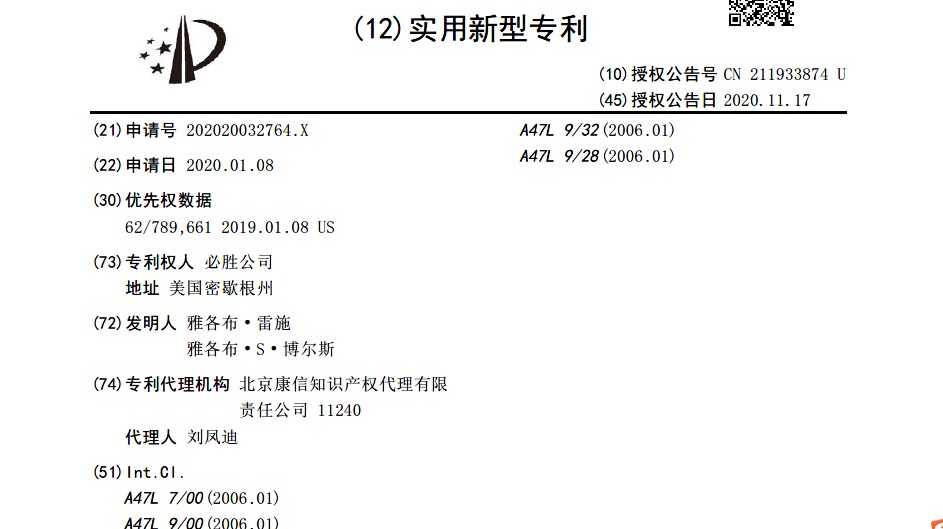
Corresponding Chinese patent No. CN 211933874 U:
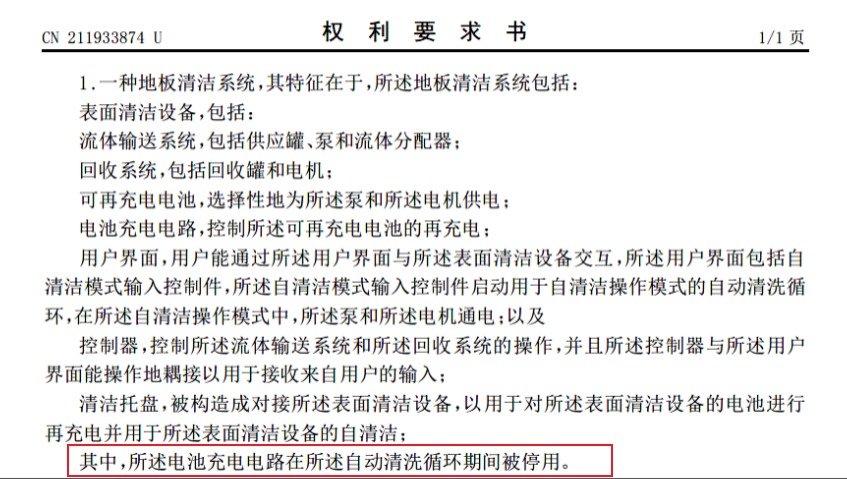
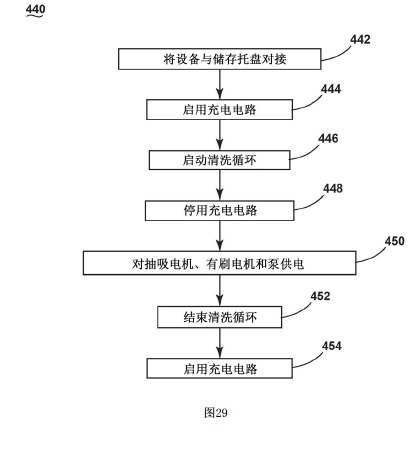
Expert interpretation: the core of this patent is software. It mainly protects “during self-cleaning, the battery pack is automatically disabled, meaning it cannot be charged.”
U.S. Patent No. 11,071,428, the 428 patent, claim excerpt:
wherein, to execute the unattended automatic cleanout cycle for the self-cleaning mode of operation, the controller is configured to: power the brushroll motor and the pump by the battery, whereby cleaning liquid is sprayed on the brushroll while the brushroll rotates, without the vacuum motor being powered; and power the vacuum motor by the battery after the brushroll motor and the pump are powered, whereby cleaning liquid is extracted and deposited into the recovery tank and a portion of the recovery pathway is flushed out; and wherein the battery charging circuit is disabled by the actuation of the self-cleaning mode input control and remains disabled during the unattended automatic cleanout cycle.
This means that, in order to execute the unattended automatic cleanout cycle under self-cleaning mode, the controller is configured to use the battery to power the brushroll motor and pump, so that cleaning liquid is sprayed onto the brushroll while the brushroll rotates, without powering the vacuum motor. After the brushroll motor and pump are powered, the battery powers the vacuum motor so that cleaning liquid is extracted and stored in the recovery tank and part of the recovery pathway is flushed. The battery charging circuit is disabled when the self-cleaning mode input control is actuated and remains disabled during the unattended automatic cleanout cycle.
Corresponding Chinese patent CN213850446U, with its core claim description:
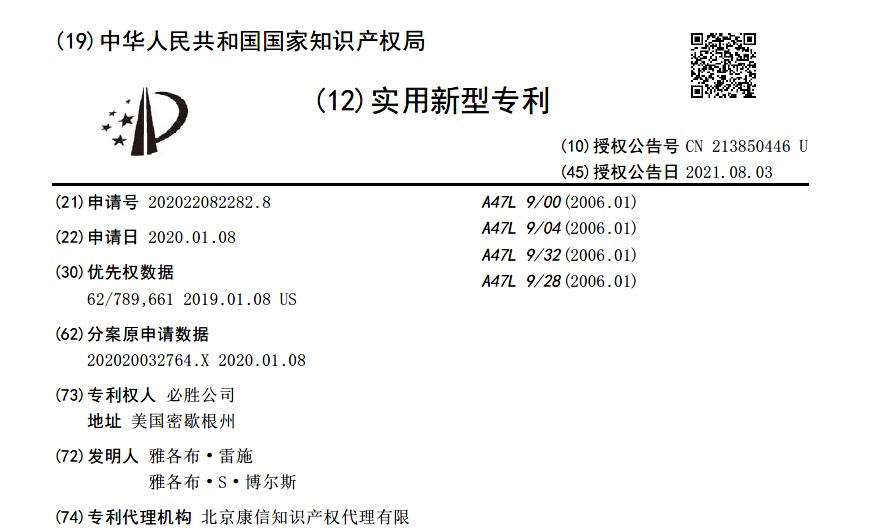
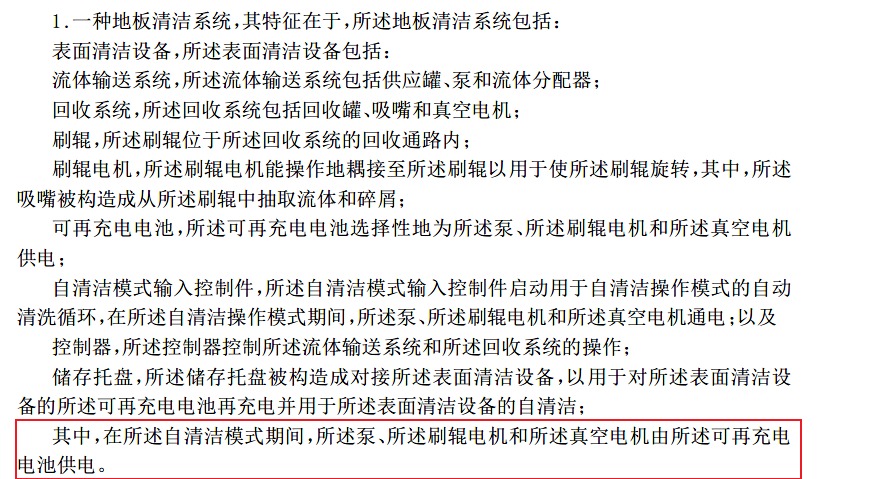
Expert interpretation: the core of this patent is software. It mainly protects “during self-cleaning, the battery pack supplies power to the water pump, brushroll and vacuum motor.”
U.S. Patent No. 11,122,949, the 949 patent, claim excerpt:
a fluid dispenser provided with the suction nozzle assembly, the fluid dispenser in fluid communication with the fluid supply chamber, the fluid dispenser including at least one outlet provided on the at least a portion of the underside of the suction nozzle assembly, the at least one outlet adapted to dispense fluid onto at least one of the agitator or a surface to be cleaned; a fluid delivery pathway between the fluid supply chamber and the fluid dispenser; and at least one fluid delivery channel located within the suction nozzle assembly, the at least one fluid delivery channel forming a portion of the fluid delivery pathway.
This means a fluid dispenser provided with the suction nozzle assembly; the fluid dispenser is in fluid communication with the fluid supply chamber. The fluid dispenser includes at least one outlet provided on at least part of the underside of the suction nozzle assembly. The outlet is adapted to dispense fluid onto at least one of the agitator or the surface to be cleaned. There is a fluid delivery pathway between the fluid supply chamber and the fluid dispenser, and at least one fluid delivery channel located within the suction nozzle assembly, with that channel forming part of the fluid delivery pathway.
Corresponding patent No. CN112932324A, with its core claim description:
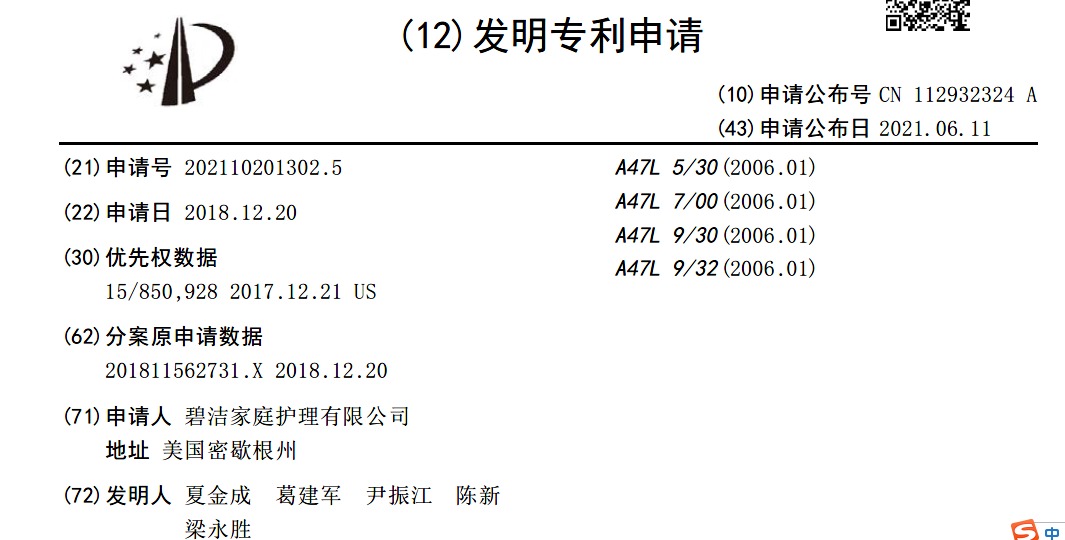
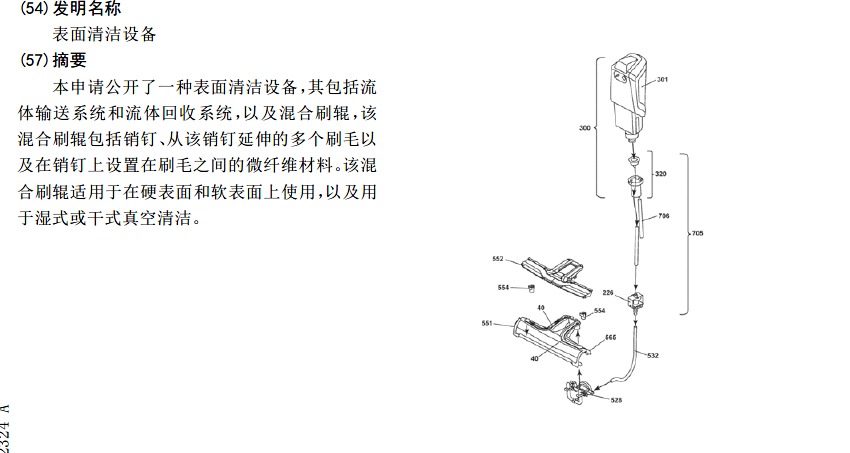
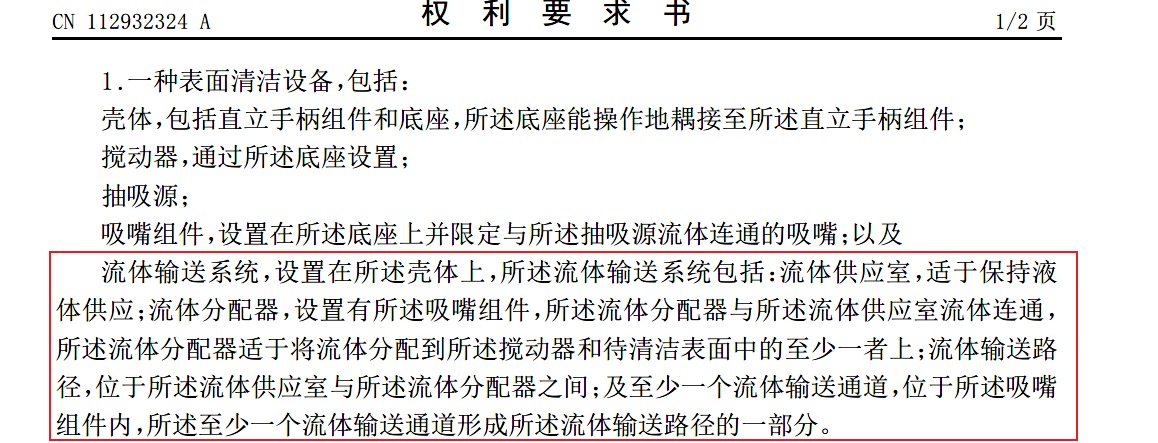
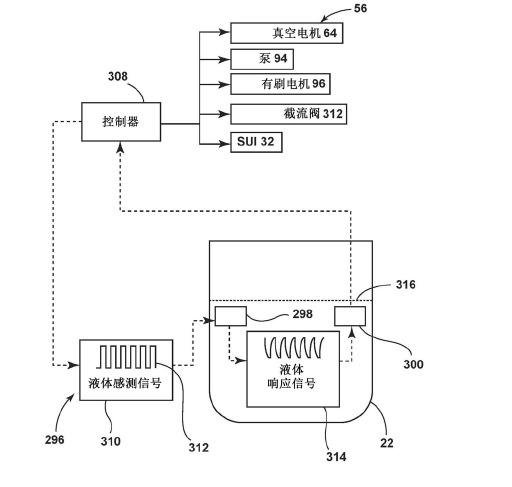
Expert interpretation: this patent concerns the fluid delivery system. The key points include the fluid supply chamber, the fluid dispenser, the fluid delivery pathway between the two, and part of the fluid delivery channel located inside the nozzle assembly.
U.S. Patent No. 10,820,769, the 769 patent, claim excerpt:
at least one fluid delivery channel forming a portion of the fluid delivery pathway, the at least one fluid delivery channel extending adjacent to a portion of the suction nozzle assembly; and an interference wiper provided on the base and adapted to interface with a portion of the at least one brushroll to remove excess liquid from the at least one brushroll.
This means at least one fluid delivery channel forming part of the fluid delivery pathway, with that channel extending adjacent to part of the suction nozzle assembly; and an interference wiper provided on the base and adapted to interface with part of at least one brushroll to remove excess liquid from the brushroll.
And U.S. Patent No. 11,096,541, the 541 patent, claim excerpt:
a fluid delivery pathway between the fluid supply chamber and the fluid dispenser; and a dual wiper configuration provided with the base and comprising a first wiper adapted to contact the agitator and a second wiper at least selectively adapted to contact a surface to be cleaned.
This means a fluid delivery pathway located between the fluid supply chamber and the fluid dispenser, and a base equipped with a dual-wiper configuration, including a first wiper adapted to contact the agitator and a second wiper at least selectively adapted to contact the surface to be cleaned.
The corresponding Chinese patent is CN112956946A, with its core claim description:
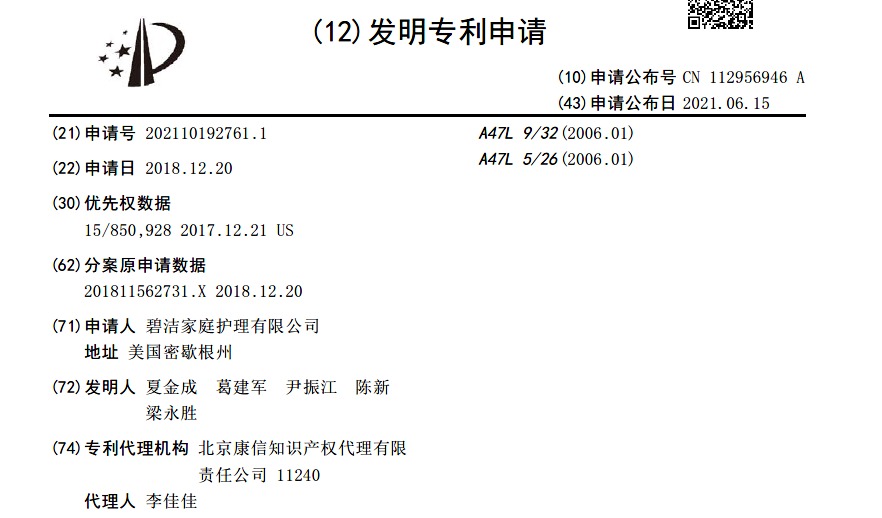
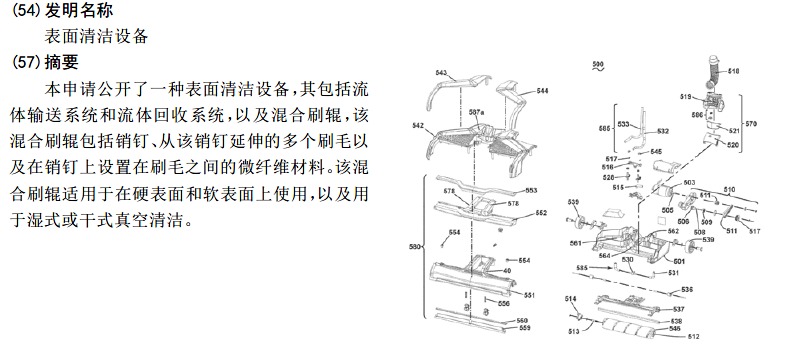
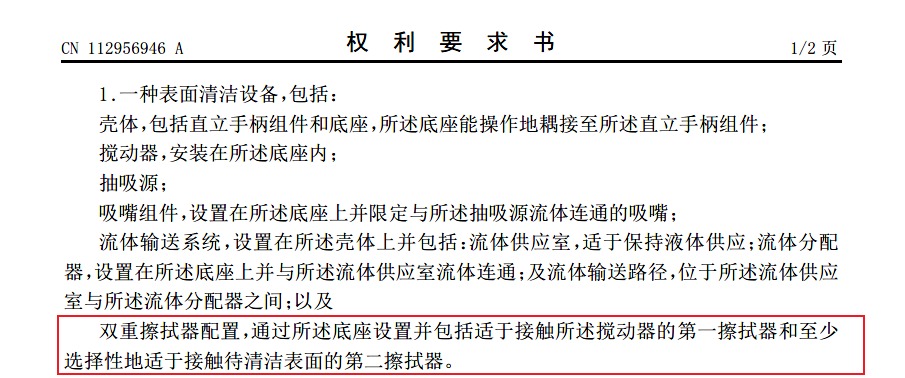
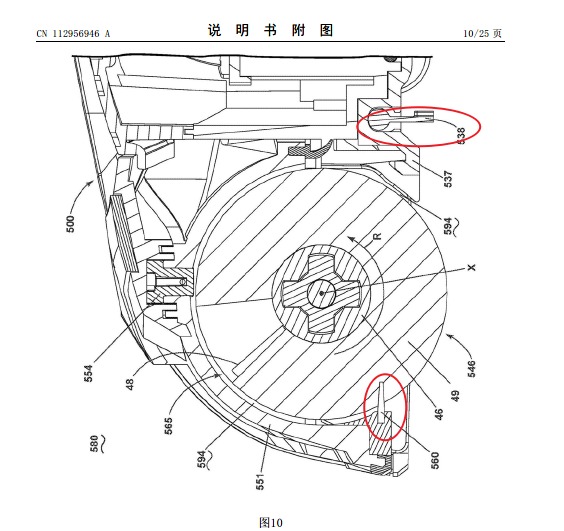
Expert interpretation: this patent concerns dual wipers, meaning one wiper that contacts the agitator or brushroll, and a second wiper that contacts the surface to be cleaned.
Regarding the disputes between Bissell and Tineco, Denny will bring everyone the deepest interpretation as soon as possible. Original articles are not easy to produce. Sharing is welcome; plagiarism and content washing are not.