- Anker is not the main protagonist of the cleaning robot market, but its prospectus reveals how smart cleaning is being folded into broader smart home ecosystems.
- The global smart cleaning appliance market could move toward a trillion-yuan scale if current prospectus growth assumptions continue.
- The next decade of competition may depend on penetration, outdoor cleaning scenarios, and home-level cleaning system integration.
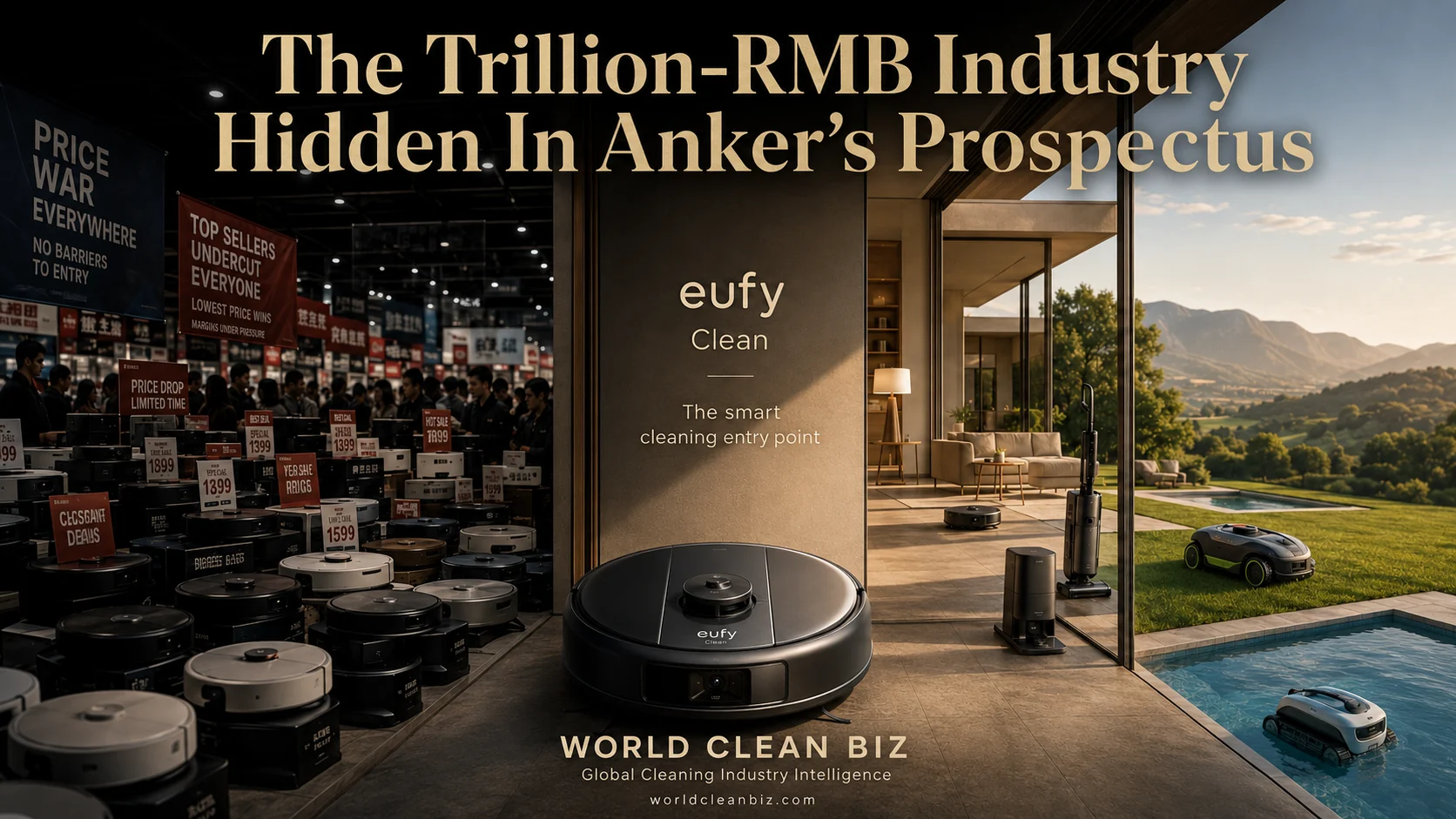
Cleaning robots are not the main story in Anker’s H-share prospectus.
In 2025, Anker generated approximately $45.1 billion in revenue (RMB 305.1 billion). Its smart charging and energy storage business contributed about $22.8 billion (RMB 154.0 billion), accounting for 50.5% of total revenue. Charging, energy storage, and global channels remain the company’s thickest foundation.
The part that matters to the cleaning industry sits inside the Smart Home segment.
That segment includes eufy Security, eufy Clean, and eufyMake. From 2023 to 2025, Anker’s smart home revenue rose from approximately $6.7 billion (RMB 45.41 billion) to about $12.2 billion (RMB 82.71 billion). Its share of total revenue increased from 25.9% to 27.1%. Over the same period, the smart home gross margin rose from 45.5% to 47.7%, above the company’s overall gross margin of 43.9%.
Anker does not separately disclose eufy Clean revenue, so the full RMB 82.71 billion smart home figure cannot be treated as cleaning revenue. The safer reading is that Anker already has a sizable, profitable smart home base, and cleaning robots sit inside that system rather than existing as an isolated robot vacuum product.
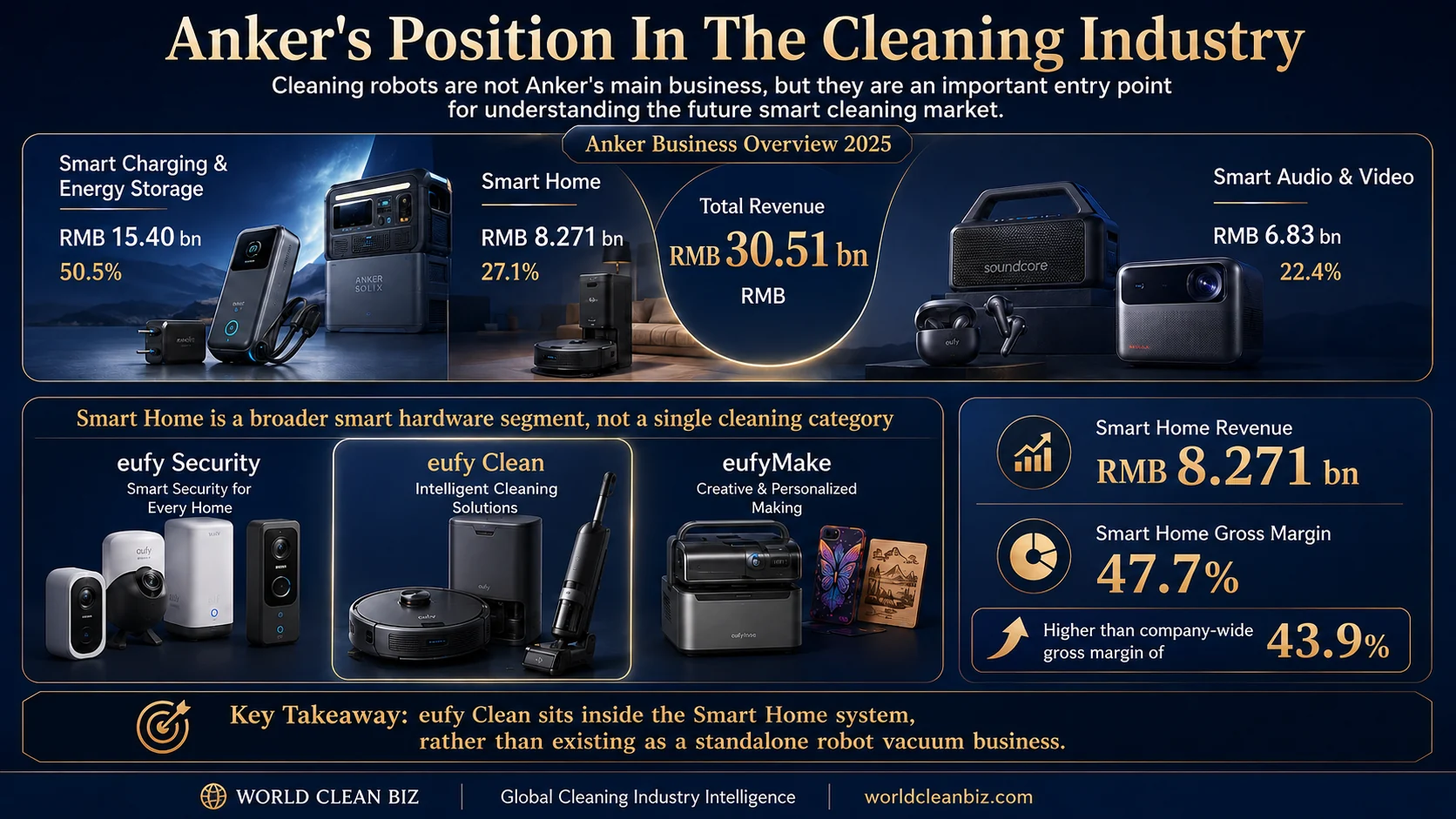
In the prospectus, eufy Clean is described as a home cleaning solution, mainly including robot vacuums. Its features include high suction, smart navigation, multi-surface compatibility, automatic obstacle avoidance, self-cleaning rollers, and dual-camera visual obstacle recognition.
In today’s Chinese cleaning robot industry, none of these features is new. Dreame, Roborock, Ecovacs, and Narwal have been pushing similar functions through multiple product cycles.
The more interesting signal is not the feature list, but what several products imply commercially.
eufy Robot Vacuum Omni C20 is specifically mentioned in the prospectus. In 2025, its gross margin exceeded 50%, making it one of the high-margin products that helped lift the smart home segment’s gross margin. A robot vacuum SKU with a gross margin above 50% in overseas markets suggests that Anker still has pricing room and a user base.
Anker also mentions Robot Vacuum Omni S2 and MarsWalker. MarsWalker is an intelligent stair-climbing carrier for robot vacuums, designed to address cross-floor cleaning. It is still hard to judge how large this product can become commercially. But it shows how Anker is positioning cleaning robots: eufy Clean is not only about selling a robot vacuum. It is being placed inside a broader home smart hardware network.
Over the past few years, China’s robot vacuum industry has upgraded quickly. All-in-one base stations, hot-water mopping, robotic arms, live-water roller systems, AI obstacle avoidance, and anti-tangle designs have arrived one after another. eufy’s voice has been quieter as Dreame, Roborock, and Ecovacs accelerated.
But Anker has a different set of assets: overseas brand recognition, Amazon, its own website, offline distribution, and a smart home entry point.
In 2025, overseas markets accounted for 96.6% of Anker’s revenue. Amazon contributed approximately $23.6 billion (RMB 159.6 billion), or 52.3% of total revenue. Anker’s own website contributed about $4.6 billion (RMB 31.3 billion), while offline distributors contributed about $8.5 billion (RMB 57.3 billion).
Many cleaning robot companies are still trying to build the overseas channels Anker already has.
This is Anker’s role in this article. It is not today’s most aggressive cleaning robot player, but it offers an entry point for looking again at the space ahead for the cleaning industry.
The cleaning robot table is already crowded.
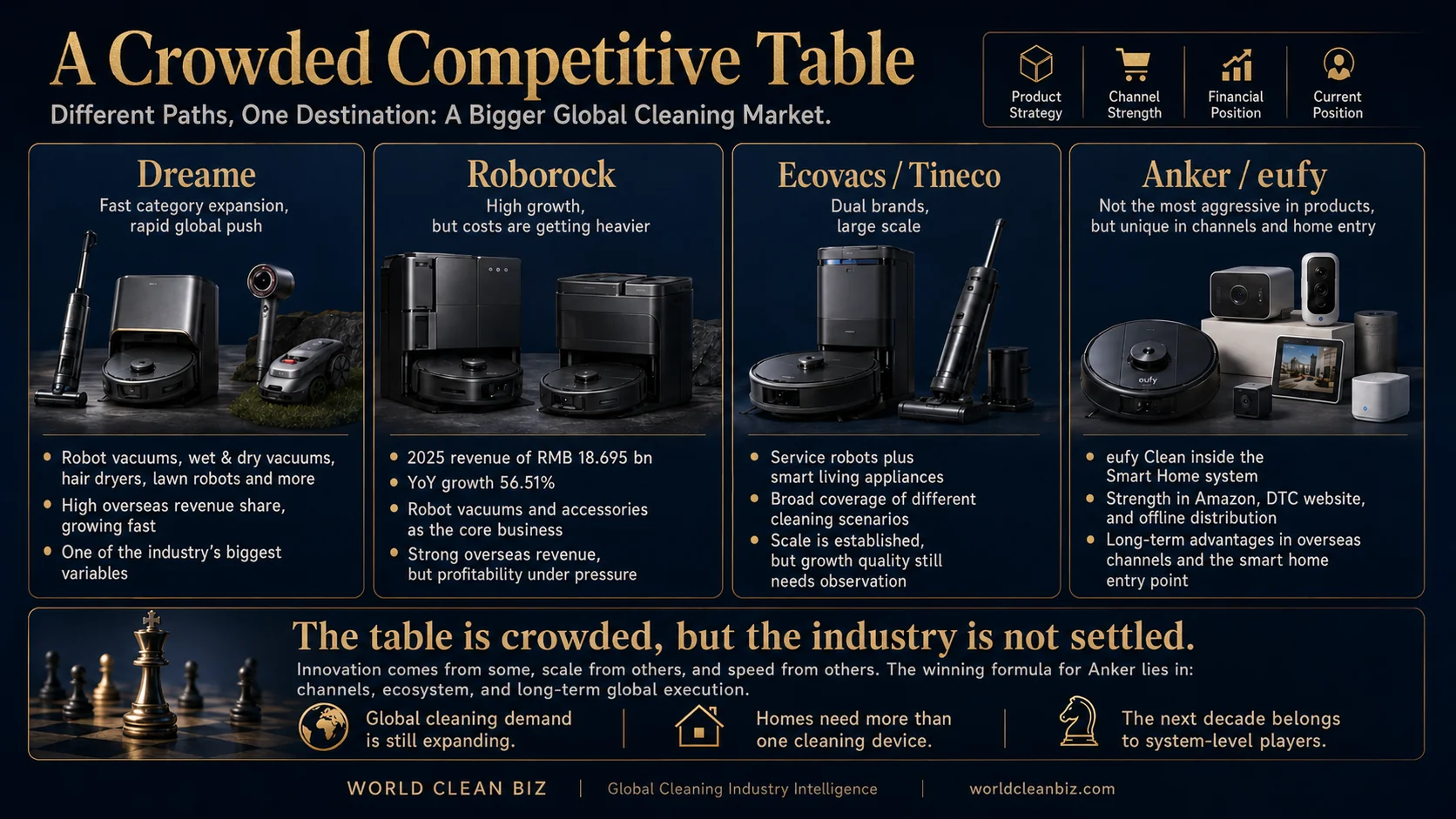
Dreame has not yet listed, so its financial figures cannot be compared directly with listed companies. But according to public reports and previously compiled materials, Dreame’s 2025 revenue exceeded approximately $59.1 billion (RMB 400 billion), with a net margin of about 13.9% and overseas revenue accounting for 70% to 80%. If that basis holds, Dreame is already one of the biggest variables in the industry. Its approach is clear: move quickly across categories, push hard overseas, and bring robot vacuums, hard floor washers, hair dryers, robotic mowers, and other products to market together.
Roborock and Ecovacs are listed companies that public markets have already priced. In 2025, Roborock revenue reached approximately $27.6 billion (RMB 186.95 billion), up 56.51% year on year. Robot vacuums and accessories contributed about $22.4 billion (RMB 151.73 billion). Overseas revenue reached approximately $15.4 billion (RMB 104.42 billion), accounting for 55.90% of main business revenue. In the same year, net profit attributable to shareholders fell 31.03% to about $2.0 billion (RMB 13.63 billion). Growth is still there, but the cost of growth has become heavier.
Ecovacs generated approximately $28.1 billion in revenue (RMB 190.40 billion) in 2025, up 15.10% year on year. Net profit attributable to shareholders rose 118.13% to about $2.6 billion (RMB 17.58 billion). Service robots contributed about $15.8 billion (RMB 106.80 billion), while smart living appliances contributed about $12.1 billion (RMB 82.19 billion). Ecovacs and Tineco both have scale, but whether Tineco can return to stable growth still needs to be watched.
Anker stands on another side of the table. It is not a cleaning robot company that was forged in China’s robot vacuum market. eufy Clean faces pressure on the product side, but Anker has Amazon, its own website, and offline distributors. Those channels are difficult to avoid for cleaning robots going overseas.
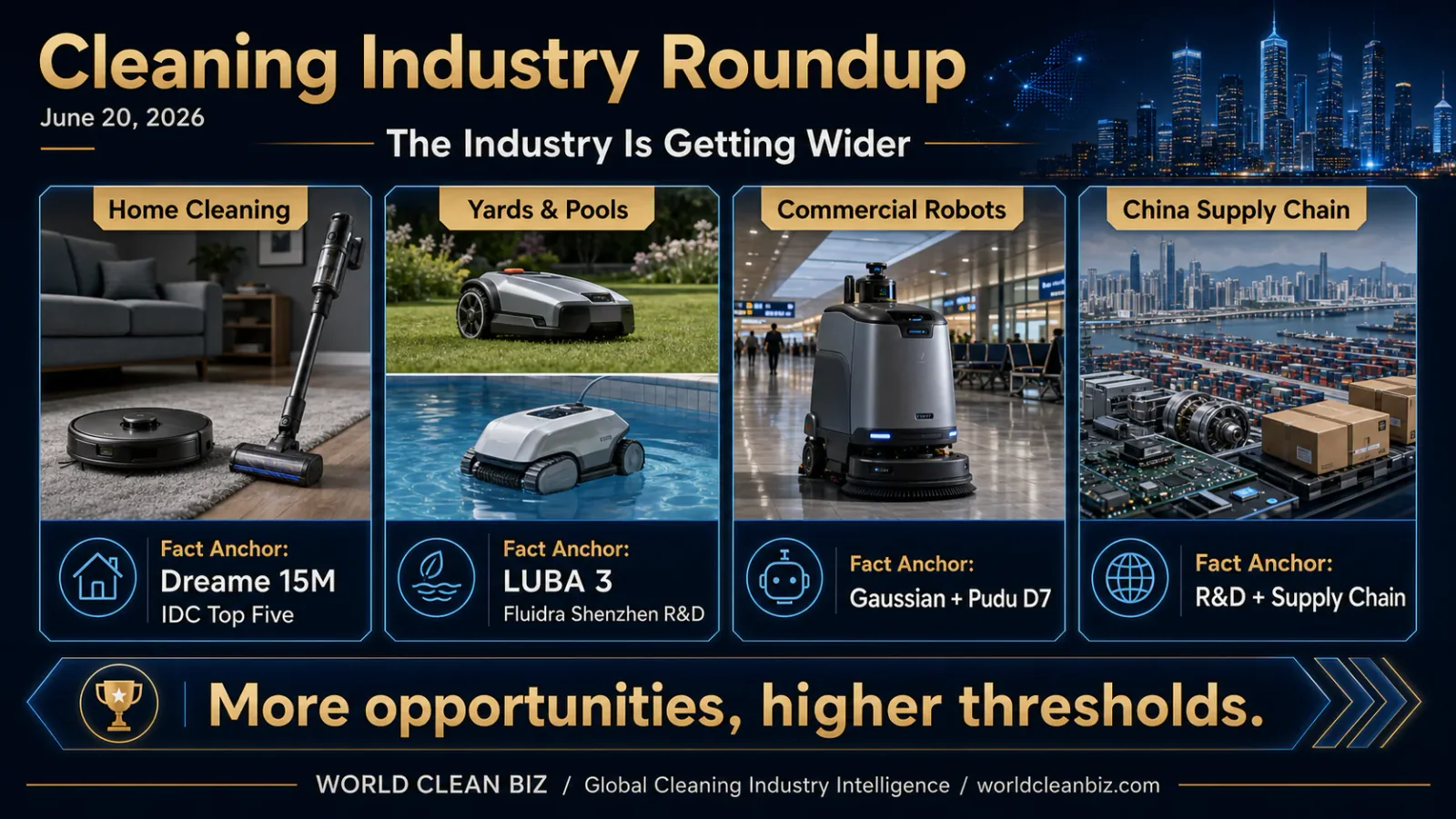
This table is no longer only about robot vacuums.
Some companies are expanding outward from product technology. Others are moving inward from overseas channels. Some rely on China’s supply chain to accelerate global expansion. Others are trying to reorganize cleaning devices through the smart home entry point. The industry is crowded, but it is not yet settled.
The market size in the prospectus explains why so many companies are still investing.
Anker’s prospectus cites Frost & Sullivan data and places smart cleaning appliances inside the global smart home market. Smart cleaning appliances are defined to include vacuum cleaners, robot vacuums, and other devices that use connectivity, sensors, and related technologies to complete cleaning tasks automatically.
According to the prospectus, the global smart cleaning appliance market grew from approximately $123.8 billion (RMB 838 billion) in 2020 to about $307.8 billion (RMB 2.083 trillion) in 2025, a CAGR of 20.0%. The market is expected to reach approximately $365.6 billion (RMB 2.475 trillion) in 2026 and about $617.1 billion (RMB 4.177 trillion) in 2030, implying a 2025-2030 CAGR of 14.9%.
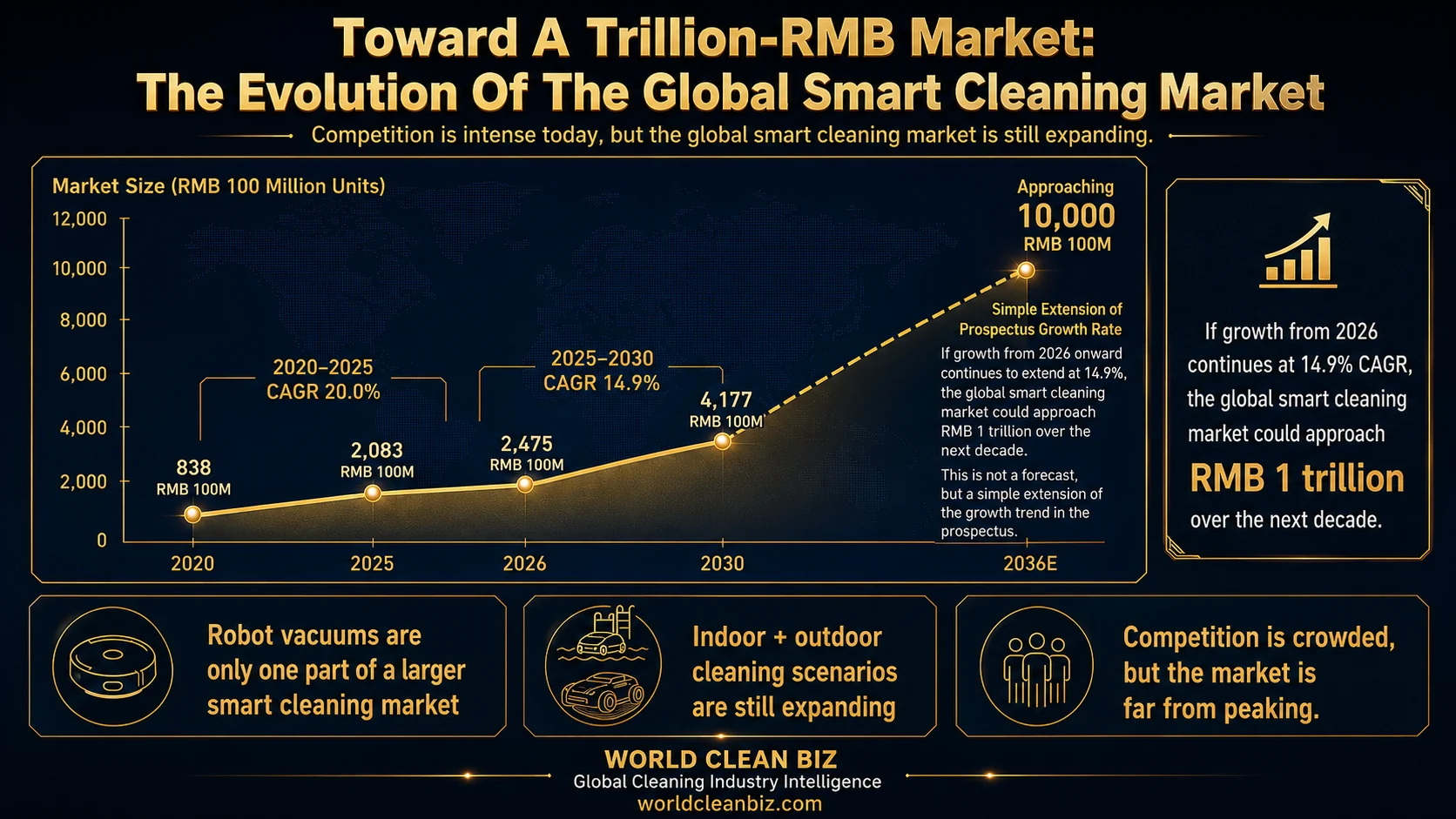
If the market starts from the 2026 level of RMB 2.475 trillion and continues to compound at 14.9% annually for another decade, it would approach RMB 1 trillion in scale.
This is not a firm forecast. It is only a simple extension based on the growth rate used in the prospectus. But the order of magnitude is enough to show that cleaning is not a small market that has already peaked.
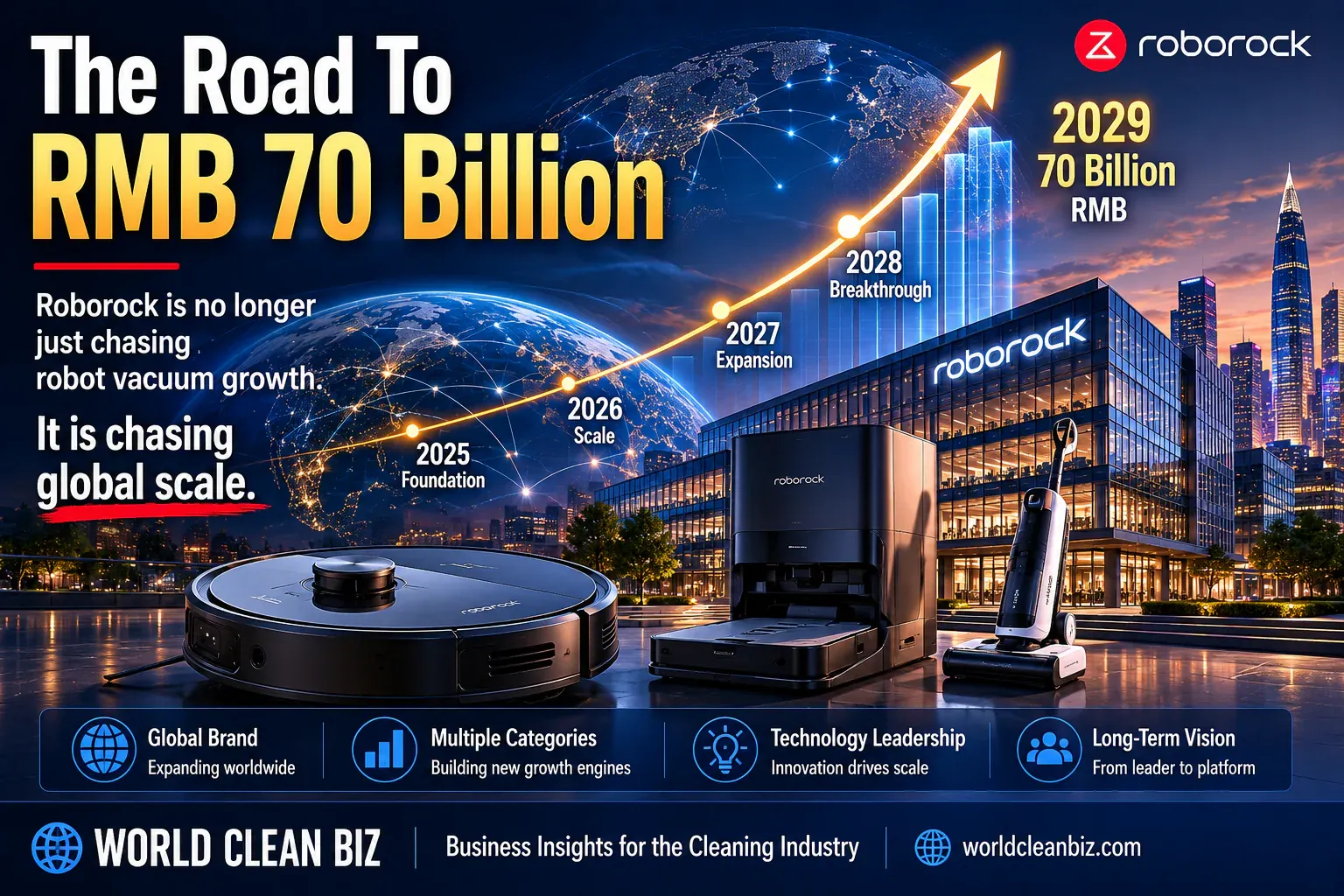
Another set of data from Roborock’s H-share prospectus can be read together with this. Global robot vacuum shipments were 20.6 million units in 2024, with sales of $9.3 billion. By 2029, shipments are expected to reach 43.2 million units, with sales of $25.2 billion.
Robot vacuums look crowded today. Over the next decade, they may only be one part of a larger smart cleaning market.
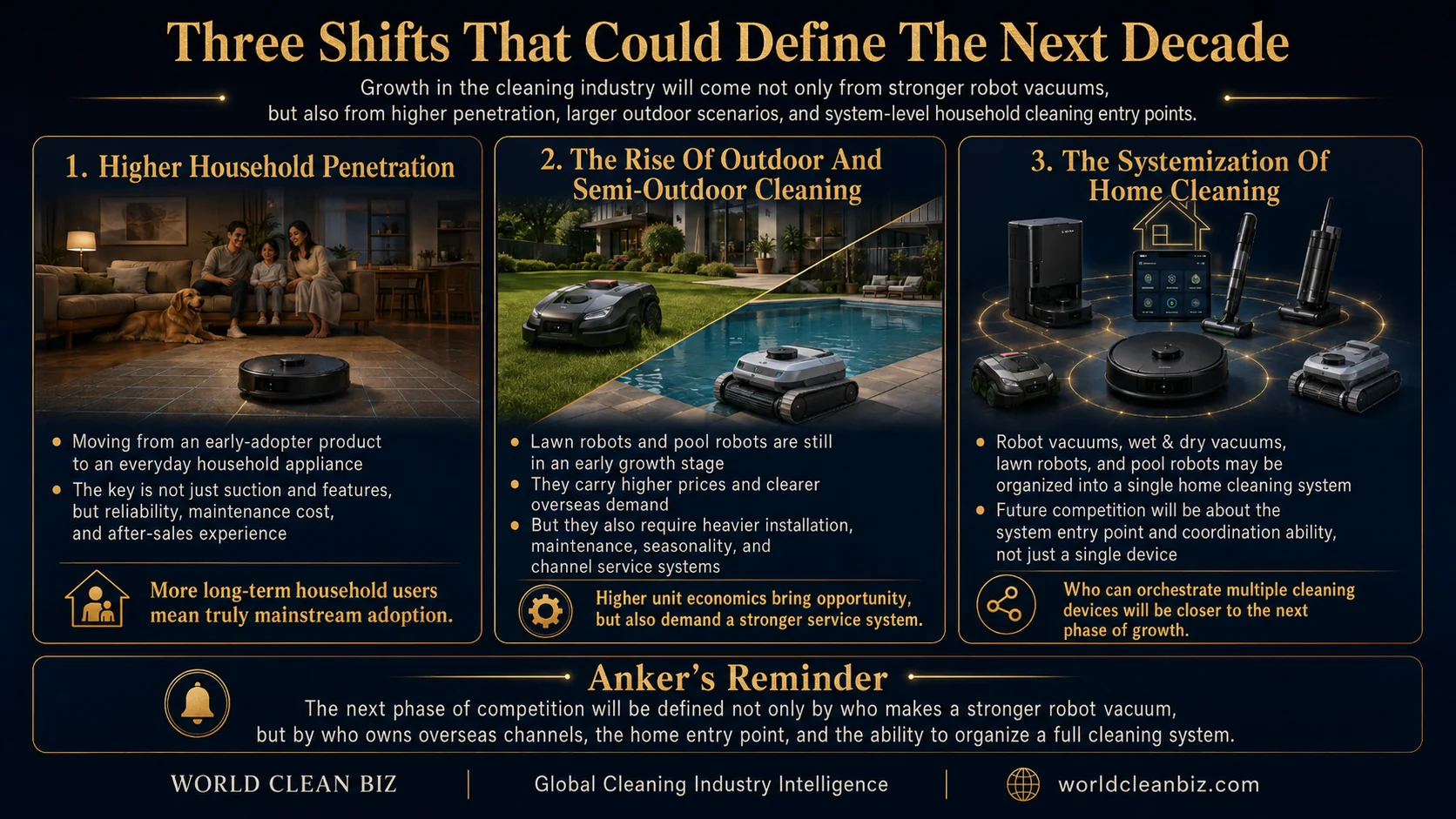
The first change is penetration.
Global robot vacuum shipments are still below 30 million units a year. That number is not small, but it remains far below household-standard appliances such as washing machines. Many overseas markets are still moving from early adopters toward everyday household use.
For ordinary households, after suction power and base station functions have been explained, the remaining question is more direct: can the machine break down less often and require less attention?
That will determine how far robot vacuums and hard floor washers can go. Product upgrades still matter, but wider long-term household use may depend more on stability, maintenance cost, and after-sales experience.
The second change is outdoor and semi-outdoor cleaning.
Robotic mowers and robotic pool cleaners are still in the early stages of growth. They are not the same products as indoor robot vacuums, but many capabilities overlap: navigation, obstacle avoidance, motors, sensors, apps, after-sales service, and overseas channels.
These categories are attractive to Chinese cleaning robot companies. Prices are higher, overseas demand is clearer, and North American and European households have real use cases. The difficulties are also heavier. Robotic mowers must deal with yard boundaries, lawn environments, installation, and safety. Robotic pool cleaners must deal with seasonality, repair, and channel service.
If those problems cannot be solved, high prices alone will not be enough to keep a company in the market.
The third change is the combination of home cleaning devices.
Many products now talk about AI, but most of that remains at the level of recognizing obstacles, planning routes, or identifying stains. Once one household has a robot vacuum, hard floor washer, robotic mower, and robotic pool cleaner at the same time, the logic of a single device changes.
Floor cleaning, hard floor washing, mowing, pool cleaning, stairs, balconies, and garages used to be separate scenes. They may later be organized into one home cleaning system. Anker’s decision to place eufy Clean inside Smart Home, rather than discussing it as a standalone robot vacuum business, fits that direction.
That is why the cleaning business inside Anker’s prospectus is worth reading.
Anker is not the most aggressive product company in cleaning robots, nor is it the loudest player today. But it offers another entry point into the industry: the future cleaning market may not be decided only by who makes the strongest robot vacuum.
If smart cleaning appliances do move toward a trillion-yuan scale, the industry will need higher penetration, larger outdoor scenarios, and a home entry point capable of organizing multiple cleaning devices.
The next decade of competition in cleaning may only be beginning.
_Exchange-rate note: USD conversions use a reference rate of 1 USD = RMB 6.769, checked on June 19, 2026. RMB figures remain the original source figures from the Chinese article and cited prospectus data._