- Cordless robotic pool cleaners are shifting the category from professional equipment toward consumer robotics.
- Chinese challengers are taking different routes: mass-market brand, premium startup and manufacturer-to-brand.
- The long-term battle may be decided by backyard automation across pools, lawns, channels and after-sales service.
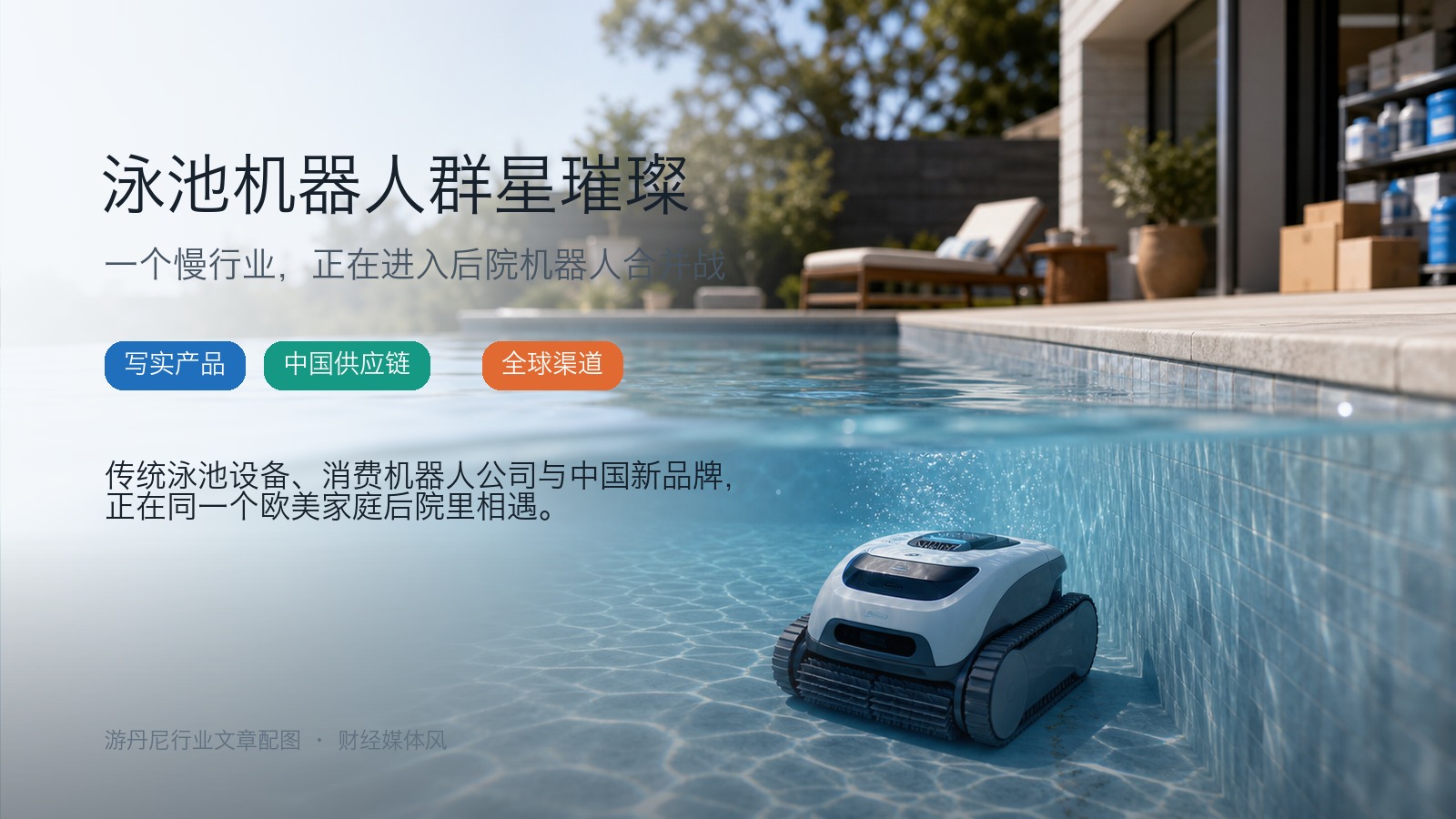
For years, the robotic pool cleaner market looked like a quiet equipment category. A homeowner called a pool service provider. A dealer recommended a device. A wired robot moved slowly across the bottom of the pool. The market was large, but it did not behave like smartphones, robot vacuums, or electric vehicles.
That is changing. Cordless products have made robotic pool cleaners easier for ordinary consumers to understand. Amazon, Costco, Walmart, Home Depot, and direct-to-consumer websites have opened new routes to market. Chinese companies are bringing faster product cycles, lower cost structures, online sales skills, and broader price-band coverage into a category that used to move slowly.
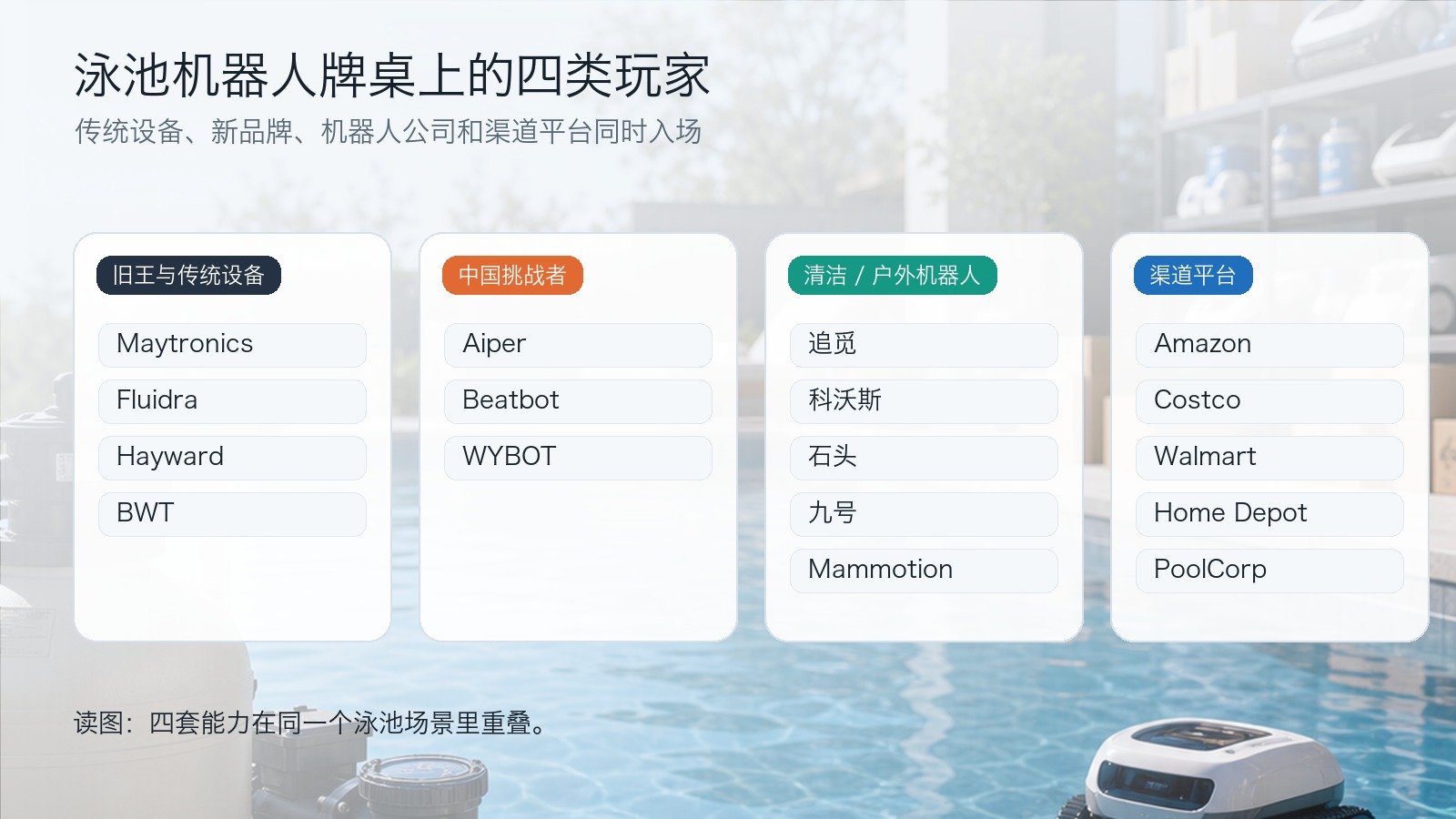
The result is a more crowded table. Incumbents want to defend the professional channel. New brands want to win consumers. Manufacturers want to become brands. Robot vacuum and robotic mower companies are starting to look at the backyard as one connected automation market.
The old leaders are still important
Maytronics and Dolphin remain the reference point in robotic pool cleaners. Dolphin was the first robotic pool cleaner many users recognized, and Maytronics built deep roots in professional pool channels and service networks. But the company is no longer operating in the same competitive environment. Maytronics reported roughly $503 million (RMB 3.40 billion) in 2025 revenue, and its residential robotic pool cleaner gross margin fell from 36.5 percent in 2024 to 23.9 percent in 2025. The pressure is no longer coming from one challenger. Aiper, Beatbot, WYBOT, and a wider group of robotics companies are attacking from different directions.
Fluidra represents a different type of incumbent. Consumers may not know the name, but they may already be using its pumps, filters, heaters, covers, cleaning accessories, or commercial pool solutions. Fluidra generated about $2.54 billion (RMB 17.21 billion) in 2025 revenue. Its real asset is not only product coverage, but the relationship network among dealers, pool builders, service providers, and installed pool owners. Its investment of $100 million in Aiper for a 27 percent stake shows how traditional pool equipment companies are trying to connect old channels with new consumer robotics.
Three Chinese paths are emerging
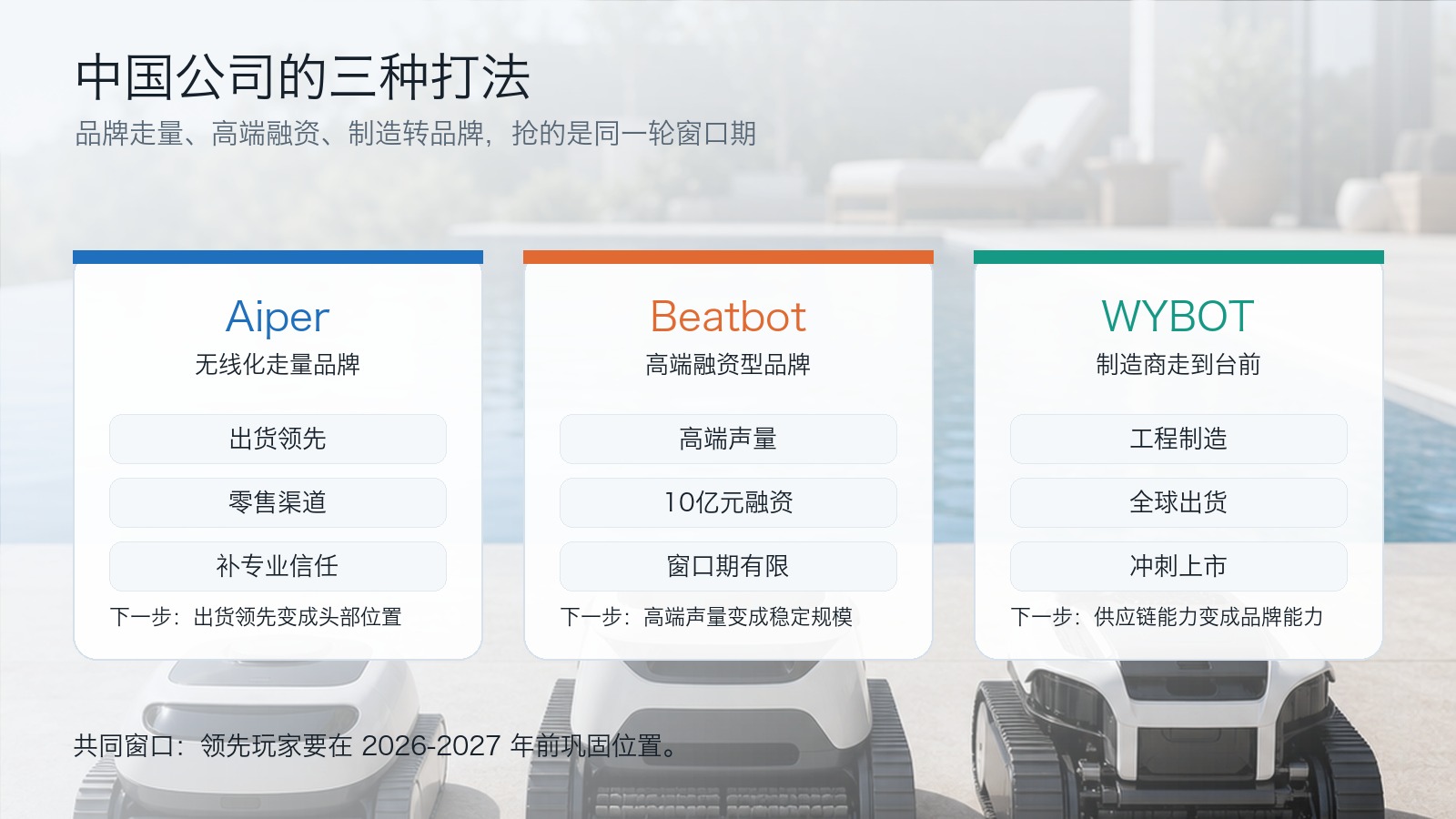
Aiper is the cordless challenger. It brought a more consumer-electronics logic into robotic pool cleaners: cordless design, one-button operation, online sales, large retailers, and fast iteration. Fluidra disclosed that Aiper generated about $195 million in 2024 revenue, up 75 percent year over year. Aiper says it has entered more than 57 countries and over 10,000 retail stores. Its challenge is to turn early shipment momentum into brand trust, channel trust, and long-term service capability.
Beatbot represents the high-end startup route. It did not begin from the lowest price band. It entered with more ambitious products, stronger water pumps, more complex motion control, and a premium technology story. The company has raised significant capital and built visibility in the high-end segment. Its next test is whether premium attention can become stable channel scale and durable product reputation.
WYBOT represents the manufacturer-to-brand path. It does not have the same consumer visibility as Aiper or Beatbot, but it is a serious supply-chain player. WYBOT’s revenue grew from RMB 378 million in 2023 to RMB 812 million in 2025, while profit increased from RMB 60.85 million to RMB 100 million. Its products have reached more than 60 countries and regions. For WYBOT, the larger test is whether manufacturing, cost control, and engineering strength can be converted into global brand power.
These three companies show the first wave of Chinese challengers: mass-market brand, premium funded brand, and supply-chain company moving forward. They are all challenging the old order, but each has a different weakness to solve.
The larger threat comes from backyard robotics
The category will not remain isolated. Robotic pool cleaners, robotic mowers, and other backyard robots are moving toward the same household scene. For American and European homeowners, the pool and the lawn are part of the same outdoor maintenance burden.
Dreame is the most aggressive large player to watch. Its revenue scale has already entered the RMB 30 billion discussion range, and it has shown a willingness to expand from floorcare into new hardware categories. At CES 2026, Dreame introduced the Zircon2 robotic pool cleaner series. If Dreame decides to invest heavily, it can raise the competitive intensity of the entire category.
Ecovacs, Roborock, Segway Navimow, and Mammotion are also relevant. Ecovacs has service-robot experience and capital resources. Roborock has strong product definition and operating discipline. Segway Navimow already has a backyard robotics position through robotic mowers. Mammotion is an aggressive product-led startup that has already entered pool cleaning with SPINO products.
Traditional pool equipment companies will not stand still either. Hayward has pumps, filtration, heating, automation, lighting, and cleaning equipment, as well as professional dealer relationships. BWT and Aquabot have long experience in robotic pool cleaning systems and professional use cases. They may not move as quickly as consumer brands, but they understand reliability and service-heavy markets.
The industry may consolidate around backyard automation
Robotic pool cleaners look like a single category today. In the long term, they may become part of a larger backyard automation market. Consumers will not want separate technology stories for the pool, the lawn, and outdoor cleaning. They will want a system that reduces maintenance work.
That changes the possible company scale. If robotic mowers and robotic pool cleaners gradually converge, the leading companies could reach much larger revenue levels than a single niche category would suggest. But the market will not support too many global brands. Eventually, only a few companies are likely to hold durable positions.
The key period may arrive around 2027 and 2028. Aiper needs to turn shipment leadership into category leadership. Beatbot needs to make premium positioning scalable. WYBOT needs to prove that a manufacturer can become a global brand. Maytronics needs to defend its professional channel and brand trust. The backyard robotics players must decide how important pool cleaning is within their product maps.
The market is crowded now, but that is only the first half. The second half will be decided by product reliability, channel discipline, global service, and capital efficiency. The robotic pool cleaner market is becoming a backyard robotics battle.
Figures cited above are based on company materials, public filings, and Denny’s industry notes. RMB conversions use a June 8, 2026 reference rate of USD 1 to CNY 6.7656 for readability.