- Maytronics helped define the robotic pool cleaner category, but the rules of competition are shifting from professional channels to cordless products and broader retail access.
- The rise of cordless robotic pool cleaners has lowered the consumer adoption barrier and opened the market to faster-moving Chinese brands.
- The next phase of the category will be decided less by product launch cycles and more by reliability, service, channel control and compliance.
Maytronics is one of the few companies that can claim to have helped define an entire category. For decades, its Dolphin brand was almost synonymous with the robotic pool cleaner, especially in professional pool channels across Europe, North America and Australia.
That position was not built overnight. Maytronics did not emerge from a Silicon Valley-style consumer electronics story. It began in the early 1980s in Kibbutz Yizre'el in northern Israel, where a financially pressured agricultural community made an unusual bet on a machine that could clean swimming pools by itself.
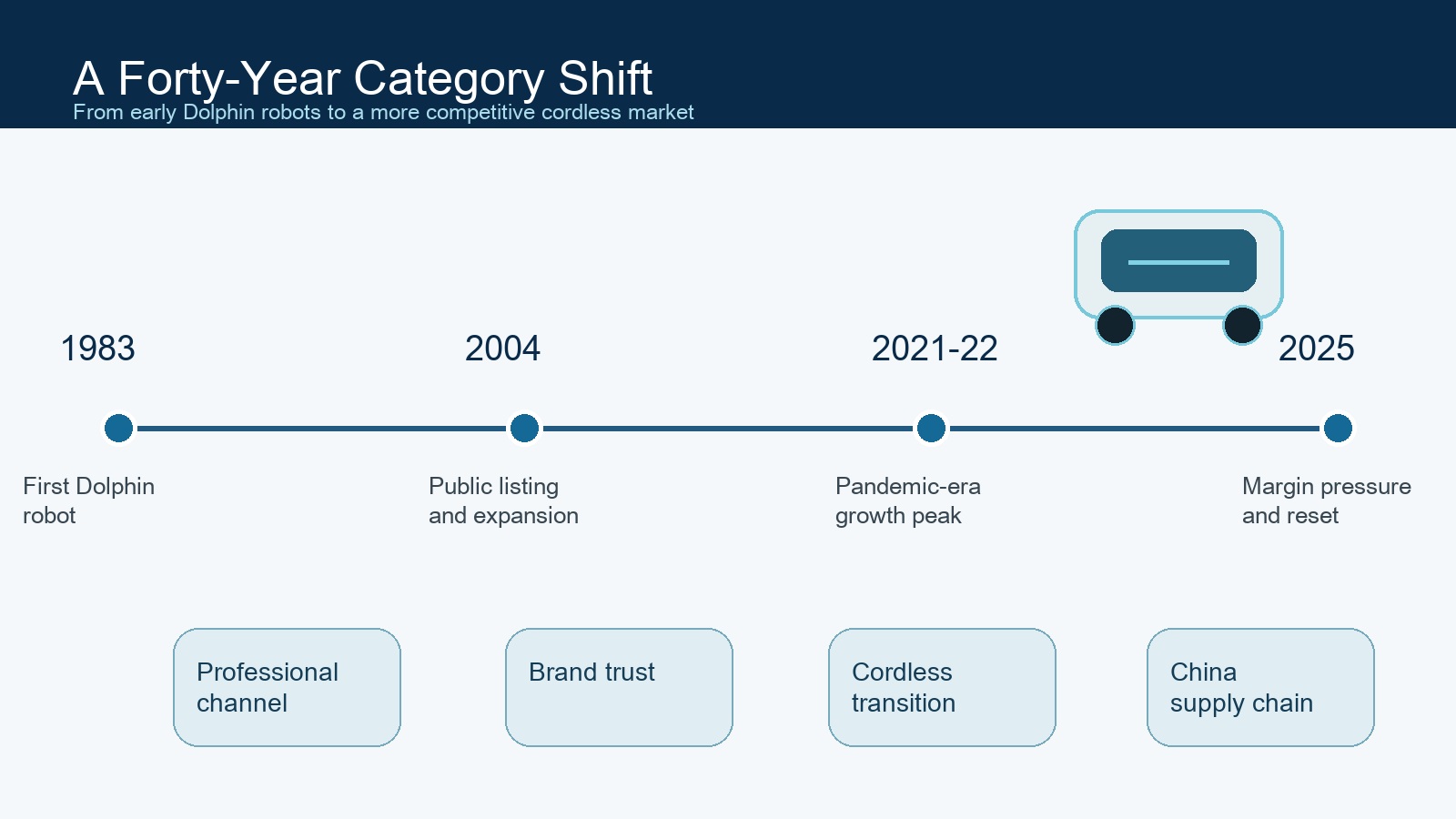
The company was founded in 1983, after the early robotic pool cleaner concept was brought from South Africa to Israel and developed into the first Dolphin product. In the decades that followed, Maytronics built a business around a simple but difficult question: how can a robot earn trust in a wet, complex and service-heavy environment?
Swimming pool cleaning is not a simple appliance category. A robotic pool cleaner must operate underwater, collect debris, scrub surfaces, filter dirt, move reliably across different pool shapes and survive repeated exposure to water, chemicals and seasonal use. For professional pool channels, reliability has always mattered as much as product specifications.
That is why Maytronics' early growth looked more like the evolution of an industrial equipment company than a consumer electronics brand. The company added dual motors, remote control, commercial models, top-access filters, anti-tangle systems and broader service capabilities over time. It listed on the Tel Aviv Stock Exchange in 2004 and later expanded into the United States, France, Australia, Spain and Portugal.
By 2019, Maytronics had become the category's most important incumbent. Its investor materials estimated its global robotic pool cleaner market share at about 48 percent, up from 32 percent in 2010. The company also estimated that robots accounted for only 26 percent of pool cleaning methods in 2019, while suction cleaners, pressure cleaners and manual service still represented most of the market.
That data point explains why the category still attracted new entrants. Even after decades of development, robotic pool cleaners had not fully penetrated the installed base of swimming pools.
The category was already growing before the new challengers arrived
The pandemic years amplified Maytronics' momentum. As households in Europe and North America spent more time on outdoor living, backyard pools and home maintenance became more important. Maytronics' revenue rose to roughly RMB 3.38 billion in 2021 and then to about RMB 4.32 billion in 2022.
At that point, many of the variables still worked in Maytronics' favor: a large installed base of pools, rising robot penetration, a trusted Dolphin brand, professional channels and a history of product reliability.
But the same period also set up the next phase of competition. Once demand expanded, the category became attractive to a new generation of suppliers and brands. The question was no longer whether robotic pool cleaners could become a meaningful product category. The question became who would define the next product form.
The answer increasingly came from cordless products.
Cordless robotic pool cleaners changed the user experience. They removed the cable, reduced the perceived complexity of ownership and made the product easier to understand for ordinary households. A wired robot was still closer to a professional pool device. A cordless robot looked more like consumer hardware.
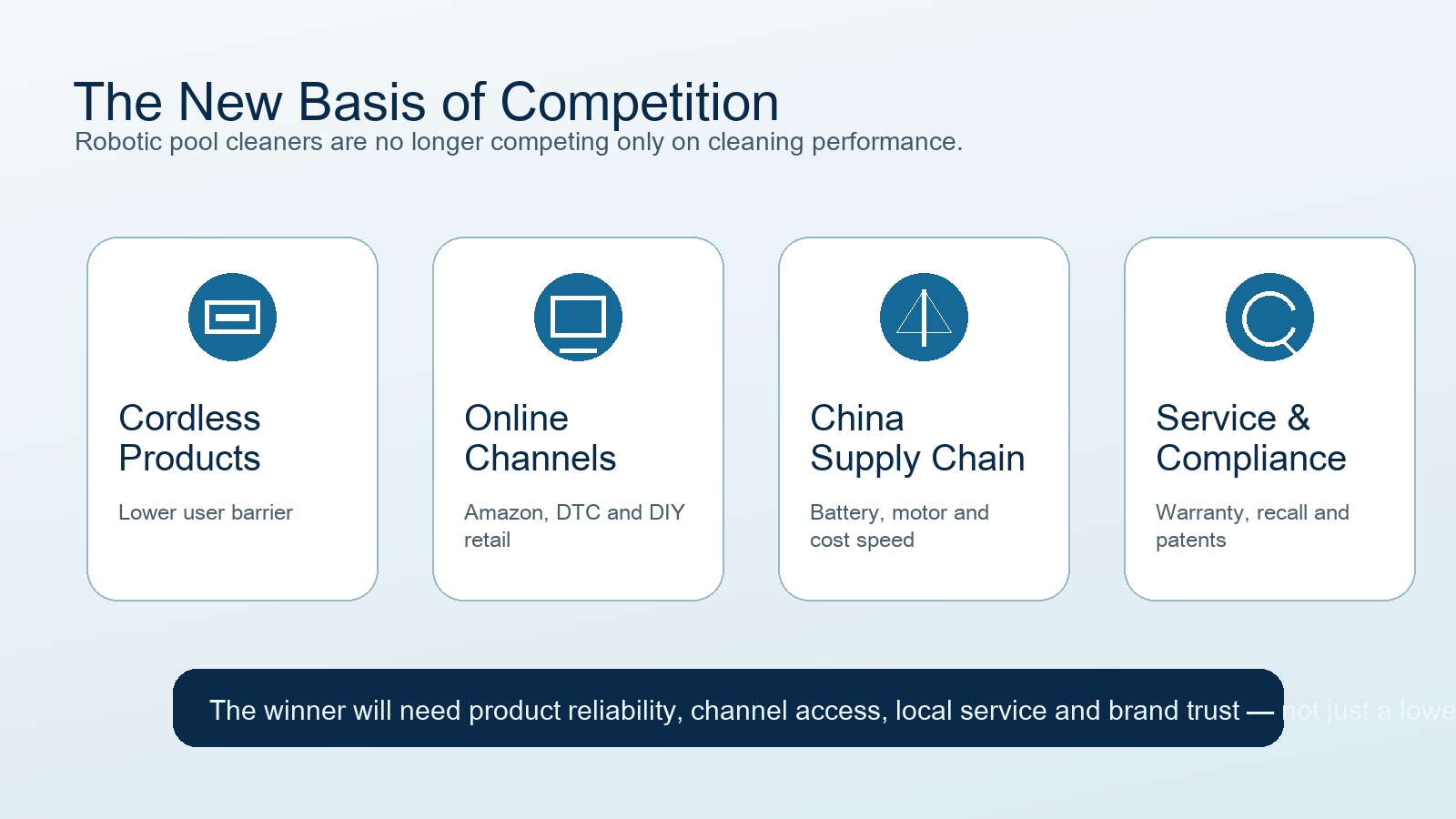
This shift also changed the channel structure. Cordless products were better suited to Amazon, direct-to-consumer websites, DIY retail and broader consumer distribution. That created an opening for China-based brands and manufacturers with advantages in batteries, waterproof design, motors, plastics, electronics and rapid product iteration.
The basis of competition has changed
Maytronics itself has acknowledged the changing environment. Its materials have pointed to the rise of cordless products, multi-brand and multi-channel offerings, and online competition from Chinese players.
Those three signals describe a deeper shift in the rules of competition.
In the old model, the strongest company combined product reliability, professional pool channels, a respected brand and service support. Price mattered, but it was not the only factor. The pool dealer, the pool builder and the service technician all played important roles in the buying decision.
In the new model, consumers can compare products online, read reviews, evaluate prices and buy directly. New brands can build volume without first controlling the traditional pool channel. The product is also moving across more price bands, from premium wired robots to mass-market cordless models and increasingly ambitious AI-enabled devices.
This does not mean the professional channel has lost its value. Robotic pool cleaners remain expensive, seasonal and service-sensitive products. They involve waterproofing, batteries, safety, spare parts, warranty and local support. But the professional channel is no longer the only route to market.
That is the core challenge for incumbents. Their advantages still exist, but they are being repriced.
Pressure showed up in the financials
The pressure became visible in Maytronics' 2025 results. Revenue fell to roughly RMB 3.40 billion, below the high point of 2022. The more important signal was in the residential robotic pool cleaner business, where revenue declined from about RMB 2.85 billion in 2024 to about RMB 2.33 billion in 2025.
Gross margin in that segment also fell sharply, from 36.5 percent in 2024 to 23.9 percent in 2025. That is not just a volume problem. It points to pressure on pricing, product mix, inventory and operating efficiency.
Maytronics also worked through inventory. Inventory fell from about RMB 2.02 billion to about RMB 1.43 billion in 2025, and operating cash flow improved. But this kind of repair carries a cost. Inventory can be reduced through more disciplined operations, but it can also require price actions that weigh on margin.
The company's management changes also suggest a business entering an operational reset. New leadership with backgrounds in supply chain, finance, restructuring and global operations indicates that the problem is no longer only about making better robots. It is about rebuilding the operating system behind the business.
For the broader industry, this is one of the most important signals. The category is still growing, but growth no longer automatically flows to the incumbent leader.
The Chinese opportunity is real, but not simple
For Chinese brands and suppliers, the opportunity is significant. Cordless robotic pool cleaners play to many of China's hardware strengths: fast engineering cycles, battery supply, motor systems, plastic tooling, cost control and online channel execution.
The rise of brands such as Aiper, Beatbot and WYBOT reflects this shift. It also shows how the category is moving from a professional equipment logic toward a broader consumer robotics logic.
But low price alone will not be enough. Robotic pool cleaners operate in a harsher environment than many indoor cleaning products. A product failure can involve water, batteries, safety, recalls and brand trust. In overseas markets, companies also face patents, compliance, customer reviews, local service and return costs.
The next phase will be harder than the first wave of cordless growth. Selling online is one thing. Building a durable global brand in a service-heavy category is another.
That is why the future of robotic pool cleaners will not be decided only by who launches the newest cordless model. It will be decided by who can combine product reliability, channel access, after-sales service, compliance, cost control and brand trust.
What the next phase may look like
The category may also expand beyond cleaning. Future robotic pool cleaners are likely to move toward a broader pool maintenance system. The direction is already visible: automatic docking, automatic charging, debris collection, AI vision, underwater mapping, water-quality sensing, connected pool control and service data.
If that happens, the market will no longer be defined only by whether a robot can clean the pool floor. It will be defined by whether the product can reduce the entire burden of owning and maintaining a pool.
That creates opportunities for both sides. Traditional pool equipment companies have channels, installed bases and service relationships. Chinese robotic brands have speed, cost structure and product iteration. The most competitive companies may be those that can combine both sets of capabilities.
Maytronics remains a strong company. Dolphin remains a powerful brand. The professional channel still matters. But the category it once helped define is no longer governed by the same rules.
A possible industry turning point may not arrive as a dramatic announcement. It may come as something more ordinary: an overseas channel partner calling a Chinese supplier and asking whether the next batch of cordless robotic pool cleaners can ship earlier, whether another container can be added, or whether available stock can be sent first.
That is how category shifts often begin in the real world.
Maytronics helped define the robotic pool cleaner. Now the robotic pool cleaner category is redefining Maytronics.