- Snap-on Tools is part of Snap-on Incorporated, an independent public company traded on the New York Stock Exchange under SNA; it is not owned by Stanley Black & Decker, TTI or another tool group.
- Snap-on operates a multi-brand portfolio and a global manufacturing network, so the parent company and group footprint do not prove the factory or country of origin of a specific product.
- The mobile franchise network is a sales and service channel, not the owner of the brand; product-level warranty terms and the authorized seller still matter.
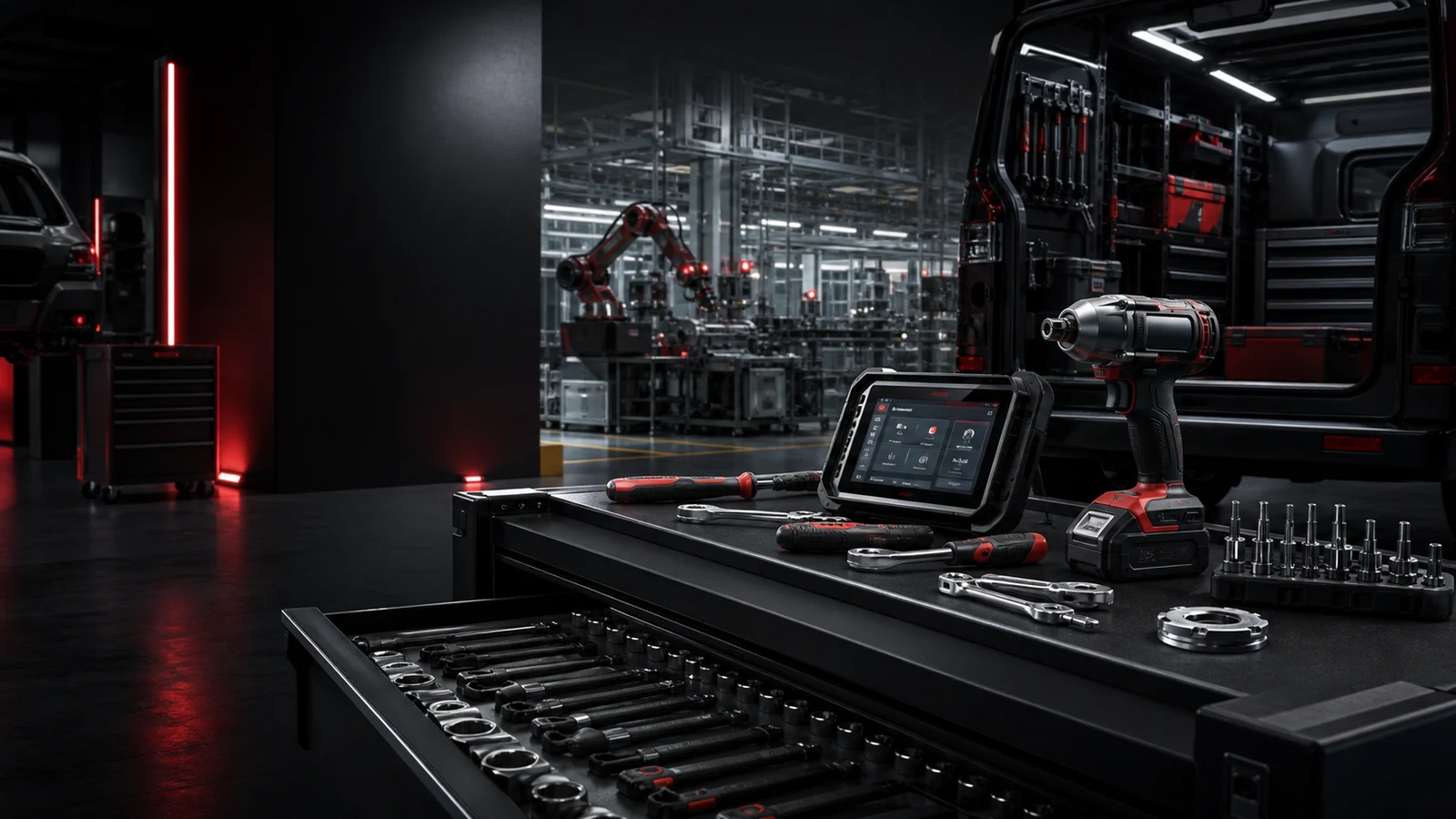
Snap-on Tools is owned by Snap-on Incorporated, an independent publicly traded company. Its common stock trades on the New York Stock Exchange under the ticker SNA. There is no larger tool conglomerate above Snap-on Incorporated in the disclosed corporate structure.
That answer needs two qualifications. First, public ownership means shareholders collectively own the corporation; it does not mean one retailer, franchisee, executive or institutional investor owns the Snap-on brand. Second, the Snap-on group contains many brands, operating companies and factories. The corporate owner is not automatically the manufacturer of every product carrying one of those marks.
Snap-on Ownership at a Glance
| Entity or relationship | Verified role | Important boundary |
|---|---|---|
| Snap-on Incorporated | Public parent company, headquartered in Kenosha, Wisconsin | The parent-company name does not identify the factory for one SKU |
| Snap-on | Principal professional tool, diagnostics and equipment brand | Brand identity is separate from the legal seller and warranty code |
| NYSE: SNA shareholders | Collective owners of the public corporation | Ownership changes through market trading; no retailer owns the company merely by selling its tools |
| Snap-on Tools Company LLC and regional entities | Operating, sales or warranty entities in defined markets | Legal responsibility varies by product and country |
| Snap-on franchisees | Independent mobile-store channel serving professional technicians | A franchisee sells and supports products but does not own the Snap-on corporation |
| Snap-on group brands | Bahco, Williams, Sioux, Mitchell 1, John Bean, Challenger Lifts and other specialist brands | Group ownership does not make every brand, battery or warranty interchangeable |
| Global production network | Company-operated and other qualified production routes across multiple countries | Group-wide plant counts cannot be assigned to a model without product evidence |
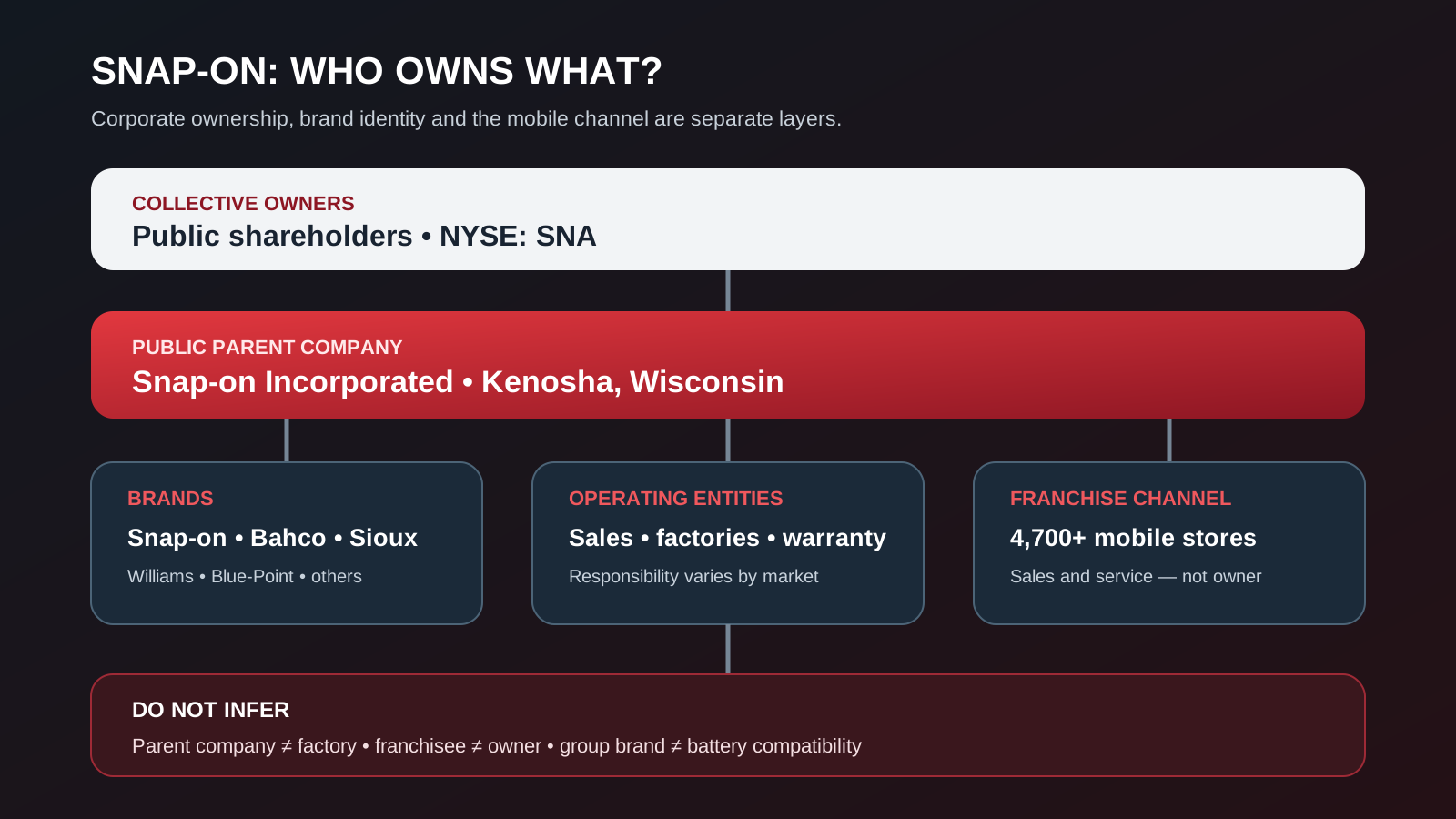
*Snap-on Incorporated owns the brand portfolio; shareholders, operating companies and franchisees have different roles.*
Is Snap-on a Public or Private Company?
Snap-on is a public company. Snap-on Incorporated files reports with the U.S. Securities and Exchange Commission, publishes annual reports and trades as SNA on the NYSE. It is also a constituent of the S&P 500.
This makes Snap-on structurally different from privately controlled tool businesses such as Hilti or STIHL. A public company has outside shareholders, an elected board and securities-reporting obligations. Its shares can be bought and sold without changing the identity of the company itself.
“Publicly traded” should not be shortened to “publicly owned” in the government sense. Snap-on is not a state-owned enterprise. It is a shareholder-owned commercial corporation.
Is Snap-on Owned by Stanley Black & Decker?
No. Stanley Black & Decker owns brands such as DEWALT, CRAFTSMAN and Porter-Cable, but it does not own Snap-on.
The confusion usually comes from portfolio similarity. Both groups sell professional tools, storage and automotive equipment. Their products can appear in the same workshops, and both have acquired specialist brands over time. Competitive overlap is not ownership.
Snap-on also is not owned by Techtronic Industries, Bosch, Chervon, Lowe's or Harbor Freight. Its verified parent is Snap-on Incorporated itself.
Who Founded Snap-on?
Snap-on traces its origin to 1920, when Joseph Johnson and William Seidemann founded the Snap-on Wrench Company in Milwaukee. Their interchangeable socket-and-handle concept let technicians “snap on” different tools, giving the business its name.
The company moved to Kenosha in 1930. That year the Snap-on Wrench Company and Blue-Point Tool Company combined as Snap-on Tools, Inc. The business later expanded beyond hand tools into power tools, storage, diagnostics, shop equipment, repair information and financing.
Founder history explains the brand, but it does not describe current ownership. Today Snap-on Incorporated is the listed corporate parent.
What Brands Does Snap-on Own?
Snap-on operates a broad portfolio rather than one red-tool label. Its official brand directory and annual reporting identify businesses serving automotive repair, aerospace, manufacturing, heavy-duty service and other critical industries.
Examples include:
- Snap-on for professional tools, storage, diagnostics and equipment;
- Blue-Point for selected tools and equipment sold through Snap-on channels;
- Bahco for professional hand tools, cutting tools and landscaping applications;
- Williams for industrial hand tools;
- Sioux for pneumatic power tools;
- ATI for aviation tooling;
- CDI, Norbar, Mountz and Sturtevant Richmont for torque products;
- John Bean, Hofmann, Challenger Lifts and Car-O-Liner for shop and vehicle-service equipment; and
- Mitchell 1, NEXIQ, Dealer-FX and other software businesses for diagnostics, repair information and workflow systems.
This list shows why “Who owns Snap-on?” and “Who made this product?” are different questions. A Bahco saw, a Sioux grinder and a Snap-on cordless impact may come from different business units and factories while sharing the same listed parent.
Who Manufactures Snap-on Tools?
Snap-on manufactures many products inside its own global network, and it also uses qualified external suppliers for selected products and components.
The company says it generally manufactures in the markets where it sells. Its current global-presence page lists 15 manufacturing facilities in the United States and 21 outside the United States. The non-U.S. locations span Argentina, Brazil, China, England, France, Hungary, Italy, Portugal, Spain and Sweden.
Company-operated manufacturing is visible at the brand level. Snap-on says Sioux pneumatic tools are made from raw materials through final assembly at its Murphy, North Carolina facility. It says the vast majority of Bahco products are manufactured in the group's own European factories.
Those examples do not prove that every Snap-on-branded wrench, storage unit, diagnostic device, battery or accessory is made by the same facility. The correct answer is a mixed, product-specific manufacturing system.
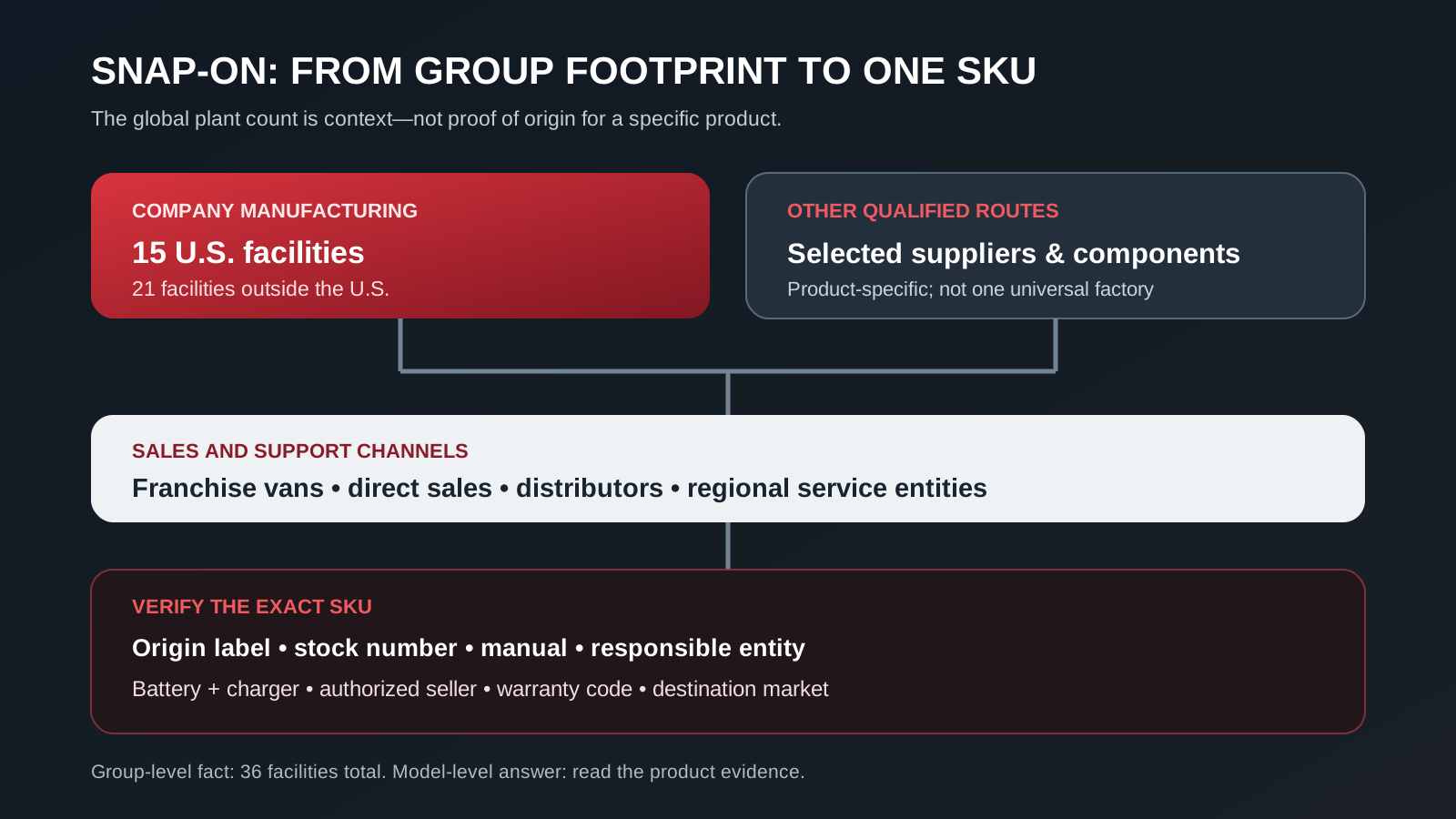
*The group has factories around the world, but the model label, documentation and seller determine the usable answer.*
Where Are Snap-on Tools Made?
Snap-on tools are made in multiple countries. The United States is an important manufacturing base, with company facilities in locations including Kenosha and Milwaukee, Wisconsin; Elizabethton, Tennessee; Murphy, North Carolina; Conway, Arkansas; and other sites.
The company also owns manufacturing operations outside the United States. Its European portfolio in particular includes long-established production capabilities for hand tools, torque systems and vehicle-service equipment. China is part of the group footprint as well.
Do not infer origin from brand color, catalog placement or the location of a franchise van. For a specific product, verify:
- country-of-origin marking on the product and package;
- manufacturer, importer or responsible party in the manual;
- exact stock number and revision;
- applicable conformity declaration;
- seller and distribution channel; and
- product-specific warranty code.
A phrase such as “Snap-on has 15 U.S. factories” is true at the group level but incomplete as a model-origin answer.
How Does the Snap-on Franchise Van Model Work?
Snap-on's mobile-store network is central to the brand's position with professional vehicle technicians. Authorized franchisees travel established routes, bring tools to workplaces, demonstrate products, handle orders and support customer relationships.
Snap-on reported more than 4,700 mobile stores worldwide and more than 3,400 franchise vans in the United States in its current company profile. The broader group also sells directly and through distributors, depending on the customer and product line.
A franchisee is not simply a delivery driver, but neither is the franchisee the corporate owner. The franchise route combines local sales, customer knowledge, credit relationships and service access under agreements with Snap-on.
For buyers, channel identity matters. Tools bought from an authorized franchisee or approved company channel have a clearer route for warranty information, returns and product support than goods with uncertain resale history.
Does Snap-on Make Cordless Power Tools?
Yes. Snap-on markets cordless impacts, ratchets, drills, screwdrivers, lights and other products for professional service work.
The company's official cordless-tool material identifies 18V lithium and 14.4V MicroLithium platforms. These are separate voltage families with different battery interfaces and product purposes. A matching color and brand do not make two battery systems compatible.
Battery compatibility should be checked by exact battery, charger and tool numbers. Snap-on group ownership also does not make a Snap-on battery compatible with a Sioux, Bahco or another group-brand product unless official documentation explicitly says so.
Cross-border purchasing adds charger voltage, plug, radio certification and warranty questions. The safest system description is the one printed in the manual for that market.
Snap-on in Shop Equipment and Cleaning Workflows
Snap-on's closest cleaning-industry connection is the professional workshop. Vehicle-service facilities need extraction, parts cleaning, fluid handling, surface preparation and continuous housekeeping around diagnostic and repair operations.
Snap-on's portfolio includes shop equipment, air-conditioning service machines, collision-repair systems, storage and asset control. These products sit alongside, rather than replace, dedicated commercial vacuums, dust extractors or floor-care machines.
Procurement teams should treat the workshop as a system. Tool storage, cordless platforms, vehicle lifts, diagnostics, extraction and cleaning equipment may have different manufacturers, service providers and compliance requirements even when purchased through the same account.
How Does the Snap-on Warranty Work?
Snap-on does not offer one universal lifetime warranty for every product.
Its current U.S. professional-use terms say the warranty duration depends on the nature of the product and the warranty code assigned to it. Products purchased from authorized Snap-on distribution channels are covered against defects in workmanship and materials for the applicable period. Batteries, electronic components, chargers, diagnostics and consumables may carry separate terms.
That distinction matters because the familiar lifetime-warranty reputation associated with selected hand tools should not be applied automatically to power tools, batteries, electronics, storage, diagnostics or shop equipment.
Before purchase, record the product's warranty code, duration, authorized seller, original-customer requirement and exclusions. Regional entities publish different consumer-law wording, so U.S. terms should not be presented as worldwide coverage.
What Buyers and Distributors Should Verify
For a defensible Snap-on purchase or sourcing record, verify:
- Corporate owner: Snap-on Incorporated.
- Brand: Snap-on, Blue-Point, Bahco, Sioux or another group identity.
- Legal seller: Franchisee, company entity or authorized distributor.
- Exact product: Stock number, model, revision and kit contents.
- Origin: Product and package markings, not group headquarters.
- Factory claim: Model-level evidence rather than a corporate plant list.
- Battery system: Exact voltage family, battery and charger.
- Warranty: Code, duration, user type and exclusions.
- Service route: Franchisee, regional service center or specialist business.
- Cross-border support: Voltage, certification, software region and parts availability.
Frequently Asked Questions
Who owns Snap-on Tools today?
Snap-on Incorporated owns the Snap-on brand and group. It is an independent public company traded on the NYSE under SNA.
Is Snap-on owned by Stanley Black & Decker?
No. Snap-on and Stanley Black & Decker are separate publicly traded companies.
Is Snap-on a U.S. company?
Yes. Snap-on Incorporated is headquartered in Kenosha, Wisconsin, and was founded in Milwaukee in 1920. It also operates globally.
Are all Snap-on tools made in the USA?
No. Snap-on has substantial U.S. manufacturing and also operates factories in other countries. Check the exact product's origin label.
Does Snap-on own Bahco?
Yes. Bahco is part of the Snap-on group following Snap-on's 1999 acquisition of Sandvik Saws and Tools.
Are Snap-on franchisees company employees?
The mobile stores are generally operated through Snap-on's franchise system. The franchisee is an authorized independent business, not the corporate owner.
Are Snap-on 18V and 14.4V batteries interchangeable?
Do not assume so. They are separately documented cordless families and must be matched by exact tool, battery and charger number.
Do all Snap-on tools have a lifetime warranty?
No. Warranty duration depends on the product and warranty code. Batteries, electronics, power tools and diagnostics can have different coverage.
Final Answer
Snap-on Tools is owned by Snap-on Incorporated, an independent NYSE-listed company. Public shareholders collectively own the corporation; Stanley Black & Decker, TTI and other tool groups do not.
Snap-on combines a large brand portfolio, company manufacturing in the United States and other countries, qualified supply relationships and a distinctive mobile franchise channel. Those layers must remain separate. For a specific product, verify the brand, model, country of origin, battery family, authorized seller and warranty code rather than relying on the parent-company name alone.
Official Sources
- Snap-on: Investors and NYSE company profile
- Snap-on: 2025 Annual Report
- Snap-on: Company history
- Snap-on: Global manufacturing presence
- Snap-on: Group brand portfolio
- Snap-on: Cordless tool platforms
- Snap-on: U.S. terms and professional-use warranty