- BLACK+DECKER and STANLEY are sibling brands owned at group level by Stanley Black & Decker, Inc., a U.S. public company listed on the NYSE as SWK.
- The present group was created when The Stanley Works and The Black & Decker Corporation completed their merger on March 12, 2010; the commercial brands are not separate parent companies.
- Group ownership does not prove who manufactured, imported, sold or warrants a particular product. Buyers must verify the exact SKU, market and dated product documents.
In this article 14 sections
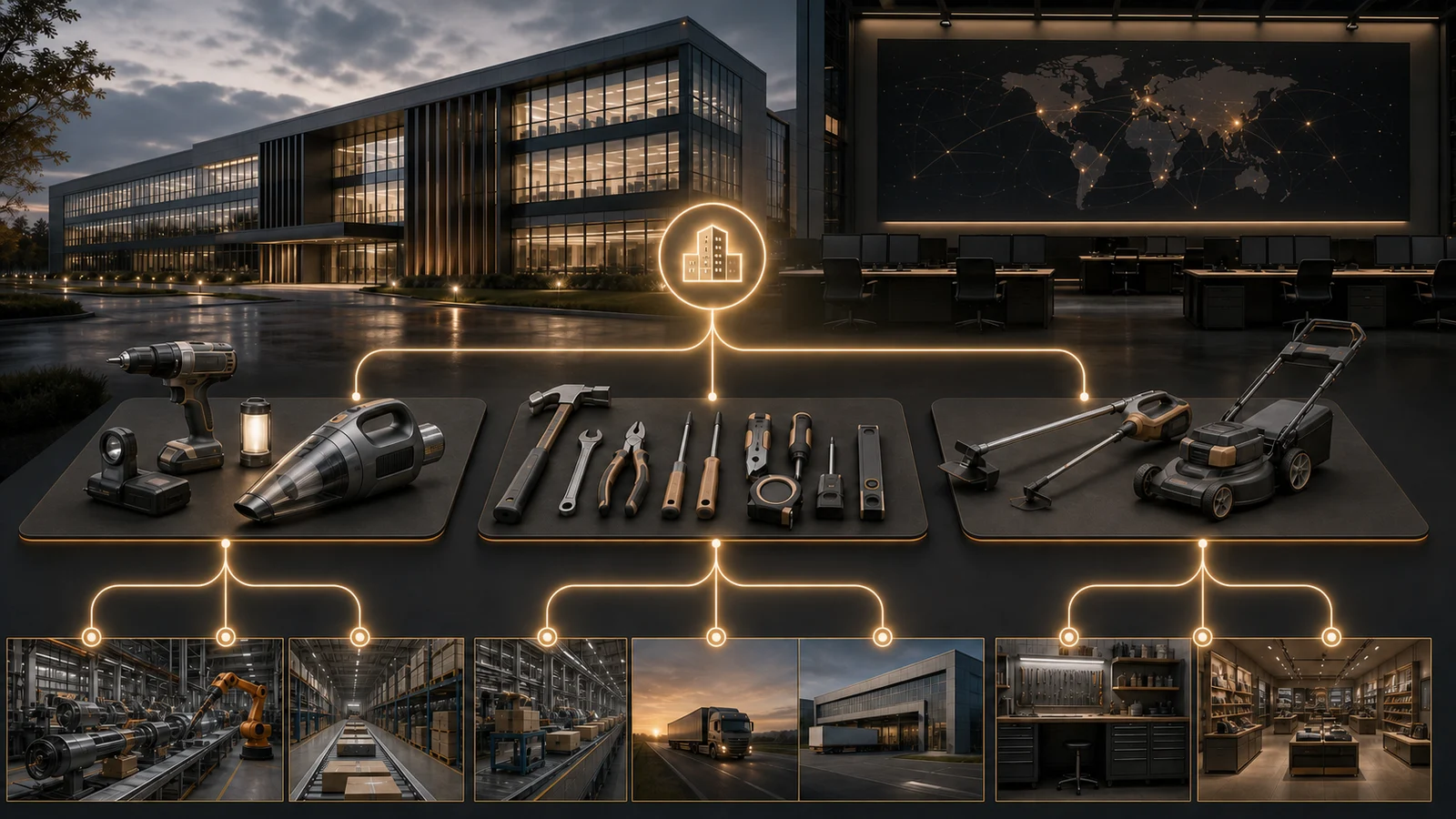
BLACK+DECKER and STANLEY tools are owned at group level by Stanley Black & Decker, Inc. The Connecticut-based company is publicly traded on the New York Stock Exchange under the symbol SWK. BLACK+DECKER and STANLEY are sibling brands in its portfolio; neither brand owns the other.
The current company structure dates to March 12, 2010, when The Stanley Works completed its merger with The Black & Decker Corporation and changed the combined company's name to Stanley Black & Decker, Inc. DEWALT, CRAFTSMAN and several outdoor-equipment brands also sit in this group.
That answers the ownership query, but not every product-responsibility question. The parent group, trademark registrant, regional seller, importer, manufacturer, factory and warranty provider may be different legal entities. For sourcing, distribution or repair decisions, the exact model and country still matter.
Ownership at a Glance
| Name | What it is | What it is not |
|---|---|---|
| Stanley Black & Decker, Inc. | Public parent group; NYSE: SWK | Not necessarily the legal seller or factory named for every SKU |
| BLACK+DECKER | Consumer-facing brand spanning tools, outdoor products, vacuums and home products | Not a separate parent of STANLEY or DEWALT |
| STANLEY | Long-established hand-tool, measuring and storage brand | Not the same thing as the listed parent company |
| The Black & Decker Corporation | Historical merger party and a legal name that may appear in records | Not interchangeable with the BLACK+DECKER brand on a product |
| The Stanley Works | Historical name of the Stanley company before the 2010 combination | No longer the current listed-company name |
| DEWALT and CRAFTSMAN | Other major brands in the same group | Not subsidiaries of the BLACK+DECKER or STANLEY brands |
| Regional affiliate or licensee | May sell, import, manufacture, distribute or warrant defined products | Does not necessarily own the global brand |
Who Owns BLACK+DECKER?
Stanley Black & Decker owns BLACK+DECKER at the corporate-group level.
The group's official brand portfolio presents BLACK+DECKER alongside STANLEY, DEWALT, CRAFTSMAN and other brands. Its BLACK+DECKER brand profile traces the brand to the Baltimore shop opened by S. Duncan Black and Alonzo G. Decker in 1910 and describes its current scope across power tools, outdoor yard care and home products.
BLACK+DECKER is a commercial brand, not the ultimate public parent. On a product label, website or warranty, a buyer may also see names such as BLACK+DECKER (U.S.) Inc., The Black & Decker Corporation or another regional Stanley Black & Decker affiliate. Those names can identify a specific legal responsibility without changing the group-level owner.
This distinction is particularly relevant in cleaning appliances. BLACK+DECKER currently markets handheld vacuums, stick vacuums, steam mops and related home-cleaning products. The brand name tells a buyer which portfolio the product belongs to; it does not, by itself, prove which factory assembled the unit.
Who Owns Stanley Tools?
STANLEY is also owned by Stanley Black & Decker.
The official STANLEY profile dates the brand to 1843, when Frederick T. Stanley opened a shop in New Britain, Connecticut. Today the brand covers hand tools, measuring products, storage and related equipment.
The word “Stanley” creates two common sources of confusion:
- STANLEY the brand appears on tape measures, knives, hand tools and storage products.
- Stanley Black & Decker, Inc. the company owns a portfolio of brands and reports consolidated financial results.
A STANLEY tape measure and a BLACK+DECKER handheld vacuum can therefore belong to the same public-company group while using different business units, supply chains, sellers and service routes.
How the 2010 Merger Created the Current Group
The ownership chain is easier to understand as a corporate transaction rather than a brand story.
The SEC Form 8-K filed for the transaction states that on March 12, 2010, a wholly owned subsidiary of The Stanley Works merged into The Black & Decker Corporation. Black & Decker continued as the surviving subsidiary, and the parent changed its name to Stanley Black & Decker, Inc.
The company's 2010 filing gives the economic detail: Black & Decker shareholders received 1.275 Stanley shares for each Black & Decker share, and pre-merger Stanley shareholders retained 50.5% of the combined company after the exchange.
It is therefore reasonable to call the event a merger of The Stanley Works and The Black & Decker Corporation. It is misleading to say that the BLACK+DECKER consumer brand bought STANLEY tools or that the STANLEY brand bought BLACK+DECKER.
The legal entities combined. Their brands became part of one larger portfolio.
Who Owns Stanley Black & Decker?
Stanley Black & Decker is owned by its shareholders because it is a public company. It does not disclose another operating corporation as its parent.
The 2025 Form 10-K identifies Stanley Black & Decker, Inc. as a Connecticut corporation and its common stock as traded under SWK. The company's 2026 proxy statement reported two beneficial owners above 5% as of February 25, 2026: The Vanguard Group at 12.0% and Capital Research Group Investors at 7.4%.
Those stakes do not make either investor the operating parent of BLACK+DECKER or STANLEY. Institutional beneficial ownership is a securities-law disclosure. The listed company remains governed through its board, management and shareholder structure.
For due diligence, use “Stanley Black & Decker, Inc. owns the brands” for the corporate relationship and “Stanley Black & Decker's public shareholders own the listed company” for the equity relationship.
Are BLACK+DECKER, STANLEY, DEWALT and CRAFTSMAN the Same Company?
They belong to the same group, but they are not the same brand.
Stanley Black & Decker uses brands to serve different users, price points, product systems and channels:
| Brand | Broad market role | Illustrative categories |
|---|---|---|
| BLACK+DECKER | Homeowner and consumer convenience | DIY tools, outdoor equipment, handheld vacuums, stick vacuums and home products |
| STANLEY | Hand tools, measuring and storage with professional and general users | Tape measures, utility knives, hammers, levels and storage |
| DEWALT | Professional tools and jobsite systems | Power tools, accessories, storage, outdoor products and selected cleaning equipment |
| CRAFTSMAN | Home, garage, automotive and yard | Power tools, hand tools, storage and outdoor products |
The table describes positioning, not a promise of technical separation. Product platforms can share corporate purchasing, components, factories or engineering resources. They can also be completely different.
Common ownership does not establish battery compatibility, accessory compatibility, App interoperability, parts interchangeability or identical warranties. Those claims require model-level evidence.
For the history and responsibility structure of the professional brand, see Who Owns DeWalt?.
Where Does MTD Fit?
Stanley Black & Decker expanded its outdoor portfolio through MTD Holdings.
In December 2021, the company completed the purchase of the remaining 80% of MTD Holdings. The announcement identified MTD brands including Cub Cadet, Troy-Bilt, Robomow, Rover and WOLF-Garten.
MTD is relevant when mapping outdoor-equipment assets, but it did not become the owner of BLACK+DECKER or STANLEY. It became part of the larger Stanley Black & Decker organization.
The same rule applies to every acquisition: identify the acquired business, the brands it brought and the current legal parent. Do not compress the whole portfolio into one manufacturing claim.
Who Manufactures BLACK+DECKER Products?
There is no accurate single-factory answer for the entire brand.
BLACK+DECKER's official support page says the company manufactures tools in the United States, Mexico, Brazil, China and the United Kingdom. That establishes a multi-country manufacturing footprint for the category described by the page. It does not identify the origin of a specific vacuum, steam cleaner, lawn tool or licensed home appliance.
The BLACK+DECKER U.S. terms of use also state that products sold on the site may include licensed products made or distributed by third-party partners. The site's terms of sale distinguish products for which the company is the original manufacturer from products where it is not.
These official disclosures show why two statements can both be true:
- Stanley Black & Decker owns the BLACK+DECKER brand.
- A defined BLACK+DECKER product may be made, distributed or serviced through another authorized company.
The product label, instruction manual, declaration, certification file, recall notice and warranty are stronger evidence than a generic search result about where the brand is made.
Who Manufactures STANLEY Tools?
STANLEY products also come through a global operating and supply network.
Stanley Black & Decker's U.S. manufacturing page documents examples of products made at American facilities using global materials. It says that a Sedalia, Missouri facility produces toolboxes under the DEWALT, CRAFTSMAN and STANLEY brands, while other U.S. facilities make blades and industrial products.
That is useful evidence for the products and facilities named. It should not be generalized into “all STANLEY tools are made in the USA.” A tape measure, knife, level, storage product or licensed item may have a different origin and responsible company.
Country of origin is a product attribute, not a permanent attribute of a global brand. It can change when a SKU, supplier, production line or sourcing period changes.
Ownership, Trademark, Seller and Factory Are Different
For B2B procurement, separate at least seven roles:
- Public parent: the group consolidating the business and controlling the portfolio.
- Trademark owner: the legal entity registered for a mark in a country and product class.
- Brand operator: the team deciding positioning, range and marketing.
- Seller of record: the company on the quote, invoice or e-commerce terms.
- Importer or responsible person: the entity taking market-access duties in the destination.
- Manufacturer and factory: the company and physical site responsible for making the product.
- Warranty or service provider: the company responsible for repair, replacement and parts.
One Stanley Black & Decker affiliate can hold several of these roles. A licensee, contract manufacturer, distributor or retailer can hold another. The correct answer must come from the relevant document, not the logo alone.
What Ownership Means for Distributors and Buyers
The group structure offers scale, brand recognition and a broad portfolio, but it does not remove SKU-level work.
For an authorized distributor, group ownership helps identify the correct corporate family and escalation route. The group's contact page sends users to separate support channels for BLACK+DECKER, STANLEY, DEWALT, CRAFTSMAN and other brands. Separate support routes are a practical reminder that a portfolio is not one universal warranty system.
For a sourcing team, the name of the public parent is only the first field in a supplier map. Ask which affiliate signs the agreement, who controls the tooling and technical file, which factory is approved for the SKU, and who pays for recalls and warranty freight.
For marketplaces and repair businesses, authorized-seller status matters. BLACK+DECKER's U.S. warranty language says coverage can depend on purchase from BLACK+DECKER or an authorized seller. Record seller authorization rather than assuming every listing has the same after-sales route.
Model-Level Due-Diligence Checklist
Before making a claim or placing an order, capture:
- exact brand, model, type number, voltage and date code;
- target country and sales channel;
- trademark owner for the relevant jurisdiction and product class;
- contracting and invoicing legal entity;
- authorized distributor or seller evidence;
- manufacturer name and physical factory address;
- country-of-origin marking and the production period it covers;
- importer, EU economic operator or other local responsible entity where applicable;
- declaration, certification and test-report holder;
- battery, charger, radio and accessory variants;
- warranty provider, duration and commercial-use exclusions;
- spare-parts source, repair network and recall responsibility.
If a supplier cites the Stanley Black & Decker portfolio as proof of authorization, request the license, authorization letter or purchase-order chain covering the exact product. A customer logo on a presentation is not enough.
Frequently Asked Questions
Who owns BLACK+DECKER?
Stanley Black & Decker, Inc. owns BLACK+DECKER at the group level. Stanley Black & Decker is a public U.S. company listed on the New York Stock Exchange as SWK.
Who owns Stanley Tools?
STANLEY tools belong to the Stanley Black & Decker brand portfolio. STANLEY is a brand; Stanley Black & Decker, Inc. is the listed parent company.
Did Stanley buy Black & Decker?
The precise answer is that The Stanley Works and The Black & Decker Corporation completed a stock-based merger in 2010. A Stanley subsidiary merged into Black & Decker, Black & Decker became a wholly owned subsidiary, and the parent was renamed Stanley Black & Decker, Inc.
Does BLACK+DECKER own DEWALT?
No, not as a standalone consumer brand. BLACK+DECKER and DEWALT are sibling brands owned by Stanley Black & Decker. Black & Decker acquired DeWalt historically, which is the source of the confusion.
Is STANLEY the same as Stanley Black & Decker?
No. STANLEY is one brand within the group. Stanley Black & Decker, Inc. is the parent company that also owns BLACK+DECKER, DEWALT, CRAFTSMAN and other brands.
Is Craftsman owned by Black and Decker?
CRAFTSMAN is owned by Stanley Black & Decker. It is a sibling brand of BLACK+DECKER, not a subsidiary of the BLACK+DECKER brand.
Where are BLACK+DECKER products made?
The brand uses a multi-country manufacturing and supply network. An official support page names the United States, Mexico, Brazil, China and the United Kingdom for tools, while official terms also acknowledge licensed third-party products. Check the exact SKU label and product documents.
Are all Stanley tools made in the USA?
No. Stanley Black & Decker documents some U.S. production using global materials, but the global product range cannot be assigned one country of origin. Verify each model and production period.
Does the same company provide every BLACK+DECKER warranty?
Do not assume so. Warranty entity, duration, commercial-use limits and authorized-seller rules can differ by product and country. Use the warranty supplied with the exact product.
Final Answer
BLACK+DECKER and STANLEY are both owned by Stanley Black & Decker, Inc. The current public group was formed through the 2010 merger of The Stanley Works and The Black & Decker Corporation. DEWALT and CRAFTSMAN are sibling brands in the same portfolio.
For an ownership search, that is the direct answer. For procurement, compliance, distribution or repair, continue to the model level: identify the trademark entity, seller, importer, manufacturer, factory and warranty provider for the exact SKU and market. Corporate ownership explains the portfolio; product documents establish responsibility.