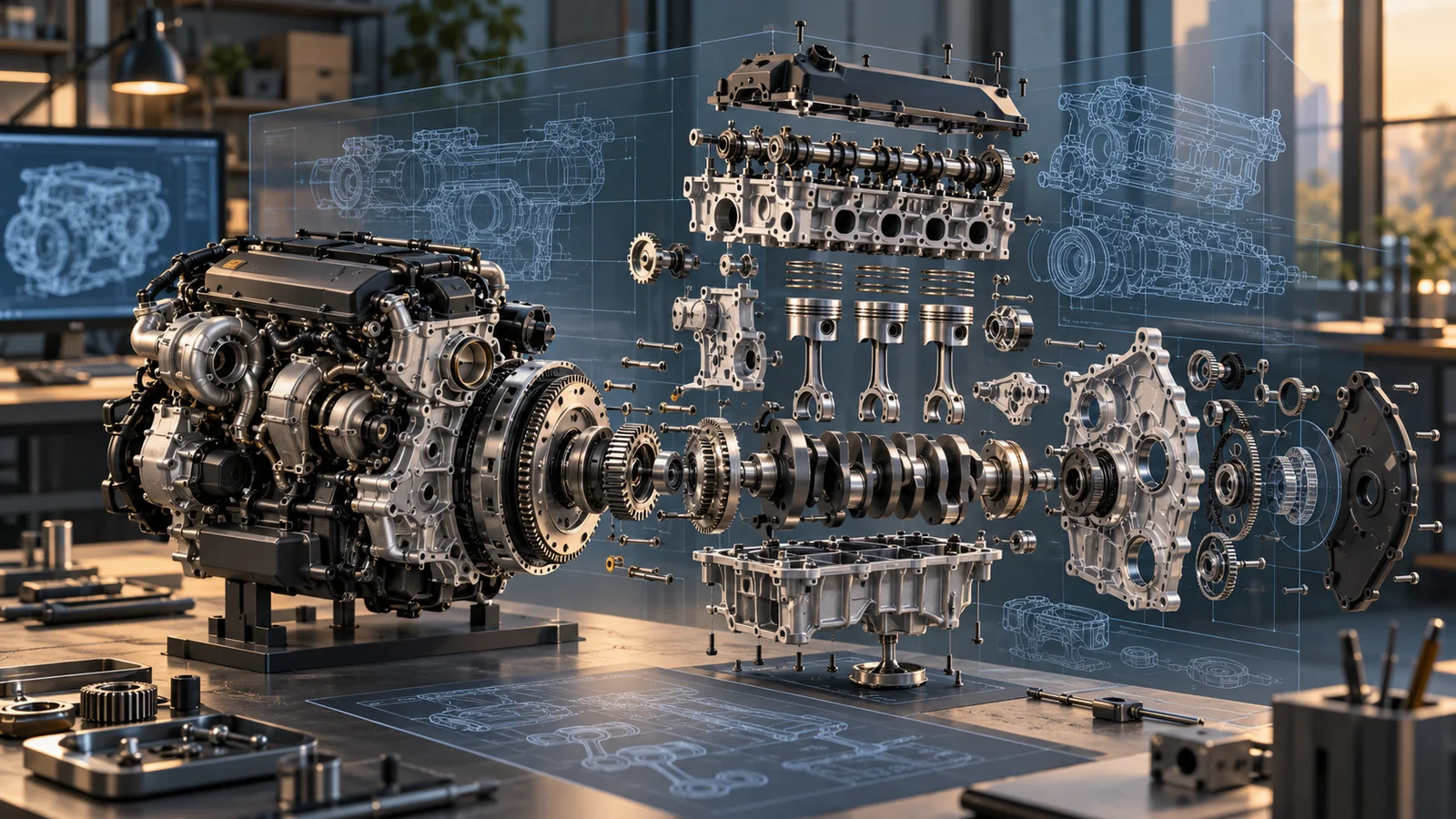
- Skyfall's research preview shows a model breaking product images into components and visual construction steps.
- The company's CAD benchmark reports results for individual components, not a complete engine.
- Editable CAD operations and manufacturing validation remain important next steps.
Can AI look at a picture of an engine and work out its internal structure?
On October 19, Skyfall AI released a research preview of SKY-001, an engineering world model. In one company demonstration, the model starts with an image, generates a rough shape of an engine, then breaks it down into assemblies and parts and shows how those parts could be constructed.
Skyfall has also demonstrated cars, robotic arms and tractors. For companies that develop physical products, the demonstrations raise a question: how much could AI change the way engineers work?
*Concept illustration; not an image from Skyfall's demonstration.*
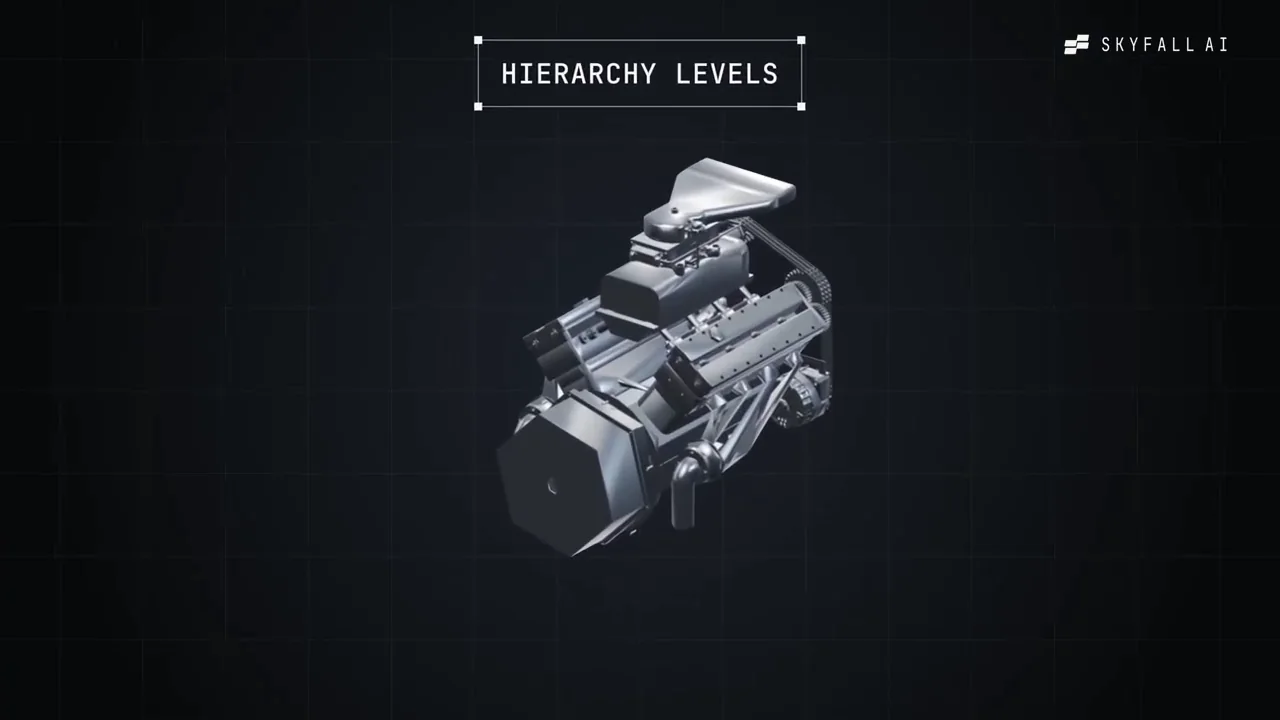
*Engine model shown in the SKY-001 launch film. Source: Skyfall AI / Flowjam.*
This is not the founding team's first venture. Skyfall's Sam Pasupalak and Kaheer Suleman previously co-founded the artificial intelligence company Maluuba, which Microsoft later acquired. This time, they have turned their attention to engineering design.

*Sam Pasupalak in the SKY-001 launch film. Source: Skyfall AI / Flowjam.*
AI can already write, make images and generate code. Designing a physical machine takes more than a convincing rendering. Every part needs a shape and a place, and the parts have to fit together.
Consider a floor washer. Its housing contains a battery, motor, water tanks, air channels and control board. Make a tank larger, and the battery may need a new position. Make the body thinner, and the air path and dirty-water system may need to change as well.
Engineers work through these trade-offs throughout development. SKY-001 attempts to handle a design process built around that kind of hierarchy and spatial relationship.
In Skyfall's demonstration, the model starts with a product image and generates a rough overall shape. It then divides that shape into larger assemblies, breaking those down again until it reaches individual parts. For each part, the model shows intermediate construction steps, from sketches to three-dimensional forms.
It is a little like taking a machine apart and then working out how each piece should be drawn. Skyfall wants AI to take on more of the decomposition and planning, helping engineers reach design options faster.
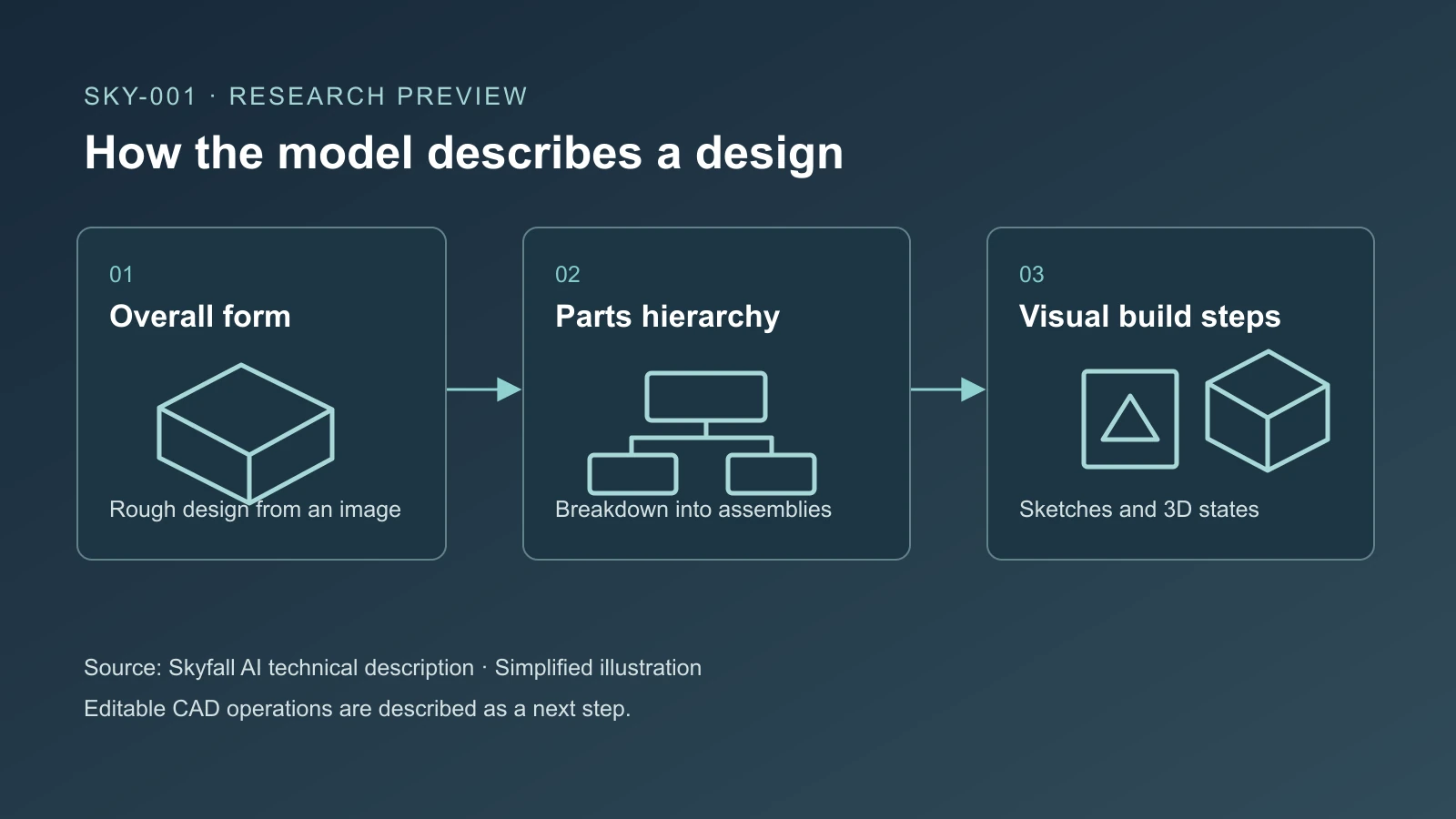
*Simplified diagram based on Skyfall's research description; not an actual SKY-001 screenshot.*
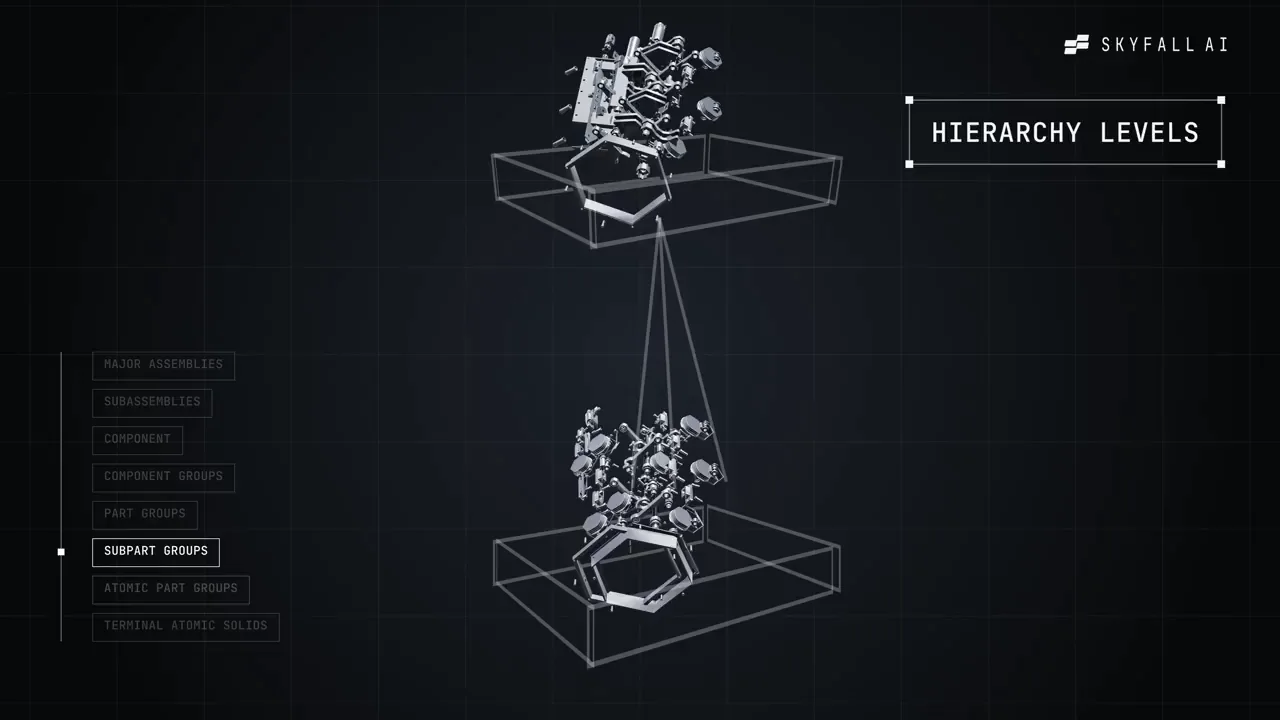
*The launch film illustrates hierarchical engine decomposition. Source: Skyfall AI / Flowjam.*
Skyfall has published results from its own tests. In its CAD construction benchmark, researchers selected 1,000 components from complex objects including cars, robotic arms, helicopters and engines. SKY-001 took an average of 3.9 seconds and cost $0.005 per test case. GPT-6 Astra took 199 seconds and cost $0.75 per case in the same comparison.
On those figures, SKY-001 was about 51 times faster and cost about one 150th as much for the tested task.
The company also measured how closely the generated geometry overlapped the reference shape. SKY-001 scored 79.7% on average, compared with 79.1% for GPT-6 Astra. These are Skyfall's own test results. The overlap measure concerns geometry, and the 3.9 seconds refers to one component-construction case, not the time needed to design an entire engine from an image. Skyfall research
For manufacturers, the appeal is the possibility of accelerating the early stages of development.
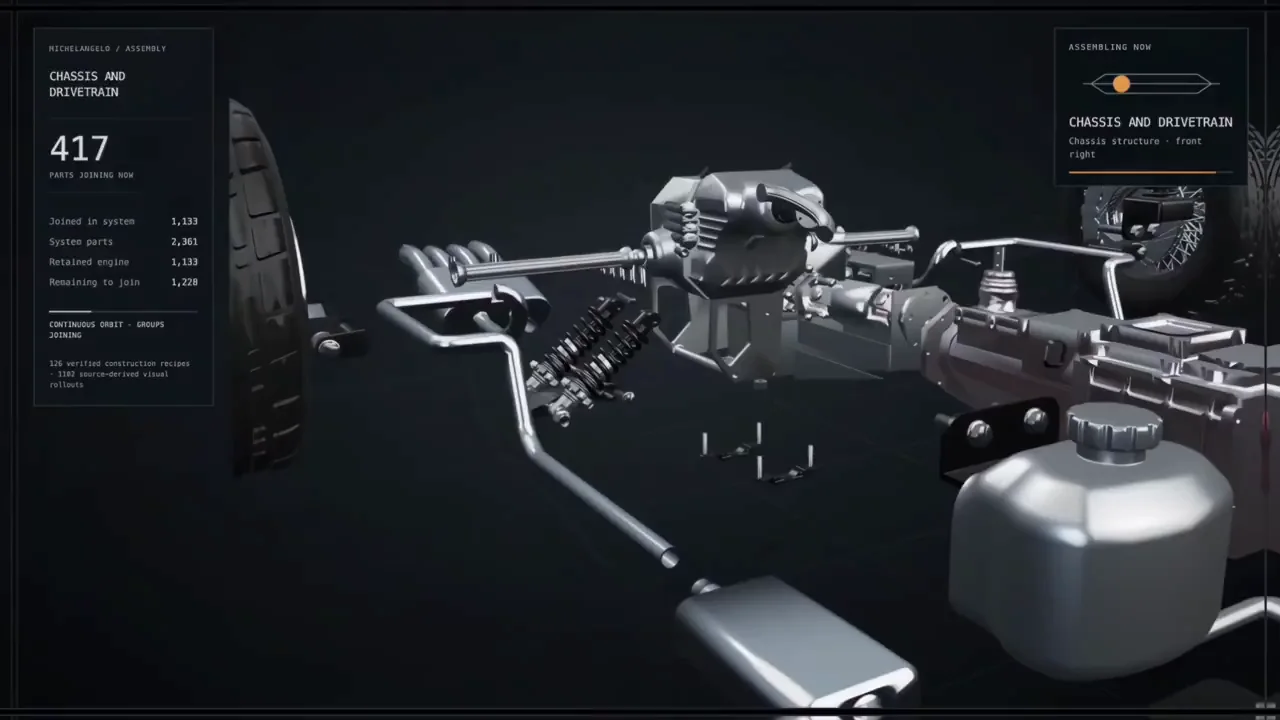
*Vehicle assembly visual from the SKY-001 launch film. Source: Skyfall AI / Flowjam.*
Imagine a cleaning-appliance company preparing a new floor washer. If AI could rapidly generate several structural options from the target dimensions and desired functions, the development team might be able to assess the space needed for the tanks, roller and body earlier, then choose which direction to develop.
A component supplier might also be able to show customers different structural options more quickly. Some of the early drawing and discussion could eventually be assisted by AI.
For now, those are potential applications. SKY-001's public demonstrations focus on design decomposition and visual construction sequences. In its technical explanation, the company lists turning sketch sequences into executable CAD operations with editable feature histories as work still to come.
There is also a limit to reconstructing an internal structure from an external image. For the parts the picture does not show, the model can generate a plausible option based on what it has learned. Engineers still need to check the dimensions, connections and hidden components.
A cleaning appliance must then go through prototyping, testing and production. Whether a tank leaks, whether a plastic part can be moulded and whether the machine remains reliable after prolonged use still have to be resolved through engineering work.
If AI can shorten the early modelling and concept-exploration stage, however, development teams may have more time for those questions. For manufacturers and brands running several projects at once, that could change the pace of product development.
SKY-001 remains in research preview, with an early-access waitlist on its website. Skyfall has said it is targeting full commercial deployment in early 2027. Skyfall announcement
The next test is whether it can enter the software engineers use every day, produce designs they can continue to edit, and ultimately stand up to prototyping and production.