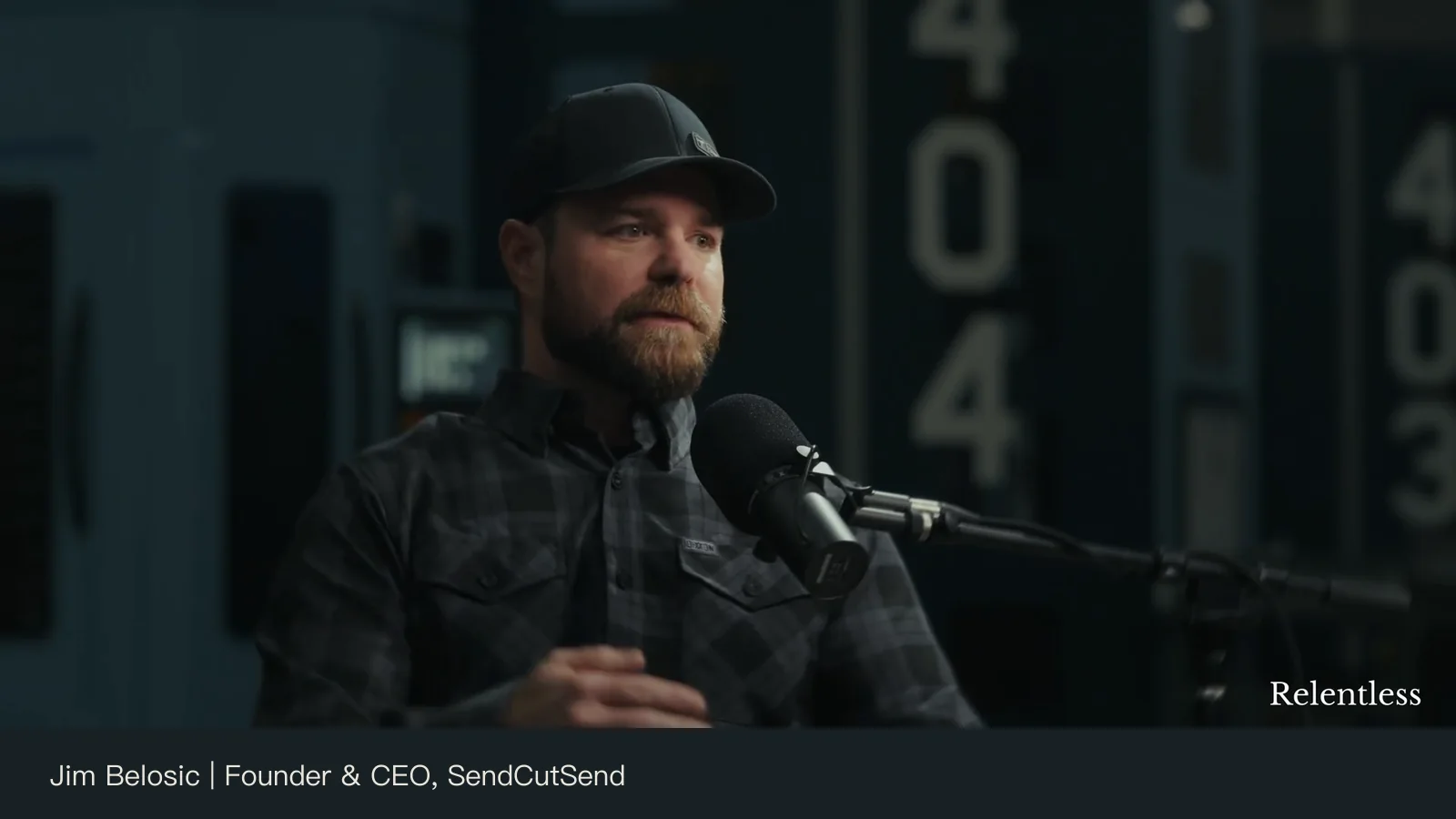
- In the May 2026 interview, Belosic said roughly 20–25% of SendCutSend’s parts could match or beat Chinese pricing.
- The approximately $110 million funding round is intended to bring capacity online faster.
- Electrical infrastructure, training and spare capacity shape how quickly the company can deliver.
A sign in SendCutSend’s factory reads: “3 p.m. is the new midnight.”
The US custom-parts manufacturer had run into a problem. An order was due to ship on a particular day. Employees finished it that evening and considered the deadline met. But the truck had already left. The parts were still in the factory.
Founder and CEO Jim Belosic would not accept that definition of done. Once a shipping label had been printed, customers were left watching a tracking status that went nowhere. Under his rule, orders due that day had to make the 3 p.m. truck.
As orders grew, telling employees to catch the truck was no longer enough.
In a Relentless interview released in May 2026, Belosic discussed the roughly $110 million the company had just raised. The money was meant to close a widening gap between incoming demand and the speed at which SendCutSend could add capacity.
SendCutSend makes parts from customers’ designs, offering metal cutting, bending and CNC machining. It began with prototypes and garage hobbyists, then increasingly took on production orders from large companies. By the time of the interview, Belosic said, large businesses accounted for roughly 90% of its business.
A big order could once put him in a difficult position. If one customer tied up equipment for a month, delivery times for thousands of others could suffer. The company needed more capacity to serve them all.
That is why scale comes first when Belosic considers whether American manufacturing can compete with China. He said roughly 20–25% of the company’s parts could already match or beat Chinese prices. He wanted to bring that share to 100%.
The American manufacturing industry he describes is fragmented across small companies. Individual shops have limited purchasing power and a limited range of processes. He wants to pool orders, buy materials in larger quantities and bring more production steps into his own operation.
Could a purchase of raw material grow from 100 tons to 1,000 tons, or more? Larger orders could reduce the number of times a supplier had to start and stop its line, as well as create room to negotiate. A few cents saved per pound could eventually change the price of a part. Lower manufacturing costs would, in turn, give customers room to grow their own businesses.
His view of automation is pragmatic. The factory combines semi-automated equipment with manual work. He is willing to use robots where they fit and retain people where they are needed. Higher-paid employees also contribute by taking the initiative to improve processes. Equipment has to work alongside those people for efficiency to keep improving.
None of this will sound unfamiliar to people in Chinese manufacturing. Consolidating purchases, reducing subcontracting and improving equipment utilization are everyday factory concerns. SendCutSend wants to organize those capabilities into a service that American customers can easily use, with fast local delivery.
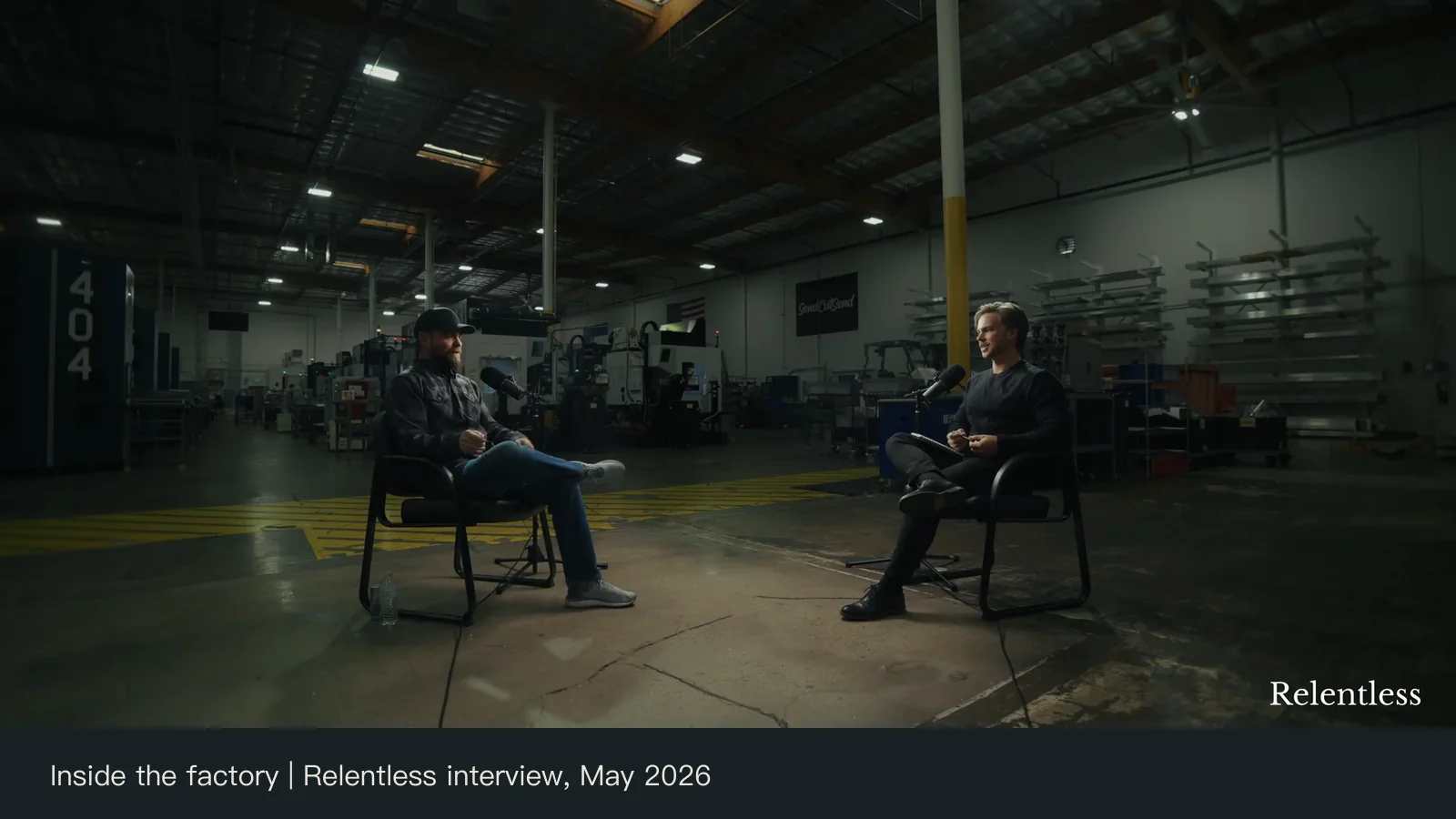
*The interview was recorded on the factory floor. Frame from Relentless, “Jim Belosic × SendCutSend Round II.”*
Belosic previously ran a software company and enjoys modifying cars. Mechanical problems appeal to him; his approach to financing a company is decidedly traditional. He compares the business to a lemonade stand: spend 50 cents on ingredients, sell the lemonade for a dollar and put the earnings into the next batch.
For roughly its first eight years, SendCutSend expanded mainly through operating cash and loans, with some smaller amounts of outside funding. Belosic did not start by raising a large sum, building a factory and waiting for orders. He preferred to find customers, establish the business and add equipment along the way.
That approach gave him control. It also limited the pace of expansion. An early facility might have cost $1 million, he said; a large facility later on could require about $50 million. Retained earnings could still fund growth, but he had become increasingly impatient with the wait.
Loans also had their limits. Banks would finance machines. Expanding a software team or funding research with an uncertain outcome was harder to finance the same way. When demand outgrew the budget, the factory could lengthen lead times, raise prices or turn work away.
All three options threatened a business he had spent years building. Customers chose SendCutSend in large part because it was fast. Belosic said he had begun to feel that he was letting them down, which led him to accept outside investment.
He said he gave up roughly 10% of the equity in the round. With customers and a track record already in place, he could raise money while retaining control. Raising it earlier might have required him to surrender a much larger stake.
He described the capital as a “time machine”: goals that would have taken five to eight years could, he hoped, be reached in eighteen to twenty-four months.
Money could speed up equipment purchases. Getting a building ready for production still meant solving one problem after another. The previous year’s expansion had already taught him some expensive lessons.
The Reno area, where he was based, had plenty of large buildings. Many, however, had been designed for logistics. A warehouse needed floor space, but its electrical service might be sized for lighting and charging forklifts. Filling it with machining equipment changed the requirements.
Belosic described a factory the company had occupied for about a year. After adding CNC machines, the team discovered that compressed-air demand was higher than expected and another compressor was needed. By his estimate, that compressor would require as much electrical capacity as four CNC machines. The equipment expansion plan had to be reconsidered against the power available.
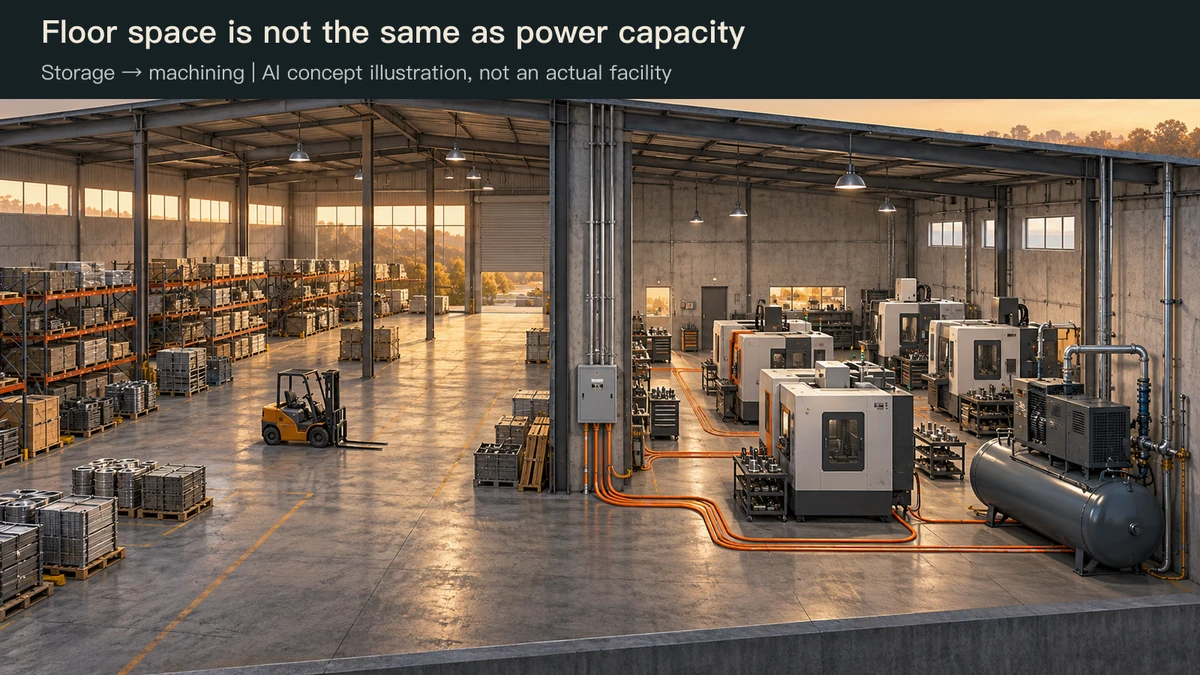
*AI concept illustration of the infrastructure problem described in the interview; not a depiction of a SendCutSend facility or an engineering plan.*
Electricians had schedules of their own. While the company negotiated equipment prices and arranged installation technicians, the electrician who knew the factory might be booked six weeks out. Someone else could take the job, but would first have to learn the equipment.
Those experiences began to influence site selection. Belosic paid more attention to areas with an established manufacturing base and better power infrastructure. He also wanted factories closer to customers. A single enormous plant would still leave parts facing days of ground shipping between the two US coasts.
Multiple sites could share the burden when something went wrong. If a winter storm in Reno stopped trucks from crossing the mountain passes, a factory elsewhere could take over some orders. The delivery promise was gradually pushing SendCutSend toward a distributed manufacturing network.
To get plants open sooner, Belosic sometimes took risks before everything was settled. At the time of the interview, the company was negotiating for a 150,000-square-foot site. The lease had not been signed, but equipment had already been ordered for the planned layout, and electrical work and hiring were being lined up.
Opening a month earlier, he reasoned, would bring the subsequent production ramp forward too. He kept alternative buildings in mind so that the equipment would have somewhere to go if the lease fell through.
Training people was harder to accelerate than buying equipment or finding a building.
The company was approaching 500 employees. Belosic could now walk into a factory on a weekend and meet new hires who did not recognize him. He could no longer check every process himself. When a new site opened, he and other leaders took turns working there, passing the company’s habits on to the local team.
Even hiring 200 people in a day would not produce the training capacity needed to put them straight to work. The company needed classrooms and equipment dedicated to instruction. Experienced employees had to make time to train recruits without bringing existing production to a halt.
New sites also created opportunities for those employees. Management positions that might never open up in a single shop became available as new facilities came online. Some people would spend a few weeks in another state; others might become a new plant’s leader.
One habit Belosic wanted to carry across those sites was spending time with customers.
He gave an example: an engineer taking another look at a design might find that shortening one dimension by half an inch would allow more parts to fit on a sheet of metal, substantially reducing the quote. During busy periods, it was difficult to give every customer that kind of attention.
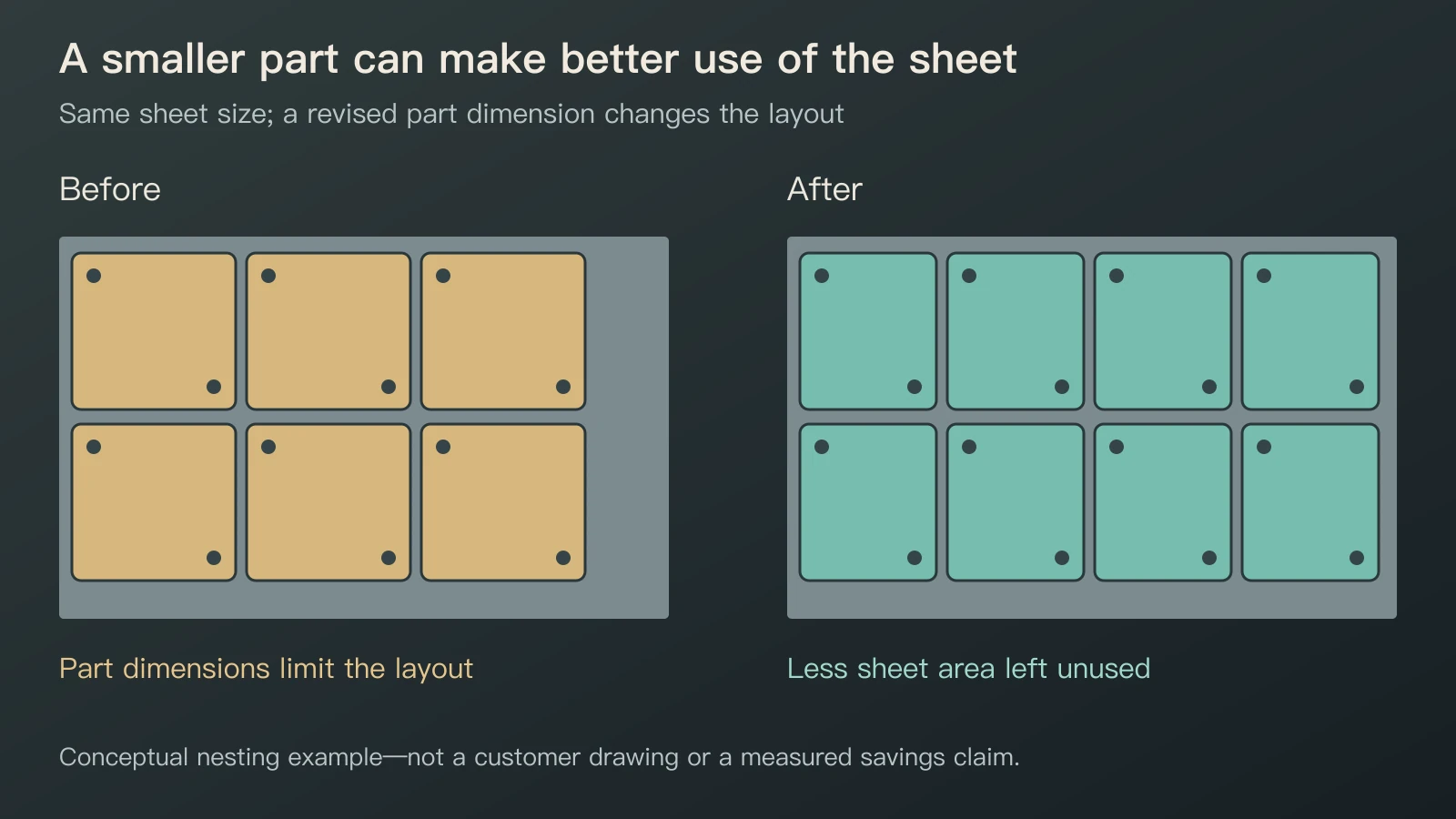
*Conceptual layouts, not a customer drawing or a measured savings claim.*
He was willing to hire more people for that work, even when an engineer’s time might not pay for itself on a single order. Helping the customer get a project made mattered enough.
That sat comfortably alongside his frugality. The company bought equipment on secondhand marketplaces, yet he would pay for overnight shipping or have an engineer help a student building a race car. After raising money, he wanted to retain the freedom to make those decisions.
The way customers created designs was changing too. The team had experimented with letting a customer describe a bracket in natural language and using a large language model to generate a CAD file. Belosic wanted to open up the company’s manufacturability rules and production capabilities so that outside developers could build tools, with SendCutSend making the resulting parts.
The company he imagined increasingly resembled a Home Depot for manufacturing. A customer would not need to know a factory owner to walk in with a project and find out what could be made and what it would cost. Hobbyists and corporate buyers could use the same manufacturing service.
I think SendCutSend’s competitiveness needs to be considered in the context of the customer’s entire project. A company rushing to revise a prototype or validate a design cannot move ahead until the parts arrive. A local factory that keeps prices under control while cutting the wait has a chance of winning that work.
Belosic still faced an unresolved tension. Fast delivery required spare capacity, but idle machines continued to depreciate. If the schedule was packed too tightly, rush jobs and maintenance would put delivery dates under pressure. Too much equipment held in reserve would drive costs up.
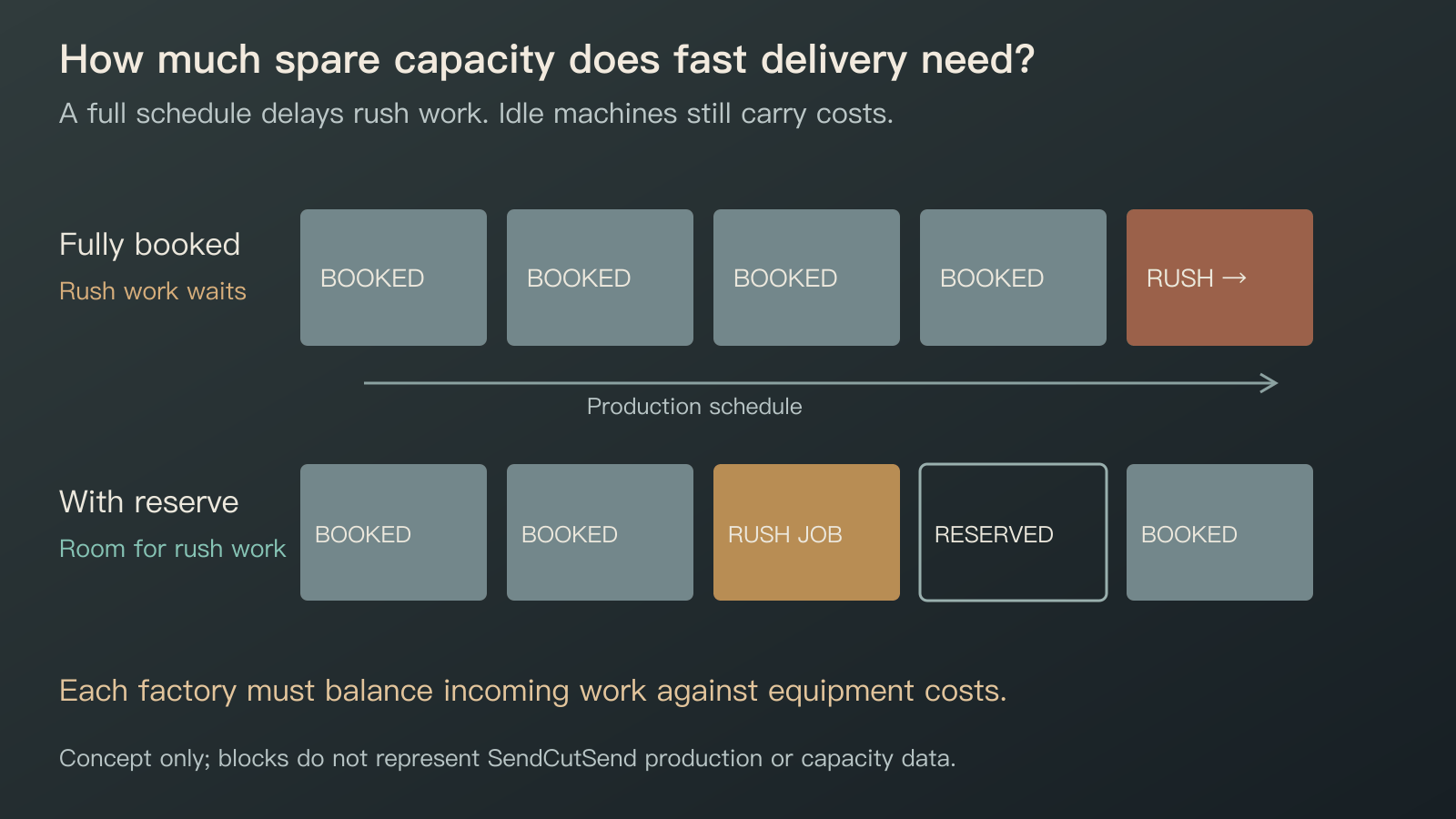
*Illustrative scheduling trade-off; the blocks do not represent SendCutSend production data.*
He believed more capacity would reduce the wait and attract more orders. Once customers came to expect a shorter lead time, the company would have to keep adding equipment and people.
The $110 million gave Belosic a chance to build ahead of demand. Each new factory would need room for urgent orders, along with enough regular work to cover the cost of its machines. Asked how to size that reserve precisely, he acknowledged that he had not yet found the answer.