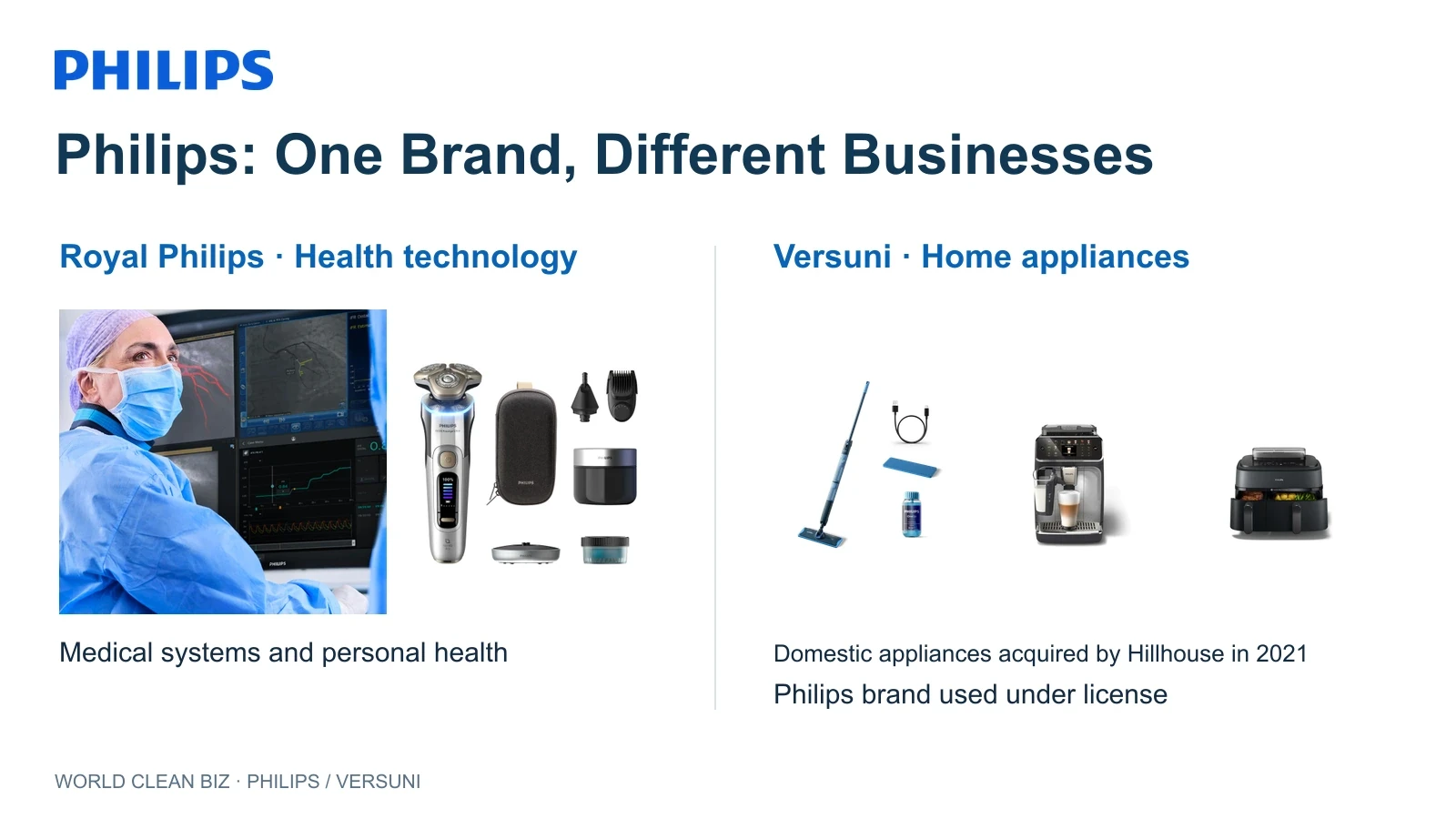
- Royal Philips retains health technology and personal health; Versuni operates the former domestic appliance business.
- Hillhouse acquired a global appliance operation, with brand licensing forming part of the transaction.
- OneUp illustrates a different product approach from multifunction floor washers; its commercial scale remains the test.
The shaver in the bathroom, the air fryer in the kitchen and the vacuum cleaner in the cupboard may all carry the Philips name. Today, however, they no longer belong to the same business.
Shavers and electric toothbrushes remain within Royal Philips. Air fryers, coffee machines and vacuum cleaners are operated by Versuni, the home appliance company acquired by Hillhouse. Consumers still see the familiar brand, but the owners, product teams and commercial priorities behind it have changed.
The Dutch company spent more than a century taking its name into homes around the world. Over the past decade or so, it has gradually broken up the sprawling business it built.
Gerard Philips and his father, Frederik, founded the company in Eindhoven in 1891. As electricity reached ordinary households, they set out to make reliable incandescent light bulbs at an affordable price.
In 1914, Philips established its research laboratory, NatLab. Work on lighting and materials expanded into electronics, while advances in X-ray tubes took the company into medicine. Health technology, which would eventually become its central business, had roots reaching back to the light-bulb era.
The Philishave rotary electric shaver arrived in 1939. Philips later helped bring the compact cassette and the CD to market. It was once a company that could influence the direction of consumer electronics, building recognition through products used by successive generations. Philips company history
As Philips grew, medical imaging equipment used in hospitals and televisions, light bulbs and kitchen appliances sold in shops increasingly called for different ways of running a business. Royal Philips eventually chose to concentrate on health technology, with other operations becoming independent.
Philips Lighting was listed separately in 2016 and renamed Signify in 2018, continuing to use the Philips brand under license. The Philips lights sold today therefore cannot simply be counted as part of Royal Philips' home appliance operations. Signify's name-change announcement
Royal Philips now has three main businesses: Diagnosis & Treatment, Connected Care and Personal Health. The first two serve needs such as medical imaging and patient monitoring. Personal Health retains the shaving, oral-care and mother-and-child products familiar to consumers.
In 2025, Royal Philips generated €17.834 billion in sales, including approximately €3.673 billion from Personal Health. Philips shavers, Sonicare electric toothbrushes and Avent products still sit within that company. The kitchen and cleaning appliances it has sold are excluded from those figures. Philips 2025 annual report
The part of the business most directly connected to the cleaning industry was acquired by Hillhouse in 2021.
The transaction valued the domestic appliance business at approximately €3.7 billion. An accompanying brand license, with an initial term of 15 years, allowed the independent company to continue selling the relevant Philips products worldwide. Before the sale, the business recorded approximately €2.2 billion in revenue in 2020. It was already a global operation spanning kitchen appliances, coffee, garment care and household cleaning. Philips transaction announcement
Hillhouse acquired the existing product teams, manufacturing resources and sales network. Describing the transaction as buying a name to put on outsourced products misses the value of the appliance operation itself.
The company was formally renamed Versuni in 2023, retaining its headquarters in Amsterdam. Most consumers still do not recognize that name, even though its products have long been part of their kitchens and living rooms. Versuni's renaming announcement
According to its official disclosures for 2025, Versuni had approximately 6,030 employees at year-end, a direct sales network in around 50 countries and sales in more than 130 countries. It owned manufacturing facilities in Brazil, Italy, Romania, India and China, while also buying finished products and components from suppliers worldwide. Versuni's 2025 disclosure
Versuni has retained manufacturing capabilities while continuing to work with outside suppliers. Where a product is developed, and who makes it, can change with market conditions and costs.
In 2024, the company opened a factory in Ahmedabad, producing Philips air fryers locally in India for the first time. Announced first-phase capacity was 500,000 air fryers a year, with garment-steamer capacity planned for a second phase. At the time, Versuni said around 70% of the products it sold in India were already made locally, a share it hoped to raise with the new plant. Ahmedabad factory announcement
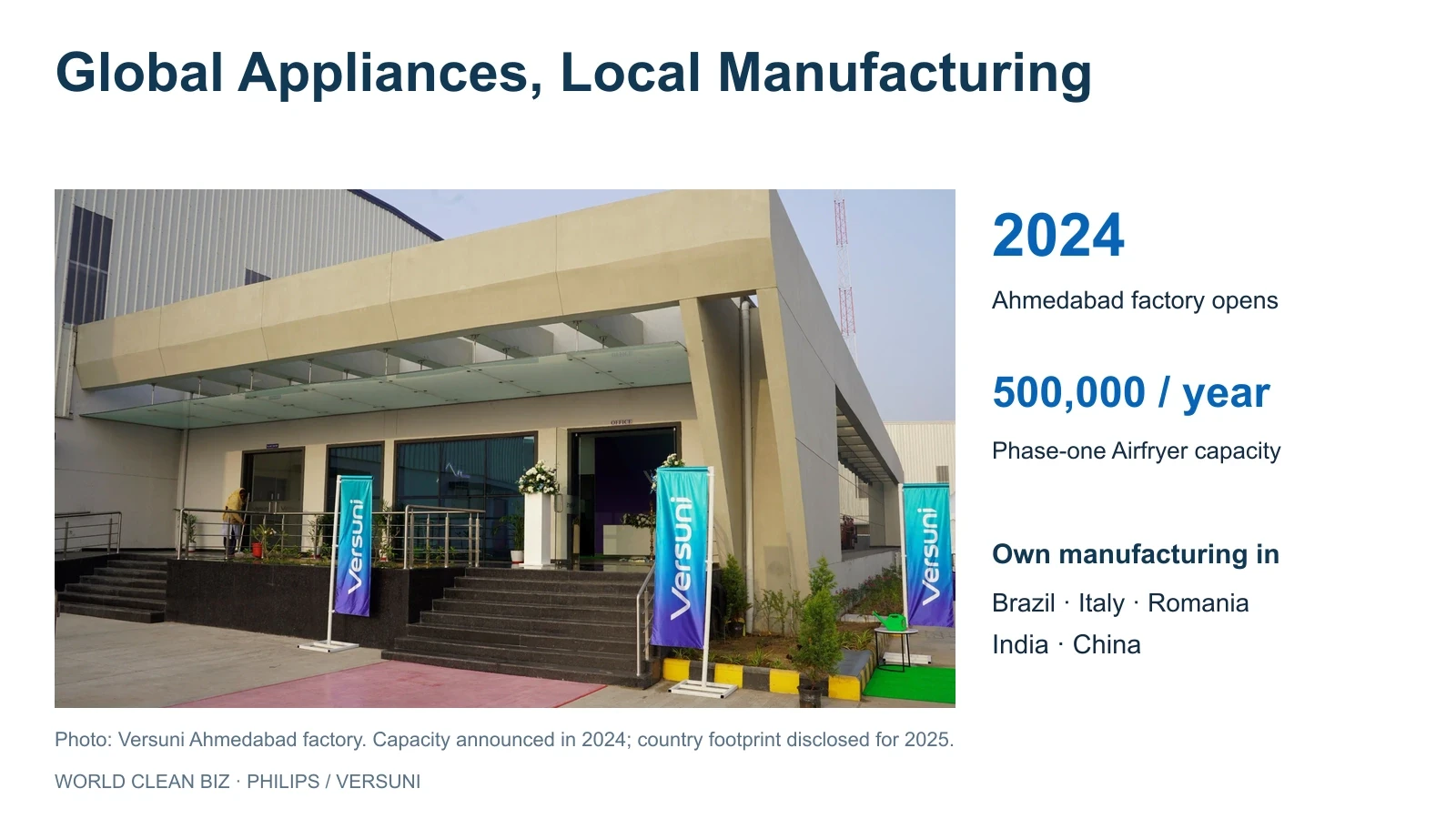
*Factory photo: Versuni. Capacity refers to the 2024 announcement, not actual output. Manufacturing locations are from the company's 2025 disclosure.*
Chinese suppliers should pay attention to this structure. Winning an order from a global brand does not necessarily mean exporting every product from China. A customer may ask suppliers to support local production or keep some manufacturing in its own plants. Suppliers have to follow the customer's geographic expansion.
Versuni's product portfolio reflects regional differences too.
It operates brands including Philips, Saeco, Gaggia, Preethi and Philips Walita, while its coffee business also involves systems such as Senseo and L'OR Barista. Italian coffee brands, an Indian kitchen brand and a Brazilian market identity coexist within the same appliance operation. Operating a brand does not necessarily mean owning its trademarks: Versuni explicitly states that Philips, Saeco and Gaggia products are sold under trademark licenses from Royal Philips. Versuni's brand statement
Among these products, the Airfryer is one of Philips' most recognizable achievements.
Philips introduced the Airfryer in Berlin in 2010. Rapidly circulating hot air cooked foods such as fries with a simpler process than conventional deep-frying. It turned hot-air cooking into an appliance consumers could readily understand and buy. Eventually, the rest of the industry entered the category. Original 2010 Airfryer announcement
The Airfryer illustrates a strength Philips has shown in product development: technology has to give people a clear reason to use it. Consumers may not care how an air duct is designed, but they do care how many steps it takes to make dinner.
Its coffee business follows a similar approach.
Philips fully automatic coffee machines serve households that want a drink at the press of a button, with LatteGo emphasizing an easy-to-clean milk system. Baristina, introduced in 2024, retains the portafilter associated with an espresso machine while simplifying grinding and brewing. A swipe of the handle starts the machine processing the beans; afterward, the user removes the portafilter to dispose of the coffee puck. Baristina launch announcement
It is aimed at people who want freshly ground coffee without learning a complicated routine. For an appliance used every day, one fewer component to wash or fewer preparation steps can matter more than another rarely used feature.
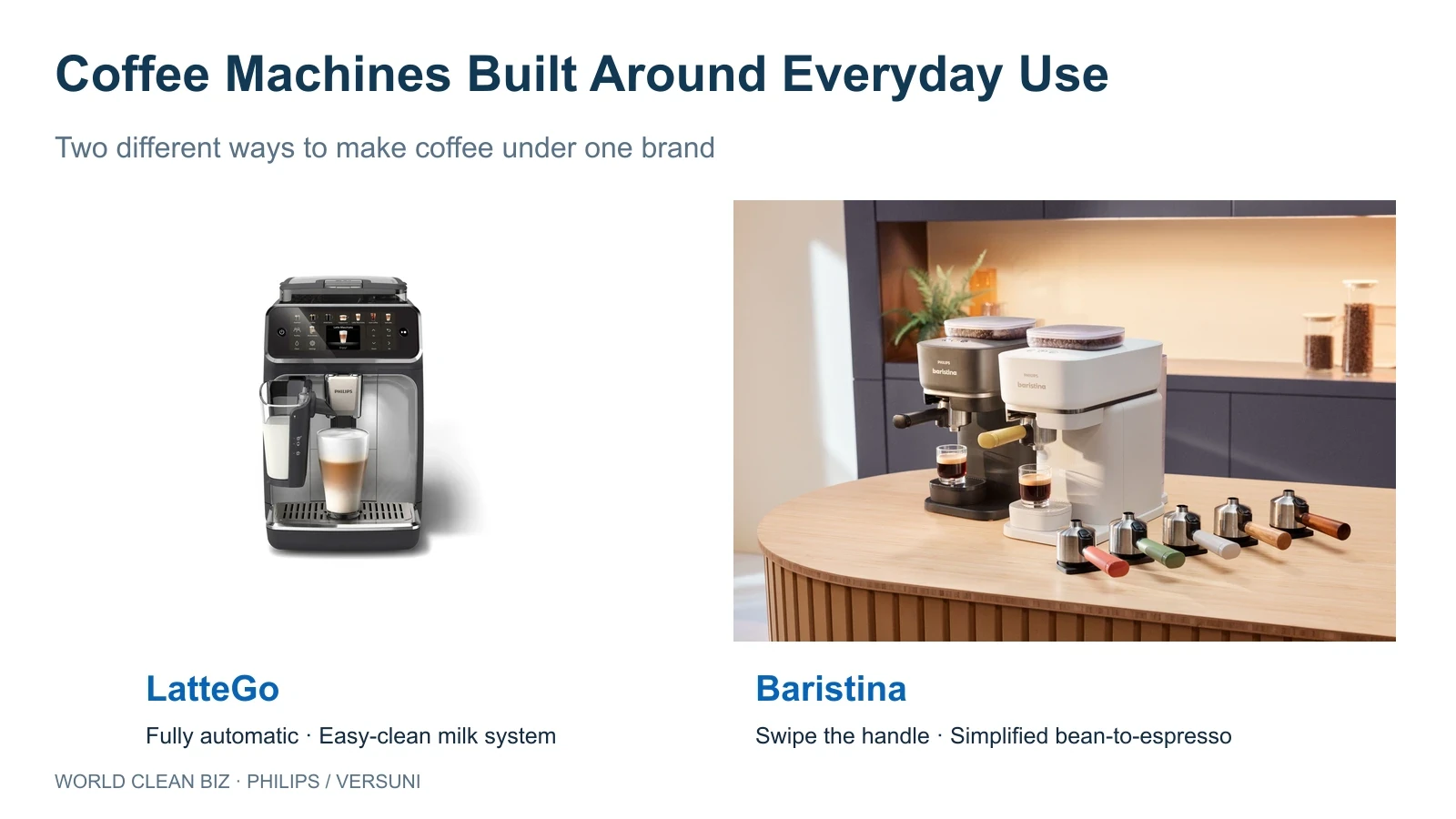
*Product images: Philips Home Appliances and Versuni. Baristina image from its 2024 launch; shown separately from the later Baristina Latte range.*
In floorcare, Philips faces more direct competitive pressure.
The brand and retail relationships built in the conventional vacuum-cleaner era can get new products into stores. But floor washers and robot vacuums no longer develop at the old pace. Versuni needs to keep making its own choices about what a cleaning product should be.
The AquaTrio 9000 series takes a modular approach. Users switch components for wet floor cleaning, dry vacuuming and handheld use. Its wet cleaning head uses twin AquaSpin brushes, allowing one system to handle hard floors and localized cleaning. Buyers get more than a dedicated floor washer, but must also accept the work of changing and storing components. AquaTrio 9000 product information
I am more interested in the OneUp electric mop, launched in 2025.
It preserves the familiar way of using a flat mop, with separate clean- and dirty-water systems inside the machine. It dispenses clean water and collects dirty water as the user mops, removing the need to carry a bucket and repeatedly rinse and wring out the pad.
OneUp does not try to put every cleaning task into a single machine. It targets people who already mop their floors and want less hassle. At launch, European recommended retail prices were €109.99 for the 3000 series and €159.99 for the 5000 series, creating a different entry point from a premium floor washer. OneUp launch announcement
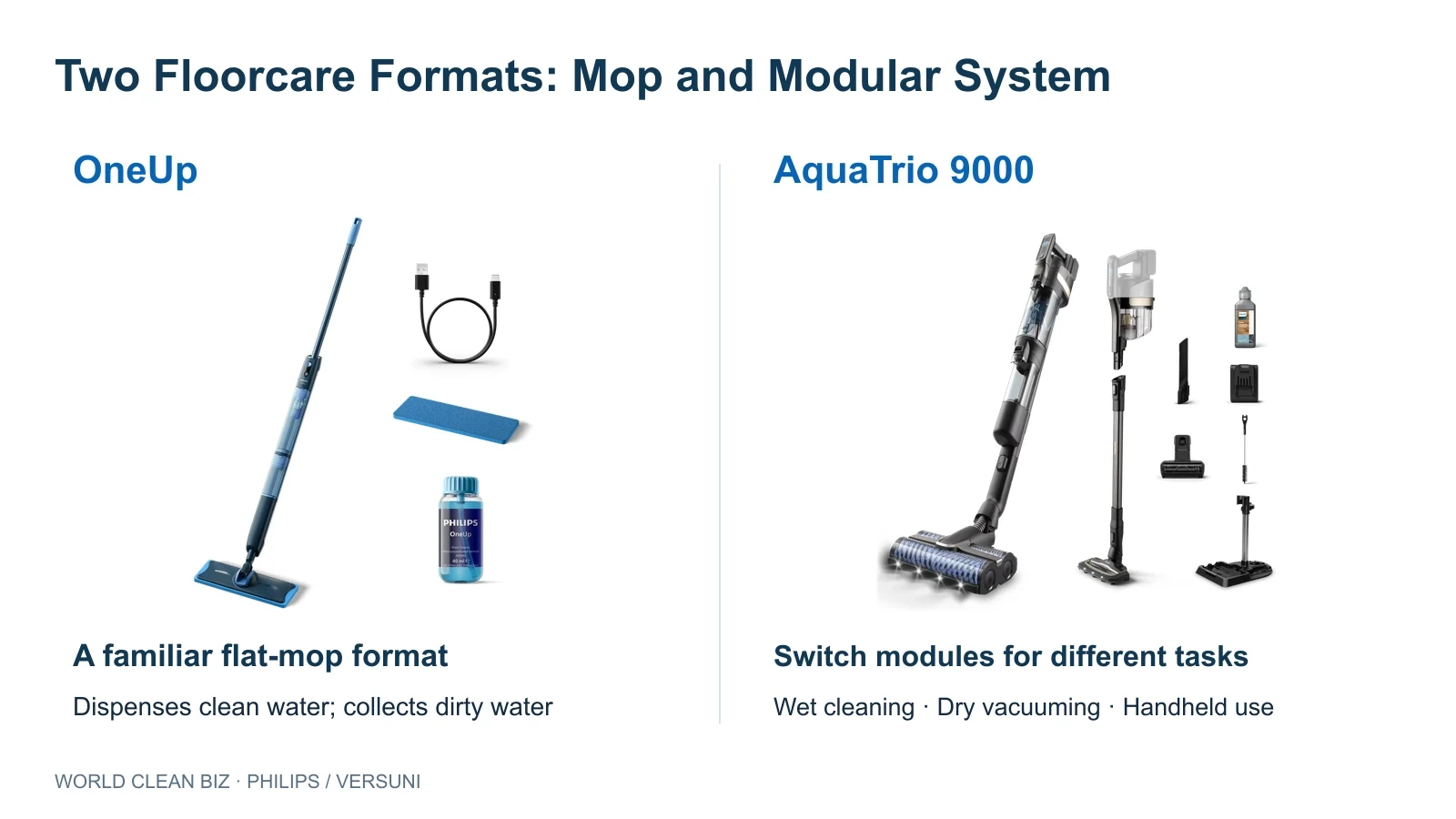
*Official Philips Home Appliances product images. OneUp dispenses clean water and collects dirty water; it does not replace dry vacuuming. AquaTrio uses separate components for wet, dry and handheld cleaning.*
This format will not suit every household and cannot directly replace a dry vacuum. But making a familiar mop easier to use may be a sufficient reason to buy for someone who does not want a complicated machine. In August 2026, Versuni brought OneUp to the United States and Canada, extending this product approach into North America. North American launch announcement
OneTurn, a garment-care product introduced in 2026, follows a related idea. It switches between horizontal ironing and vertical steaming, using a rotating design and an ironing mat to reduce the preparation associated with a conventional ironing board. It addresses a specific household inconvenience without asking users to learn an entirely new way of doing the chore. OneTurn product announcement
These launches show that the independent Philips appliance business is still trying to develop new products. Launching them and building substantial sales are different achievements, however.
Versuni does not publish a complete, comparable breakdown of annual revenue and category profitability in the way a listed appliance group does. The number of new products alone cannot establish which business has grown fastest under Hillhouse, or how much growth has become profit. The €2.2 billion revenue figure from 2020 describes the business at the time of the sale; it should not be presented as today's sales.
For suppliers, Versuni's appeal remains clear: a mature product can reach multiple countries through its network. Coffee machines, floorcare and garment care provide different opportunities to work with the company.
Customers of this kind need more than a prototype that looks convincing at a trade show. Once a product enters international distribution, it needs continued delivery and repair support. Whether filters and cleaning heads remain available for years, and whether faults can be resolved promptly, will influence future purchasing decisions.
To me, the most interesting question is whether Philips Home Appliances can once again produce something with the category-building impact of the Airfryer. OneUp shows an approach distinct from mainstream floor washers. Turning that product judgment into sales at scale would be more persuasive than simply adding more ranges.
For China's cleaning industry, this suggests an opportunity for cooperation: once the technology and manufacturing capabilities are in place, how can suppliers help define products with brands that understand overseas households, rather than simply wait for a purchase order?
The first WCB International Cleaning Appliances Expo will take place in Suzhou on November 18–20, 2026, with close to 200 cleaning-industry exhibitors expected, alongside industry forums and buyer–supplier meetings. We want to bring brands, appliance manufacturers and component suppliers together to discuss specific products and business opportunities.
To exhibit or visit, contact Denny You.
