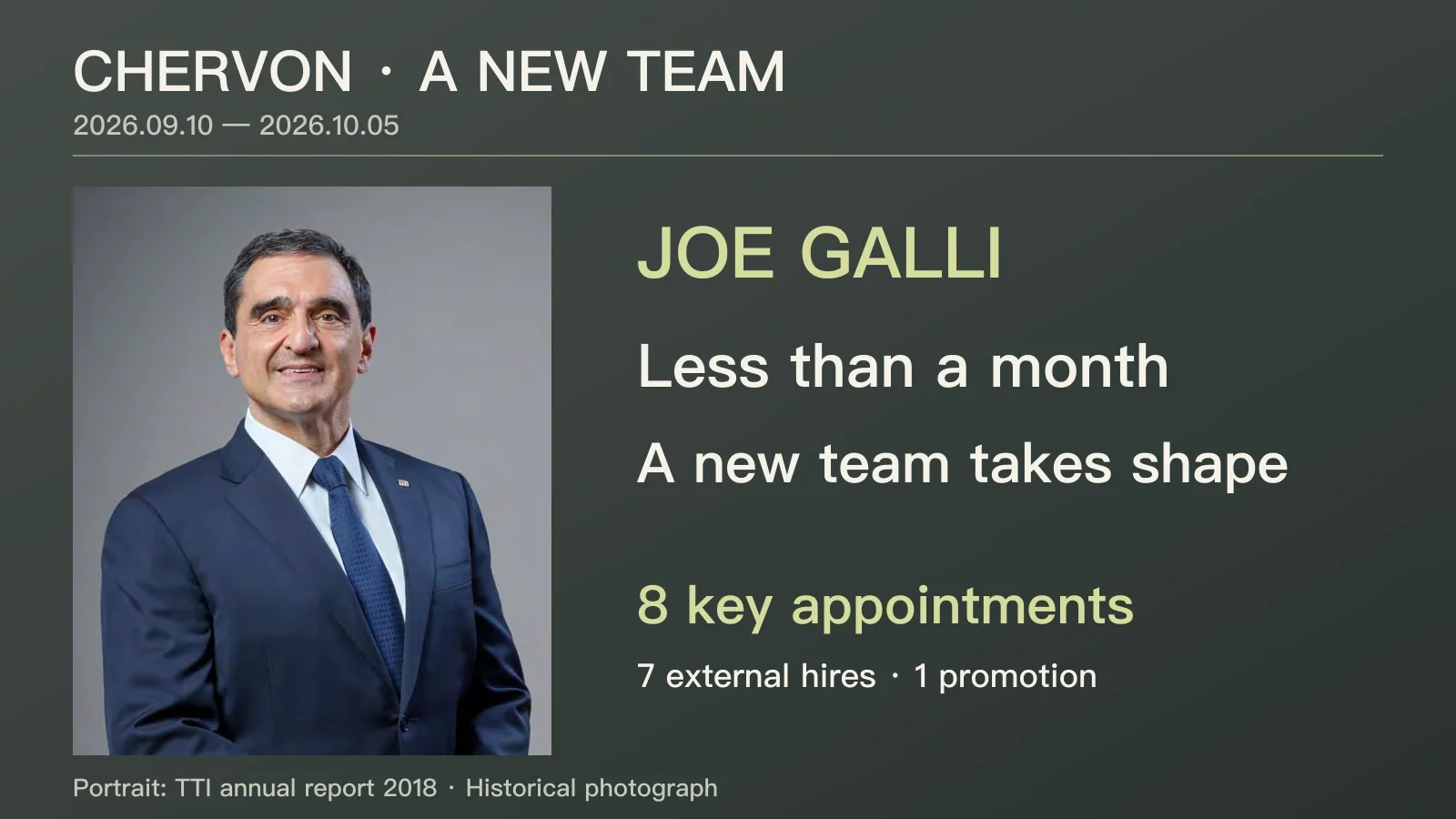
- Pan built Chervon from an export business into a global brand owner; Galli helped develop the rivals it now faces.
- EGO gives Chervon an established cordless outdoor business, while FLEX and SKIL leave room for further expansion.
- Jeffrey Campbell's appointment four days after Galli became CEO provides a concrete sign of investment in professional channels.
In September 2026, Pan Longquan handed Chervon's chief executive job to Joseph Galli Jr.
*Cover: Editorial collage using Pan Longquan's portrait from the Jiangsu Development Conference organizing committee, Joseph Galli's historical portrait from TTI's 2018 annual report, and a Chervon distributor-visit photograph. The portraits have not been AI-redrawn; this is not a photograph of a joint event.*
Pan had built the company from an export business. Over more than three decades, he established factories, acquired overseas brands and brought tools to European and American markets. The man he chose to run it had led one of Chervon's most important competitors: Techtronic Industries, or TTI.
Milwaukee and RYOBI, businesses Galli helped expand, are among the competitors Chervon's brands must confront. He would now help Chervon pursue sales he had spent years helping his former employer build.
On the day of the appointment, Pan relinquished the CEO role while remaining chairman and an executive director. More than two years after retiring from TTI, Galli was once again responsible for running a tool company. Chervon's appointment announcement
Pan had not initially set out to become a tool manufacturer.
In 1988, he completed a master's degree in earth sciences at Nanjing University and joined a state-owned import-export company in the city. His English helped him become an export salesman. His work gradually extended from machinery components to power tools. Chervon director biography
Five years later, he left with RMB8,000 in savings, rented hotel rooms with his partners and began finding orders for himself.
The business did not initially require a factory. Chervon bought from Chinese suppliers and delivered to overseas customers. But Pan soon discovered that a trading company could identify quality problems without having the means to fix them. Some suppliers lacked independent design capabilities; even after a test report identified a fault, they could not put it right. As orders grew, factories could also bypass Chervon and approach its customers directly.
In 1997, he decided to enter manufacturing, focusing on mid- to high-end tools and learning through partnerships with international brands. Production problems that could once have been left to suppliers would now become Chervon's own responsibility. 21st Century Business Herald's interview with Pan
A case published by China Europe International Business School, or CEIBS, records a scene that stayed with him. At an overseas tool exhibition in 1996, European and American products occupied prominent positions. Chervon's were placed in a corner near a rubbish bin. Pan subsequently strengthened quality control and established a laboratory, hoping his products would receive a different reception. CEIBS case
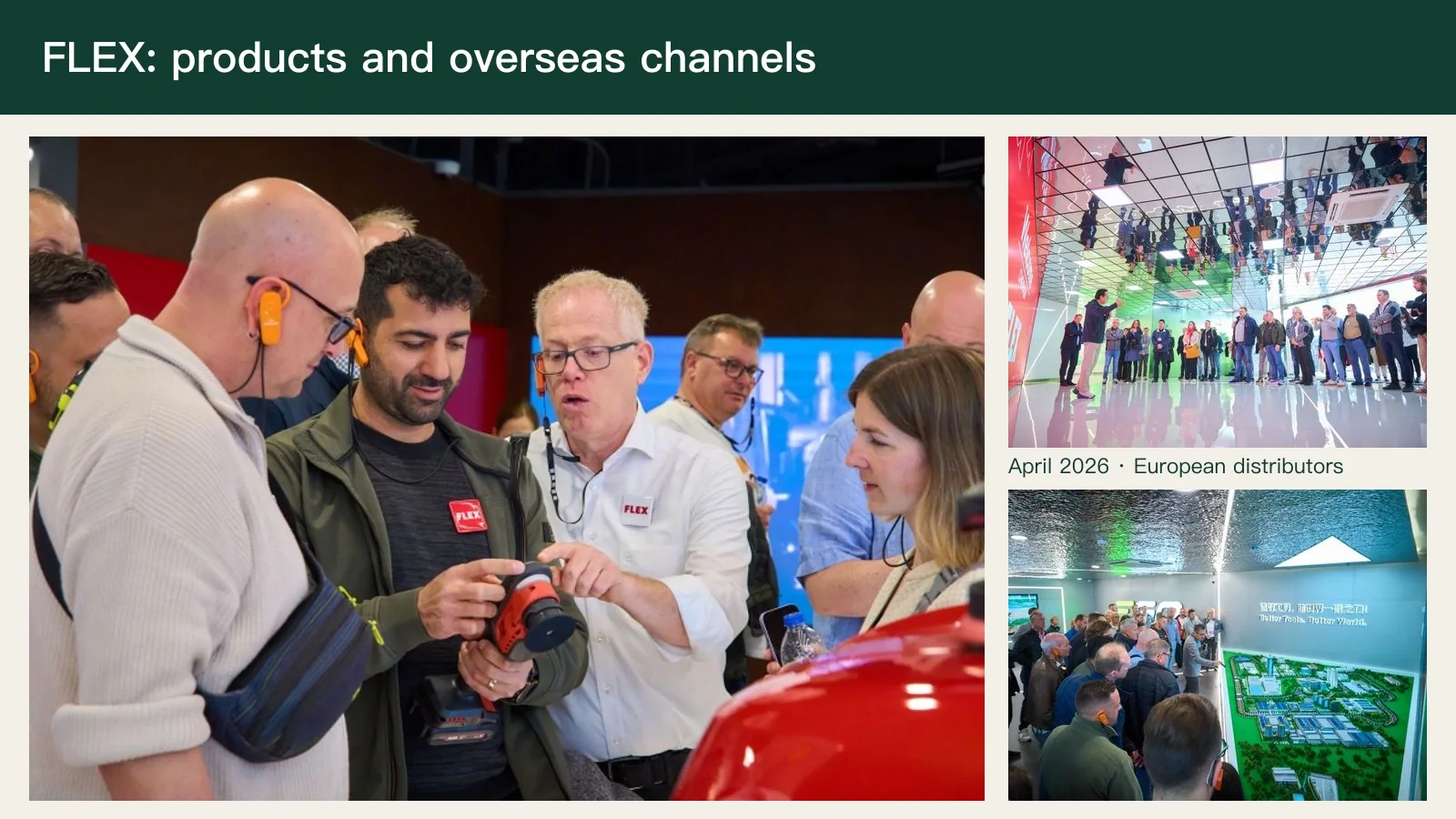
*FLEX European distributors visit Chervon, April 2026. Source: Chervon.*
While Chinese factories were working to earn the confidence of international customers, Galli was learning how to sell more tools—and command higher prices—in the United States.
He joined Black & Decker in 1980 as a field salesman covering North Carolina. He fitted out a van as a showroom for tool accessories. On hot afternoons, he invited hardware-store managers inside for a cold drink and a look at the products. Forbes later reported that sales in his territory grew rapidly.
Galli subsequently helped develop DeWalt's professional tool business. Black & Decker's household image made it difficult to become the first choice of professional tradespeople. DeWalt offered a way back into that market, with sales teams taking products into stores and places where tradespeople gathered. From 1992 to 1999, DeWalt's sales rose from approximately $60 million to more than $1 billion, according to Forbes. Forbes profile
His career did not remain within the tool industry. After leaving Black & Decker in 1999, he joined Amazon as president and chief operating officer. The move did not go smoothly, and he left after roughly a year. He subsequently became CEO of Newell Rubbermaid.
It was not until 2006, when he joined TTI, that Galli returned to tools. He became group CEO in 2008. Galli's career history
Pan, meanwhile, was making another decision that would change Chervon's relationship with its customers.
Chervon had spent years preparing its own DEVON brand for a Chinese-market launch in 2007. Shortly before that, Bosch proposed forming a joint venture.
Telling Bosch about the brand plan might jeopardize the partnership. Keeping quiet would only postpone the issue: the products were about to launch, and the two companies would still have to confront their new competitive relationship. Pan chose to explain directly that Chervon wanted a lasting partnership—and brands of its own.
The CEIBS case records that the joint venture went ahead. Pan's candor increased his counterpart's trust. CEIBS account of the partnership
The relationship changed again in the years that followed. Chervon acquired Germany's FLEX in 2013, then bought SKIL-related operations from Bosch, completing the acquisition of the North American SKIL and SKILSAW businesses in 2017. From supplier to partner to brand operator, Chervon was moving into markets its customers had occupied. Chervon's development history
After taking over FLEX, Pan also had to address German employees' concerns about their new shareholder. He spoke with the union and promised employees that no one would be laid off over business performance in the first year; he would shoulder the operating difficulties. A CEIBS report says Chervon honored that promise a year later. CEIBS corporate social responsibility report
Pan had previously needed to persuade overseas customers to trust a Chinese factory. Now he also needed overseas employees to believe a Chinese company could run the brand they knew.
At TTI, Galli was likewise working with businesses from different places, each with its own history.
TTI had acquired Milwaukee in 2005, before he joined. Galli and the brand teams subsequently expanded cordless products. Milwaukee pushed deeper into specialist trades, while RYOBI served a broader range of household and yard users. The group had to keep developing products while allocating investment suited to each brand.
The cordless opportunity Pan seized was more often found on European and American lawns.
In 2014, Chervon's EGO entered North America, focusing on lithium-ion outdoor power equipment. Motor and electronic-control capabilities developed in tools could also be applied to mowers and blowers, but outdoor work brought new demands for runtime and reliability. Chervon's outdoor equipment business

*EGO mower and battery examples, shown separately to illustrate the cordless platform rather than a specific retail bundle. These are current product photographs, not the 2014 launch lineup. Source: EGO.*
A household replacing a petrol mower was already comparing products. Battery equipment removed the need to refuel and reduced some engine maintenance. If it could handle the yard, a new brand had a chance. EGO used that shift to establish a market of its own.
In 2023, Chervon announced a partnership with John Deere, bringing EGO products into its dealer network in the United States and Canada and providing for subsequent product-development collaboration. A Chinese business once dependent on overseas customers for orders could now bring its own brand into an established outdoor-equipment sales network. Partnership announcement
Its competition with TTI was becoming increasingly direct.
FLEX's entry into professional cordless tools brought it up against Milwaukee's installed user base. SKIL served household and DIY buyers, overlapping with RYOBI. EGO's lithium-ion outdoor market also included RYOBI and Milwaukee. Their products did not all occupy the same price points, but they competed for consumer spending and retail shelf space.
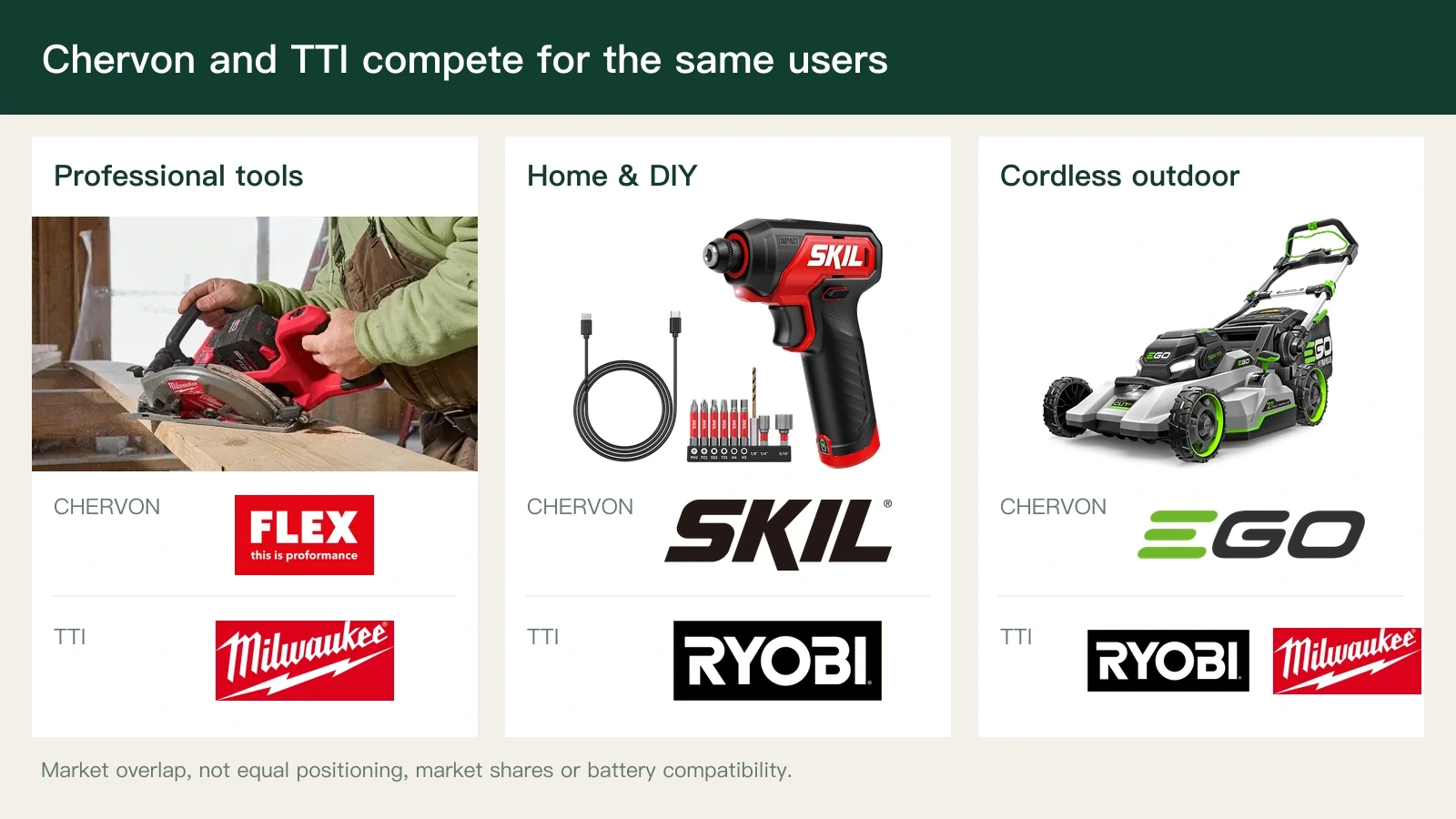
*Overlapping customer markets, not equivalent products, market shares or battery compatibility. TTI operates RYOBI's relevant tool business under license. Original logos and illustrative product photographs: Chervon, TTI, SKIL and EGO.*
For Chervon, making a competitively performing drill was not enough to persuade a tradesperson to replace an entire tool collection. Batteries already owned, familiar controls and a nearby servicing dealer all influenced the next purchase.
Advantages Galli had helped build would now become obstacles he had to help Chervon overcome.
EGO gave Chervon a response of its own. After buying a mower and battery, a customer had a practical reason to buy a blower on the same platform. Chervon was acquiring consumers capable of generating follow-on orders, rather than depending solely on brand customers placing their next purchase order.
But its businesses were not advancing evenly.
In 2025, Chervon generated $1.628 billion in revenue, with owned-brand operations accounting for 76.7%. Group revenue fell 8.2%; power tools declined 18.3%, while outdoor power equipment was broadly flat. Growth returned in the first half of 2026, with revenue rising 12.8% to $1.029 billion. 2025 results, 2026 interim results coverage
That improvement preceded Galli's arrival. The company Pan was handing over already had businesses capable of growing, alongside brands that had yet to reach their full scale.
The two men have not publicly disclosed the details of their discussions or negotiations. In the appointment announcement, Pan emphasized Galli's repeated success in the industry. Galli pointed to Chervon's technology and manufacturing foundation and said the two shared ambitions for breakthrough technology and global growth.
The partnership is not difficult to understand.
Pan had taken Chervon from an export company into international brand competition. Further progress meant pursuing markets that the global tool giants had cultivated for years. Galli knew those customers and had helped run a large tool group. His experience could shorten some of the learning required.
Yet for a company long run by its founder, bringing in a prominent adviser and handing over the CEO role are different decisions. Pan remained chairman and an executive director while giving Galli responsibility for group operations. That created room for the partnership to work. It also required them to confront decisions about allocating resources and choosing which businesses deserved greater investment.
In my view, Pan's ambition extends beyond running a sound tool business. He wants Chervon closer to the front of the global industry. Hiring the former head of TTI puts that intention directly in front of its competitors.
Galli, too, needed an opportunity worth coming out of retirement for.
At a company lacking basic engineering and manufacturing capabilities, he might spend years building the foundations. At one whose businesses were all mature, there might be less room to change its trajectory. Chervon had EGO as a base, with expansion opportunities in FLEX and SKIL—a position where he could still make a difference.
I see his decision as another pursuit of a professional legacy. He had already helped build DeWalt and spent years leading TTI. Another CEO title would add little on its own. Taking Chervon into the global industry's front rank would give him a place in the development of a third important tool business.
Pan wants his company to move further ahead. Galli has an opportunity to add another substantial achievement to his career. Their ambitions converge here, but past successes cannot win the competition ahead for them.
On September 14, 2026, four days after Galli took over, Chervon announced the appointment of Jeffrey P. Campbell as senior vice president of Industrial Commercial Sales, reporting directly to him.
Campbell had held sales-management roles at Porter-Cable, Irwin/Lenox, Werner and Apex Tool Group. His new position put him in charge of a sales network serving professional and automotive tool channels. In the announcement, Galli emphasized his knowledge of key accounts and after-sales service. Campbell appointment announcement
The announcement did not say how much business they intended to take from any particular rival. But the people Chervon was adding already indicated where it intended to invest.
On professional tool dealers' shelves, Galli will encounter familiar names again. This time, his job is to persuade customers to make more room for Chervon.