In this article 6 sections
EU trade action may change the landed cost of Chinese robotic lawn mowers, but it does not solve Husqvarna's competitive problem by itself. Automower still has a trusted brand, a broad dealer and service network, professional users and a growing wire-free portfolio. Its harder task is proving that reliability, installation support and lifecycle service justify a premium as Chinese brands bring RTK, LiDAR, vision and all-wheel drive into lower price bands.
Chinese Brands Have Reset the Price Reference
Around this year's Prime Day, robotic lawn mowers were pushed onto the promotional shelves of American and European e-commerce platforms.
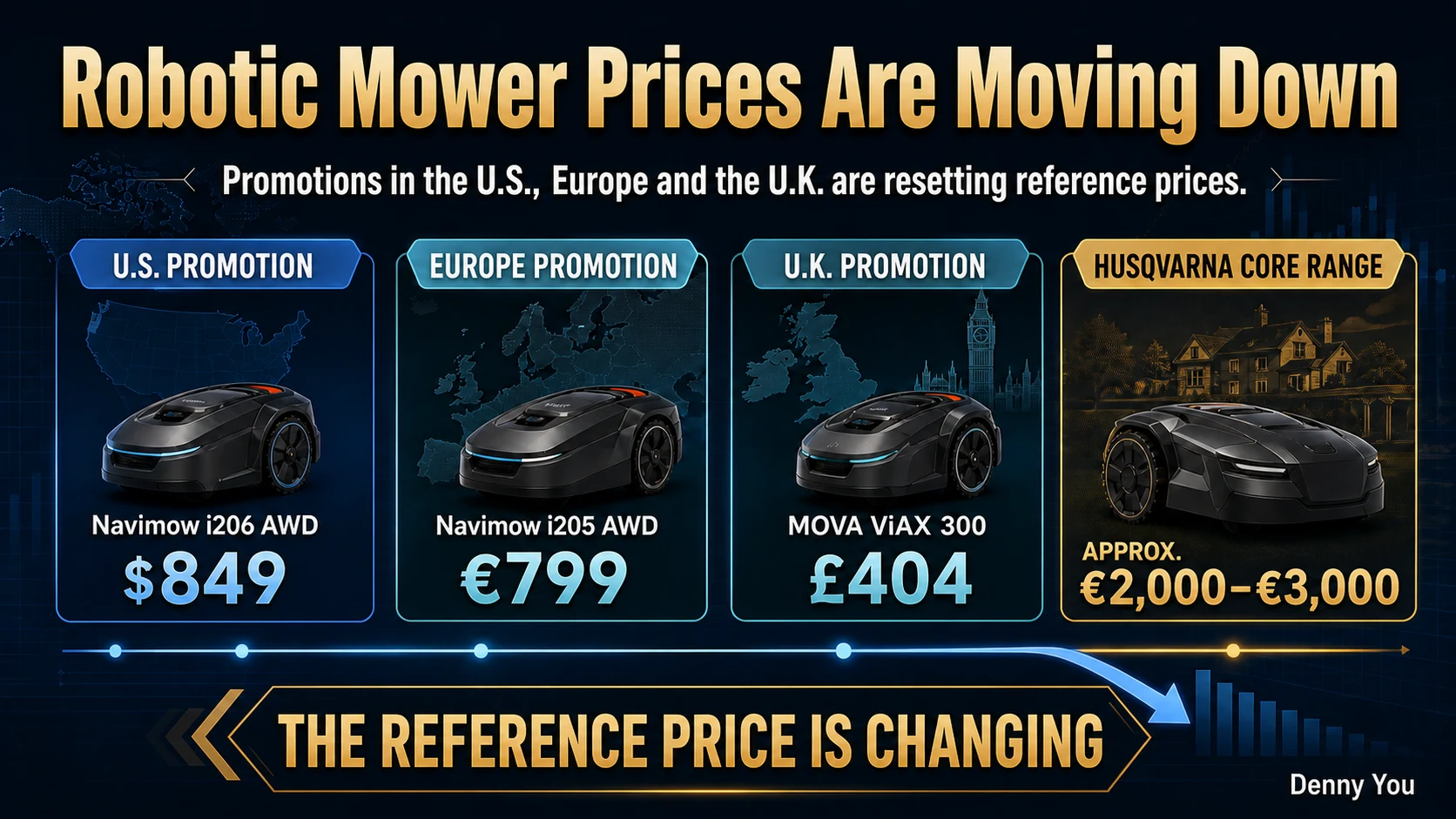
In the United States, Mammotion's LUBA 3 AWD became an Amazon Best Seller in robotic lawn mowers. Segway Navimow, a Ninebot brand, ran promotions across the range: the i206 AWD fell from $999 to $849, while the i210 AWD dropped from $1,299 to $1,049. Ecovacs' Goat O1000 Lidar Pro was marked down from $1,500 to $1,199. Anker's Eufy E15 fell from $1,799.99 to $949.99, a discount of almost 50%.
Prices were falling in Europe as well. On Segway Navimow's European Prime Day page, the i205 AWD dropped from €899 to €799, while the i208 AWD was priced at €1,099. In the UK, the MOVA ViAX 300 fell from £519 to £404 on the official website. Earlier, during a spring promotion on the UK platform Yimbly, the MOVA ViAX 300 sold for about £431 after discounts, below the £479 price on Amazon at the same time.
Husqvarna has been cutting prices too. In May 2026, the Automower 410iQ appeared on Amazon in a limited-time promotion at $1,799.99, down $800 from $2,599.99. Replacement blades, a charging station and an EPOS GPS reference station were included. It was a substantial discount, but it looked more like a peak-season concession on one premium model than a reset of the brand's pricing system.
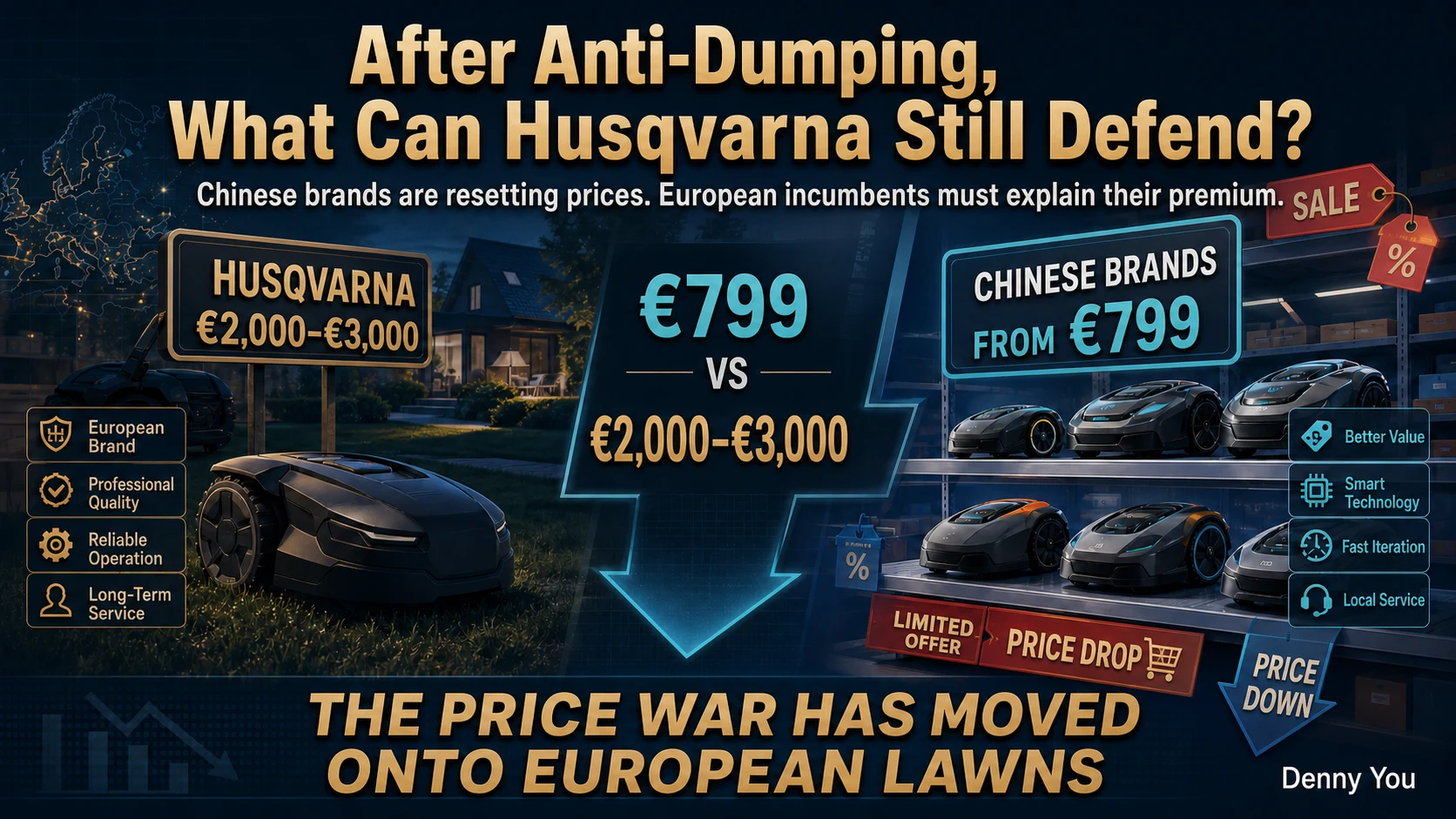
Chinese brands are putting boundary-wire-free navigation, vision, RTK, LiDAR and all-wheel drive into the $1,000-to-$2,000 range, and sometimes below it. The pressure on Husqvarna is not limited to one model. It reaches the pricing power the company has built around Automower over many years.
Automower has been on the market for a long time. Husqvarna has dealers, installers and after-sales service across Europe, as well as the trust of professional users. Buyers once chose a brand that promised fewer problems before looking closely at the specification sheet.
Now the specification sheet has moved to the center of the shelf.
Based on public channel prices, the Husqvarna 305E NERA has been reviewed in the UK at about £1,948. European dealer prices for the standalone machine and wireless packages generally fall between €1,700 and €2,200. New models such as the 405VE NERA and 410VE NERA are priced at roughly €2,249 to €3,299, while the higher-end 430V and 450V NERA go higher still.
Around Prime Day, Chinese brands pushed many wireless models to about €1,000, with some priced even lower. Consumers are not looking at a simple price difference. They are seeing similar headline features at very different prices.
European households have become less willing to spend several hundred euros more on a non-essential category. When €799 and $999 robotic mowers sit on the same e-commerce page, Husqvarna's core models at €2,000 to €3,000 need a new explanation for their price.
Husqvarna is filling gaps in its range. In 2026, it added AI Vision to the NERA line. In the UK, the new Aspire R6V, Automower 308V and 312V brought entry prices down to £999–£1,499 for small and medium-sized gardens.
Husqvarna sells more than a machine. It sells distribution, installation, service and brand credibility. For a traditional outdoor-power-equipment company, the pricing system also holds the dealer system together. If core products follow e-commerce platforms into deep discounting, dealer margins, installation services and long-term after-sales support will all be repriced.
Chinese brands are bringing the robot-vacuum playbook onto the lawn: launch quickly, lead with specifications, build demand through reviews and use platform promotions to gain users. Buyers once started by asking a dealer and comparing installation plans. More of them now search on Amazon, watch YouTube reviews and wait for Prime Day.
What the EU Anti-Dumping Case Changes
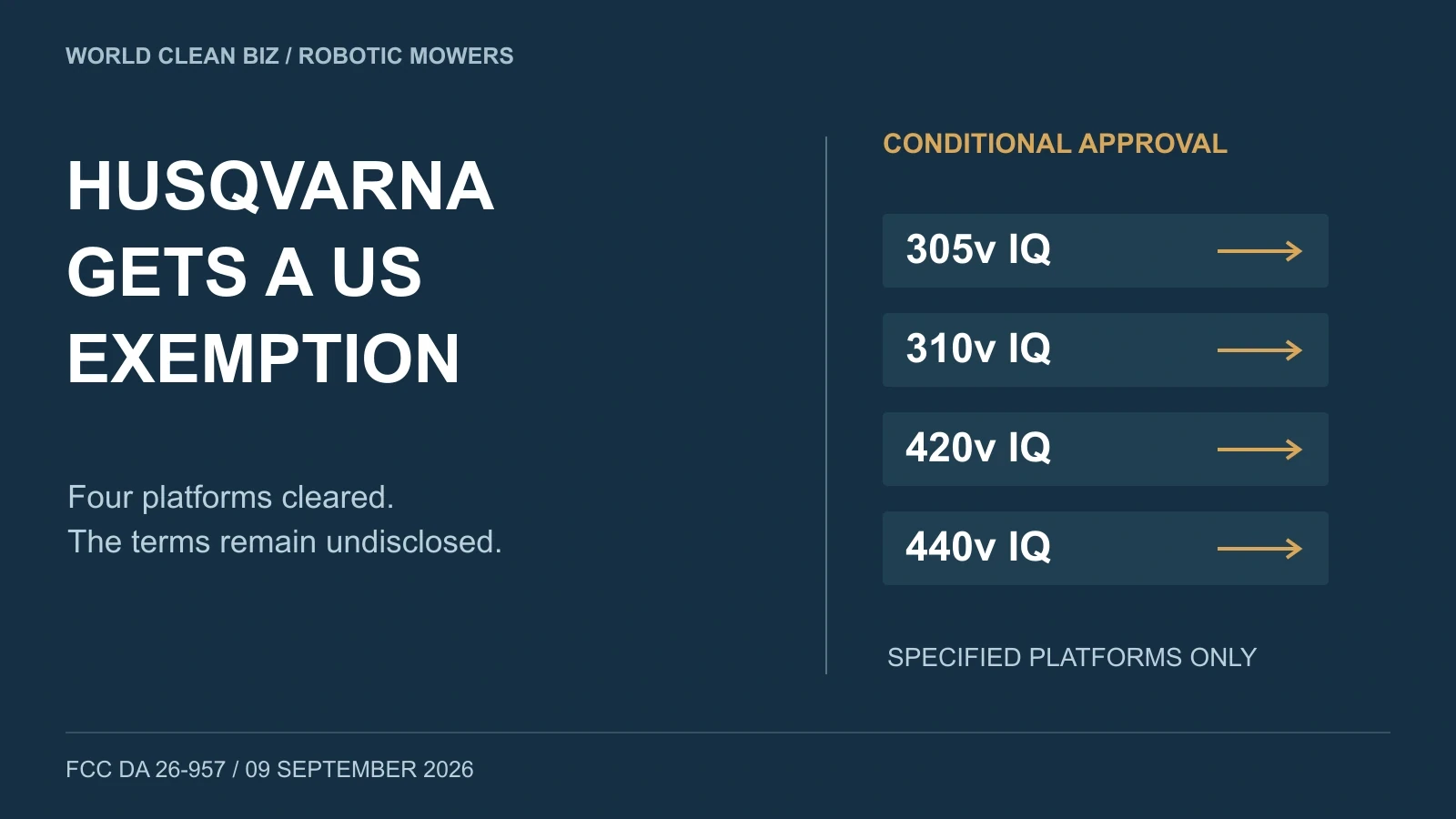
On November 19, 2025, the European Commission opened anti-dumping proceeding C/2025/6235 into robot lawn mowers originating in China. The complaint had been filed by Husqvarna Manufacturing CZ. On January 22, 2026, Commission Implementing Regulation (EU) 2026/142 required customs authorities to register covered imports.
Registration preserves the possibility of collecting duties retroactively if the legal conditions are later met; it is not itself a final anti-dumping duty or a published duty rate. Importers therefore face uncertainty before they know the final landed-cost effect.
Registration can force dealers and importers to model possible retroactive duty exposure when planning inventory and retail prices. Manufacturers may also review production locations, but any origin change depends on the applicable customs rules and the actual manufacturing process.
Anti-dumping measures apply by product scope and origin, not simply by brand nationality. Companies may review production locations and supply chains, but relabeling or minor assembly does not automatically change customs origin. European importers need product-level origin and compliance evidence rather than assumptions about a brand.
Chinese companies once stood mainly behind European brands as suppliers. Some are now using their own brands to capture growth directly, so the competitive pressure is no longer limited to OEM pricing.
Husqvarna's Remaining Advantages
The new price reference is already in the market.
What Husqvarna can still sell is fewer headaches. Reliability, a service network and years of maintenance support remain the basis for its premium.
Chinese brands still need to build local after-sales teams, spare-parts warehouses and dealer relationships. Once they can offer both “lower-priced” and “easy to own,” Husqvarna's premium will be recalculated.
What Husqvarna fears most is not that Chinese brands are cheap, but that they become reliable enough.

Why Faster Development and Aftermarket Matter
In July 2025, Husqvarna Group announced Glen Instone as its new CEO, and he formally took office in August. Instone previously led the Husqvarna Forest & Garden Division, the group's core business and the one most directly exposed to robotic mower competition. Husqvarna did not recruit an executive from consumer electronics. It elevated the head of its forest and garden business to lead the group.
Pressure from Chinese brands is not confined to price lists. It also comes from product iteration, supply-chain responsiveness and engineering execution. Husqvarna's public 2025 results show the response taking shape: the group launched 13 new boundary-wire-free robotic mower models, its largest launch to date, and introduced a scalable AI Vision platform for object detection, edge detection and night operation.
That leaves Husqvarna in a contradictory position.
On one side, the EU proceeding may reduce price pressure from products found to be dumped. On the other, Husqvarna still needs faster iteration, lower costs and a more responsive supply chain regardless of the case's outcome.
Robotic lawn mowers are only one part of Husqvarna Group.
According to Husqvarna Group's 2025 annual report, net sales reached SEK 46.6 billion. In the first half of 2026, group sales were SEK 28.3 billion, while management reported challenging European demand and continued work on costs, the manufacturing footprint, OEM partnerships and aftermarket. Even if Chinese brands push prices down in robotic mowers, Husqvarna is not a company that can be broken by a single product category.
Foreign brands once felt this pressure mainly in the Chinese market. It is now playing out on the European lawns Husqvarna knows best.
Final Answer
Husqvarna still holds four meaningful cards: the Automower brand, a large installed base, servicing dealers and professional robotics experience. The EU anti-dumping case may alter the cost equation, but it cannot replace product speed, dependable wire-free operation or strong aftermarket support. Husqvarna will defend its premium only if those advantages produce fewer interventions and a lower lifetime risk for the customer.
Sources
- European Commission notice C/2025/6235 opening the anti-dumping proceeding on November 19, 2025: https://eur-lex.europa.eu/eli/C/2025/6235/oj/eng/pdf
- Commission Implementing Regulation (EU) 2026/142 registering covered imports from China: https://eur-lex.europa.eu/eli/reg_impl/2026/142/oj/eng
- Husqvarna Group 2025 annual report and robotics strategy: https://www.husqvarnagroup.com/sites/husqvarna/files/2026-03/202603249629-1.pdf
- Husqvarna Group interim report for January-June 2026: https://www.husqvarnagroup.com/en/report/interim-report-january-june-2026
- Husqvarna Group announcement of AI Vision robotic mowers for 2026: https://www.husqvarnagroup.com/en/press/husqvarna-group-reveals-ai-vision-technology-robotic-lawnmowers-2026-2397307