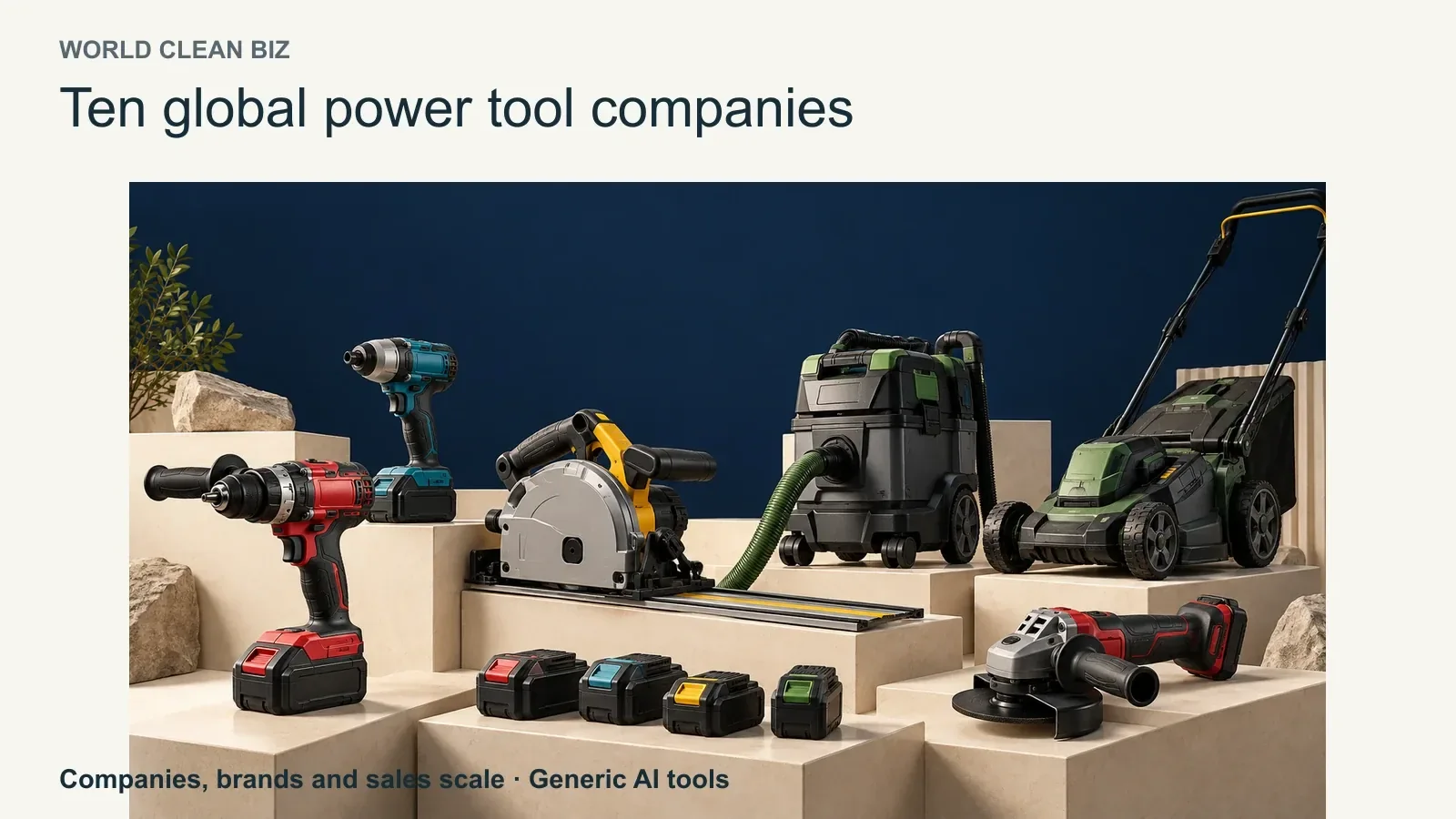
- A relatively small number of companies operate many of the world's best-known tool brands.
- TTI generated $15.26 billion in 2025 revenue; Milwaukee and RYOBI together accounted for approximately 91%.
- Chinese companies are competing through acquired brands, independent product development and distribution in emerging markets.
In this article 10 sections
The power tool industry has many brands, but a relatively small number of companies behind them. TTI operates Milwaukee and RYOBI's licensed tool business; DeWalt and BLACK+DECKER belong to Stanley Black & Decker. Chinese companies including Chervon, Positec and INGCO have also become international competitors.
This article profiles ten representative companies. Those with revenue figures appear in descending order of scale, including related outdoor equipment, accessories and other operations. Most figures cover 2025; Makita's cover the fiscal year ended March 2026. Koki Holdings and Positec appear at the end, where the section numbers do not indicate established revenue rankings.
1. Techtronic Industries: $15.26 billion in annual revenue
Horst Julius Pudwill and Roy Chi Ping Chung founded TTI in 1985. Manufacturing and overseas customer business provided its starting point, before it progressively built a brand-led business. The acquisition of Milwaukee in 2005 was a decisive step.
Milwaukee was an American company founded in 1924. Under TTI, it pushed product development deeper into individual trades, including electrical and plumbing work, designing tools around specific tasks.
Pressing a pipe connection or cutting a cable could become the starting point for a dedicated product. If a tool saved meaningful working time, professionals had a reason to pay more for it. Milwaukee kept expanding along those needs, gradually covering more of the work performed on a jobsite.
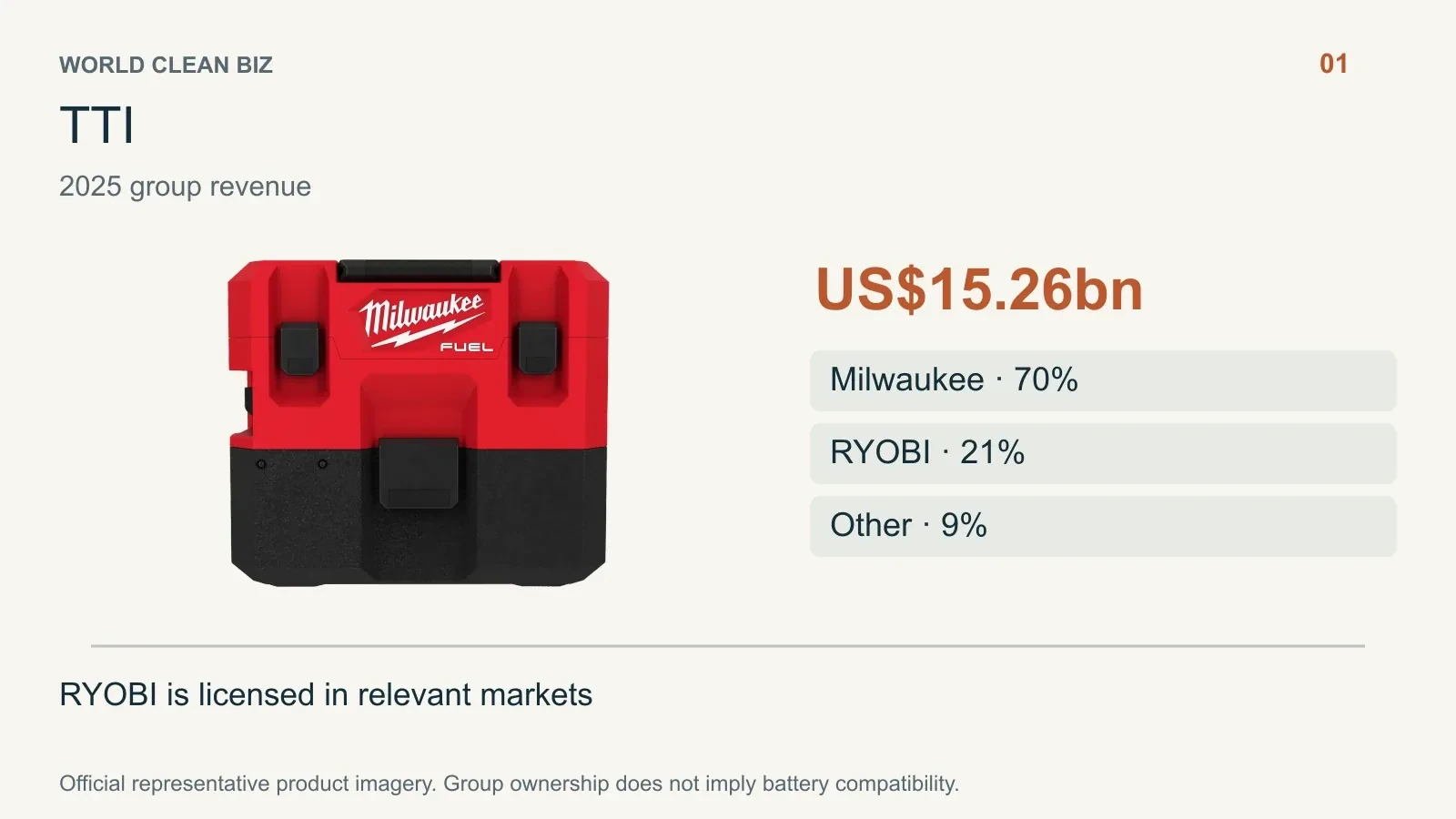
In 2025, Milwaukee generated $10.7 billion in sales, accounting for 70% of TTI revenue. RYOBI generated approximately $3.2 billion, or 21%. Together they contributed roughly 91% of the group's $15.26 billion in revenue. TTI's net profit was approximately $1.2 billion.
RYOBI and Milwaukee serve different purposes. The former focuses more on household DIY and yard users; the latter keeps moving deeper into professional markets. The RYOBI trademark belongs to Japan's Ryobi Limited. TTI operates the relevant tool and outdoor businesses under license in its licensed markets; it did not acquire the Japanese Ryobi group.
For Chinese manufacturers, TTI offers an appealing example. Manufacturing provided the foundation; operating brands gave the company a direct role in pricing products. Milwaukee's scale today is far beyond the orders a traditional contract manufacturer could expect from any single customer.
2. Stanley Black & Decker: approximately $13.16 billion in Tools & Outdoor revenue
Stanley Black & Decker connects the histories of two long-established American businesses.
Stanley, founded in 1843, grew from hardware products. Black & Decker, founded in 1910, built its position in portable power tools. They completed their merger in 2010 to form today's Stanley Black & Decker.
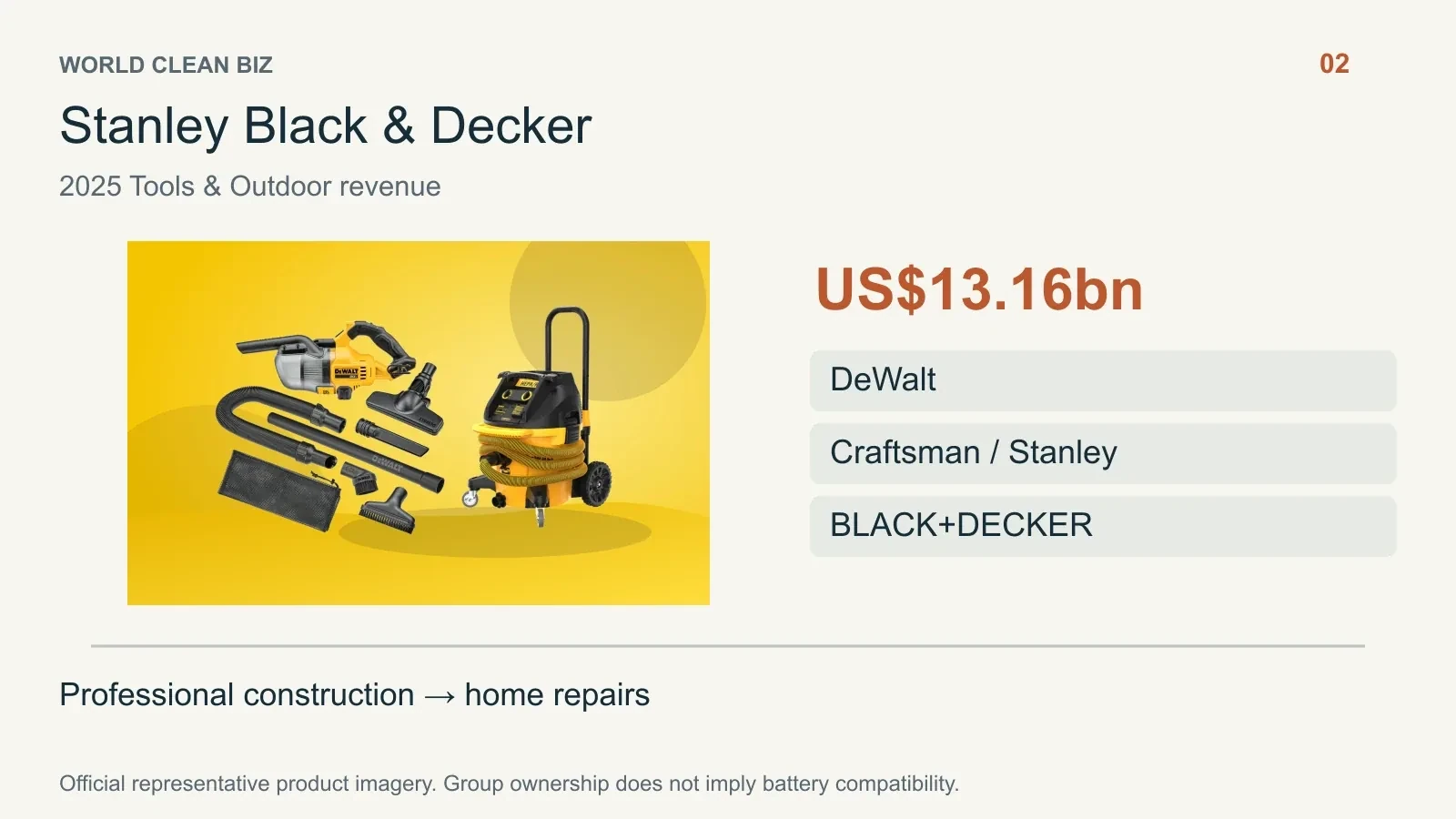
Acquisitions continued to broaden the portfolio. It now includes DeWalt for professional construction users, BLACK+DECKER for households, and brands such as Craftsman and Stanley. Different brands occupy different price points, allowing the group to address needs from home repairs to professional construction.
In 2025, group revenue was approximately $15.1 billion. Tools & Outdoor contributed approximately $13.16 billion, including power tools, hand tools and outdoor equipment, and remained the main source of revenue.
DeWalt is one of its most important professional brands. Starting in woodworking machinery, it went on to build an extensive cordless range. FLEXVOLT batteries and the POWERSHIFT system have taken it further into higher-powered construction equipment.
A construction customer once made largely separate purchases of handheld tools and heavier machinery. Electrification is bringing more of those decisions together. Stanley Black & Decker wants its existing brands and distribution to capture more of that spending.
But a large brand portfolio also requires sustained investment. Resource allocation and product renewal affect whether the company can keep pace with its competitors. DeWalt delivered low-single-digit organic growth in 2025, while Tools & Outdoor revenue declined. A collection of established brands does not guarantee growth across every business.
3. Hilti: approximately CHF6.3 billion in annual sales
Hilti is headquartered in Liechtenstein. Its standing in construction is closely connected to how directly it works with customers.
For a company employing many construction workers, buying tools is followed by maintenance and equipment management. A machine that remains out of service can disrupt the work schedule.
Hilti has developed services around those problems. Its Fleet Management offering brings tool use and maintenance arrangements into a contract, reducing the burden of purchasing and managing equipment individually.
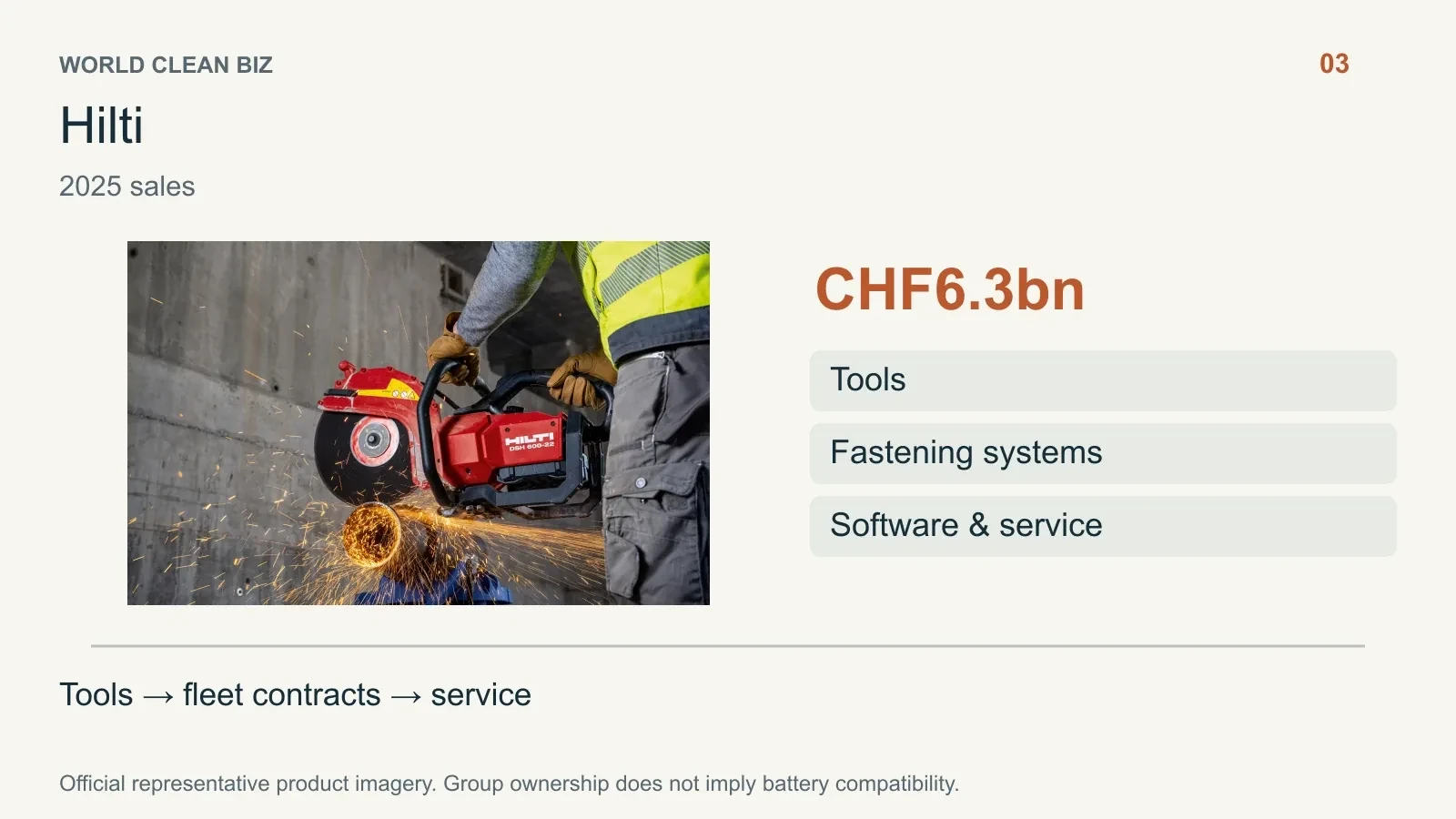
In 2025, Hilti generated approximately CHF6.3 billion in sales and CHF728 million in operating profit. Its business includes tools, fastening systems and related software and services.
This model requires a sales and service organization that remains close to jobsites. Hilti's prices therefore need to be considered against the customer's overall construction costs.
A competitor can launch a rotary hammer with similar performance. Building equally close customer relationships takes considerably longer. That has given Hilti a position beyond the mass-market tool aisle.
4. Bosch: approximately €5 billion in Power Tools sales
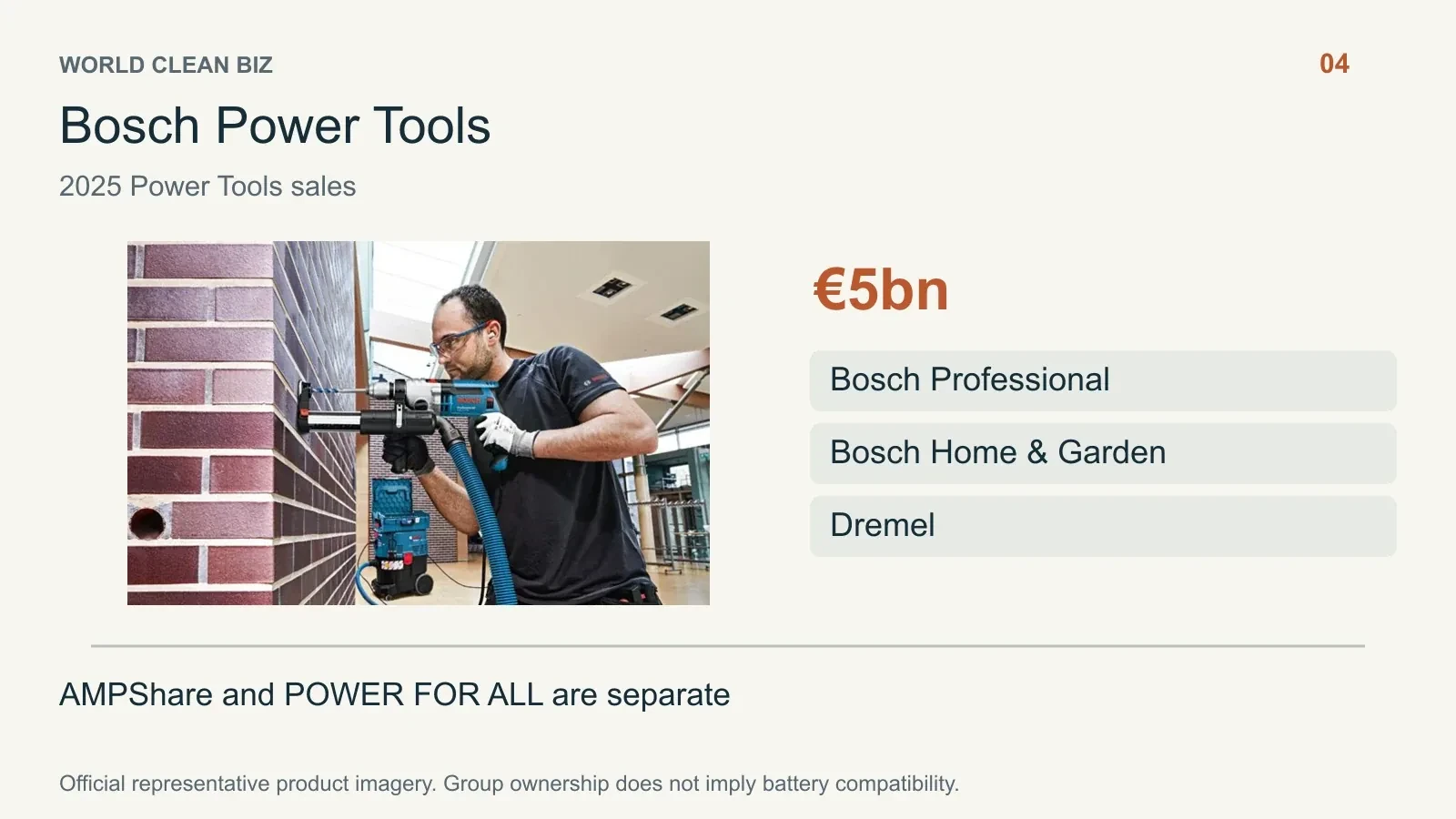
Power tools are only one part of Bosch. In 2025, the Power Tools division generated approximately €5 billion in sales. Its portfolio includes Dremel as well as Bosch.
The most visible distinction within the Bosch range is between blue professional tools and green home-use products. They address different usage patterns and price expectations, serving professional construction and household DIY respectively.
Measuring equipment broadens Bosch's presence on the jobsite. A customer can encounter the brand from laser measurement and layout through to drilling and cutting.
Bosch also works with other companies on battery alliances. AMPShare serves the professional market; POWER FOR ALL serves the home-and-garden market. They are separate systems, with compatible products from participating brands sharing batteries within each respective system.
No company can develop every specialist tool itself. Partner brands can fill gaps in the range. The alliances extend the uses for a battery and give customers fewer reasons to leave the platform when they need a particular tool.
5. Makita: ¥777.6 billion in annual revenue
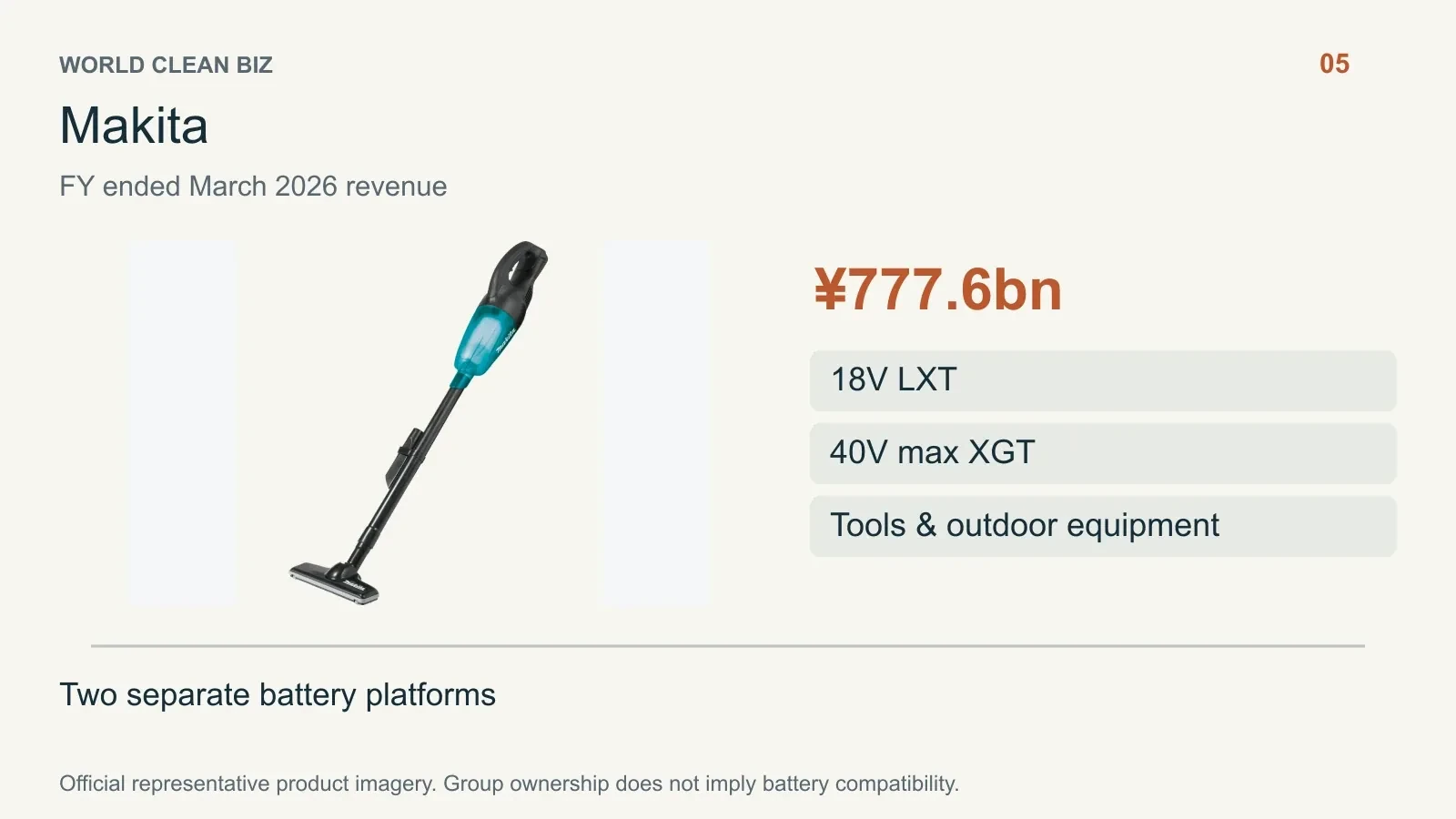
Makita began in Japan in 1915, selling and repairing electric motors before entering power tools. Unlike groups that have repeatedly acquired and managed multiple brands, Makita has long concentrated its main resources on its own core name.
That approach has allowed it to accumulate products and customers over many years. Renovation workers, carpenters and construction crews can find familiar Makita tools and service channels in many countries.
The 18V LXT system is an important part of its cordless business. Once users have bought batteries, they can progressively add tools from the same platform. Makita developed the 40V max XGT platform to address higher-power requirements, extending into heavier work and outdoor equipment.
For the fiscal year ended March 2026, revenue reached ¥777.6 billion, up 3.2%. Operating profit was approximately ¥104.7 billion, giving it an operating margin of roughly 13.5%.
Makita demonstrates the global scale a company can build around tools. Its position owes much to accumulated manufacturing experience and to the familiarity that users and dealers have with its products.
An established platform also brings trade-offs. Existing customers want their batteries to remain useful; higher-powered products can require different technology. Makita has to pace development between serving its large installed base and advancing newer platforms.
6. Chervon: approximately $1.628 billion in annual revenue
Chervon's tool business grew out of Nanjing, later expanding through its own brands and acquisitions.
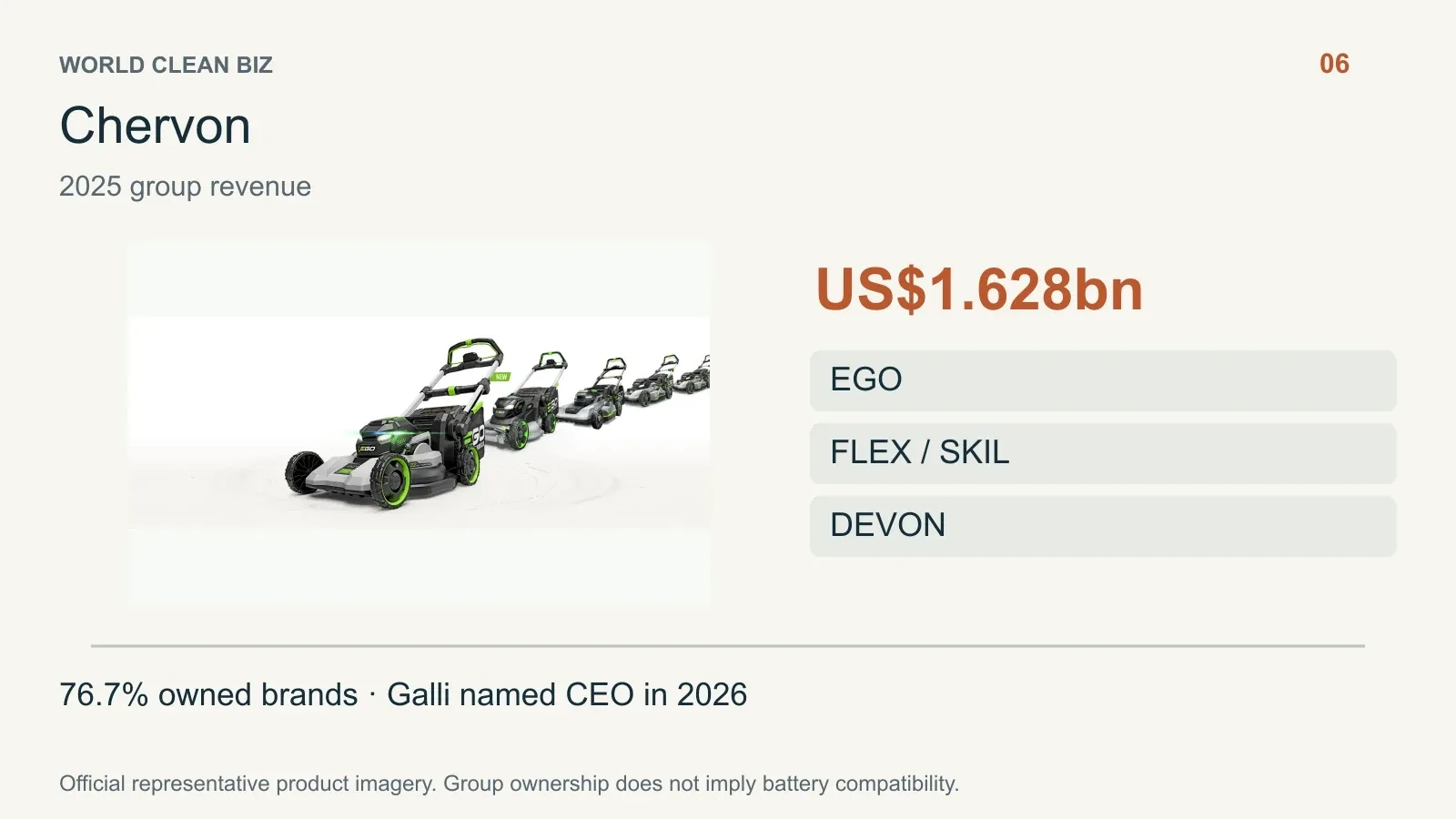
It acquired Germany's FLEX in 2013 and completed its acquisition of the North American and European SKIL and SKILSAW businesses in 2017. Alongside its own EGO and DEVON brands, those deals gave Chervon a portfolio serving different markets.
EGO helped the company capture the transition from gasoline to lithium-ion outdoor power equipment. Lawn mowers and blowers make substantial demands on power and runtime. Chervon invested in batteries and complete machines for those applications, gradually building international sales.
In 2025, Chervon generated approximately $1.628 billion in revenue and $97.7 million in net profit. Its own-brand business contributed 76.7% of revenue. Brands now account for most of the business, although contract manufacturing remains part of its operations.
The year also exposed competitive pressure. Revenue fell 8.2%, with power tool sales down 18.3% and outdoor power equipment essentially flat. In its annual disclosure, Chervon acknowledged the intense competition FLEX and SKIL face from major global tool companies and the continuing investment they require.
In September 2026, Chervon brought in a significant new figure: former TTI chief executive Joseph Galli Jr.
Galli became Chervon CEO on September 10, with founder Peter Longquan Pan remaining chairman and an executive director. Galli had helped develop DeWalt's professional tool business at Black & Decker, joined TTI in 2006 and became group CEO in 2008, serving until his retirement in 2024. During his tenure, Milwaukee became a major force in professional tools.
The executive who helped build DeWalt and Milwaukee is now leading Chervon into competition with his former employers.
Chervon already has a manufacturing and engineering foundation, while EGO has demonstrated its ability to develop a brand. For FLEX and SKIL to gain more ground in professional tools, they still have to break through the distribution and customer relationships that industry leaders have spent years building. Galli's brand-building experience is directly relevant to that task.
Pan's decision to hand over the CEO position marks another stage in Chervon's development. The question now is whether Galli can turn one of its existing brands into a business with Milwaukee-like growth momentum.
7. INGCO / Yinghe Tools: approximately RMB10 billion in annual sales
While many tool companies focused on Europe and North America, Suzhou-based Yinghe took a different route.
Its INGCO and TOTAL brands are relatively unfamiliar to many Chinese consumers, yet they have entered hardware stores across Southeast Asia, the Middle East, Africa and Latin America. Western tool groups also sell in those markets, but their attention and investment are uneven. Yinghe quietly developed distribution in places that received less attention.
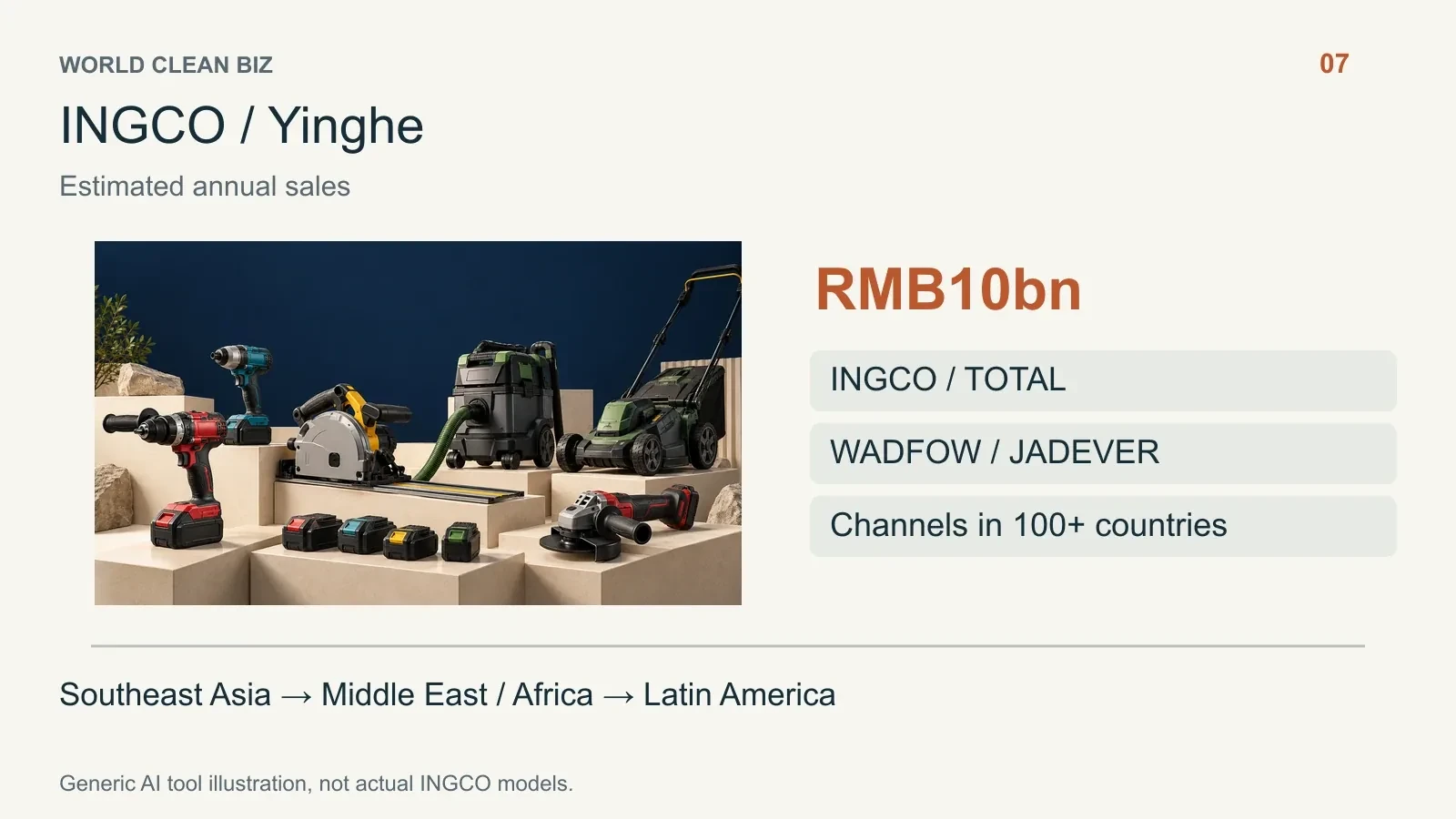
It avoided the fiercest competition in the main European and North American markets, serving local tradespeople and hardware stores with affordable, broad product ranges. Its annual sales are estimated at approximately RMB10 billion.
The range extends well beyond drills and angle grinders into hand tools, garden equipment and small construction machinery. Brands within the related operating group include INGCO, TOTAL, WADFOW and JADEVER. INGCO has established sales channels in more than 100 countries.
For a local hardware store, one-stop purchasing has a straightforward appeal. The owner can buy more of the assortment through a single brand system, reducing the work of finding individual suppliers. Drawing on China's extensive tool supply chain, Yinghe keeps adding products and capturing more shelf space.
This route attracts less attention than buying a century-old brand, but it has allowed the business to accumulate scale. By the time the wider industry began taking notice, it had already spent years operating in many of those overseas markets.
8. TTS Tooltechnic Systems: €807 million in annual revenue
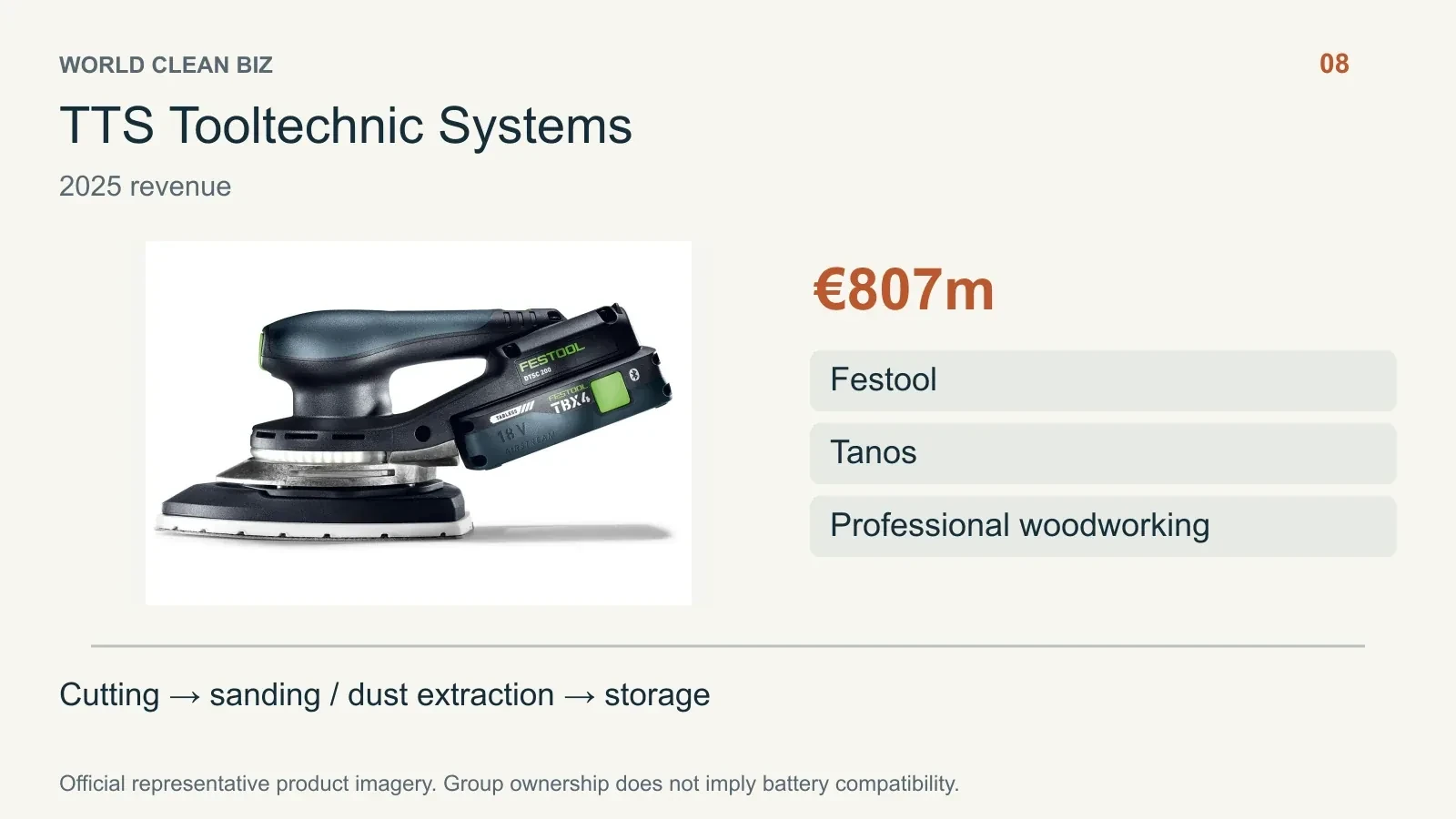
TTS is less familiar than Festool, the brand it owns.
The German family business traces its history to 1925. Festool has long served professional woodworkers and renovation trades, with recognizable products including track saws, sanders and the DOMINO joining system. Sister brand Tanos is closely associated with tool storage systems.
In 2025, TTS generated €807 million in revenue. It is smaller than the diversified tool giants above, but it has established its own space in the professional market.
Festool often develops products around a complete workflow. Saws work with guide rails, sanders connect to dust extractors, and storage cases organize tools for transport. For carpenters regularly working inside customers' homes, cutting accuracy, dust and cleanup all affect the job.
That helps explain the premium. Customers pay more in the expectation of reducing rework and lost time over repeated use.
TTS does not need to compete with mass-market brands for volume in every category. Its business rests on whether professional woodworkers keep choosing it for their next machine.
9. Koki Holdings: Japanese and German tool businesses under one roof
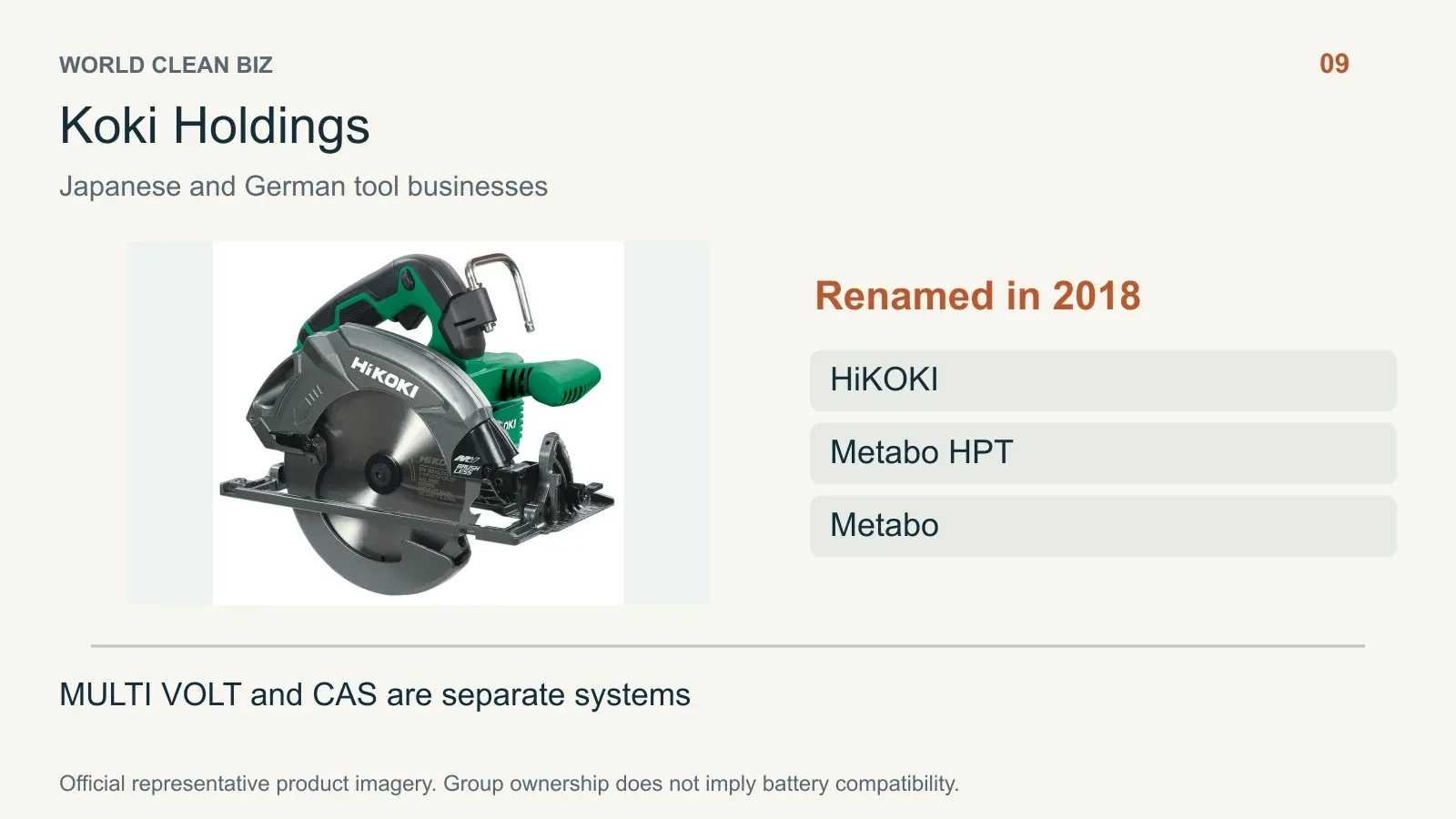
Koki Holdings was formerly Hitachi Koki. In 2016, Hitachi Koki acquired Germany's Metabo. In 2017, it was acquired by a KKR-established vehicle and delisted. The company adopted the Koki Holdings name in 2018.
The tool branding changed as well. HITACHI progressively became HiKOKI. North America primarily uses the Metabo HPT name, while Germany's Metabo retains its separate brand.
The group therefore brings together professional tool businesses with different origins. HiKOKI carries forward its Japanese product heritage, while Metabo has its own customer base in metalworking and construction.
A common parent does not automatically mean a common product platform. HiKOKI's MULTI VOLT and the CAS system in which Metabo participates must be considered separately. Similar names do not establish battery compatibility.
Koki Holdings has to retain each brand's professional users while improving the efficiency of the group. Hitachi once provided a powerful source of recognition. As an independent business, the company has to reinforce its position through products and distribution.
10. Positec: from Suzhou manufacturing to overseas consumers
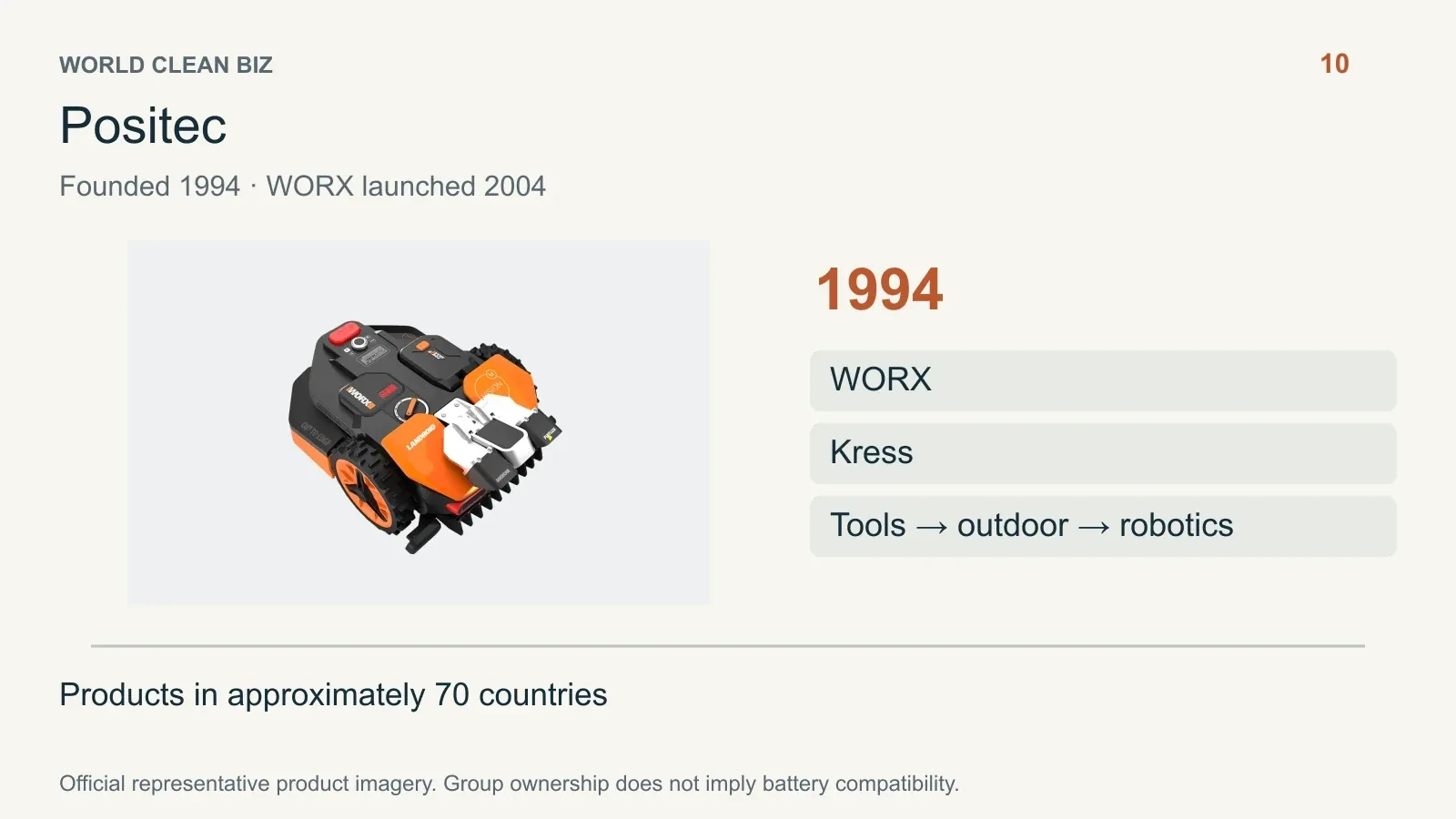
Don Gao founded Positec in Suzhou in 1994. Its early manufacturing business built tool development and production capabilities. With the launch of WORX in 2004, the company began investing more deeply in its own brand.
The move from contract manufacturing to brands substantially changes what a company must take responsibility for. Previously, the customer had decided whom a product would serve. A brand owner must judge demand itself and carry the inventory risk when a product does not sell.
WORX gradually entered overseas household tool and garden markets, while also offering professional products in certain regions. Positec also owns Kress. Its business has expanded further into outdoor equipment and robotics, with products reaching approximately 70 countries.
Garden equipment gives Positec more room to grow. Households buying tools also need to maintain lawns and yards, allowing battery and motor technology to extend across some categories. Robots, however, bring additional demands in navigation, software and reliable outdoor operation, requiring further development spending.
Positec has moved beyond making cheaper versions of foreign tools. It deals directly with overseas consumers and bears the consequences of its own product decisions.
Chinese tool companies once spent more time discussing how to become suppliers to these giants. Today, Chervon has recruited the executive who once led TTI, while INGCO has built its own markets outside the main Western battlegrounds. Chinese companies are now competing for overseas dealers' shelves—and for the customer's next tool purchase.