- China’s August 5 countermeasures prohibit domestic organizations and individuals from relevant transactions or cooperation with the RBA.
- The conflict leaves multinational brands responsible for meeting US UFLPA requirements without using the RBA system in China as they did before.
- China is likely to build its own audit standards, certification bodies and supply-chain data systems as it moves from rule taker to rule maker.
On July 31, the US Department of Homeland Security added 43 Chinese companies to the Uyghur Forced Labor Prevention Act Entity List.
The latest group did not consist only of companies based in Xinjiang. It included Chacha Food, Synear Food and Septwolves—three familiar consumer brands known across China for sunflower seeds, frozen dumplings and clothing. That companies like these were suddenly restricted by the United States over allegations of forced labor shows how increasingly absurd the situation has become.
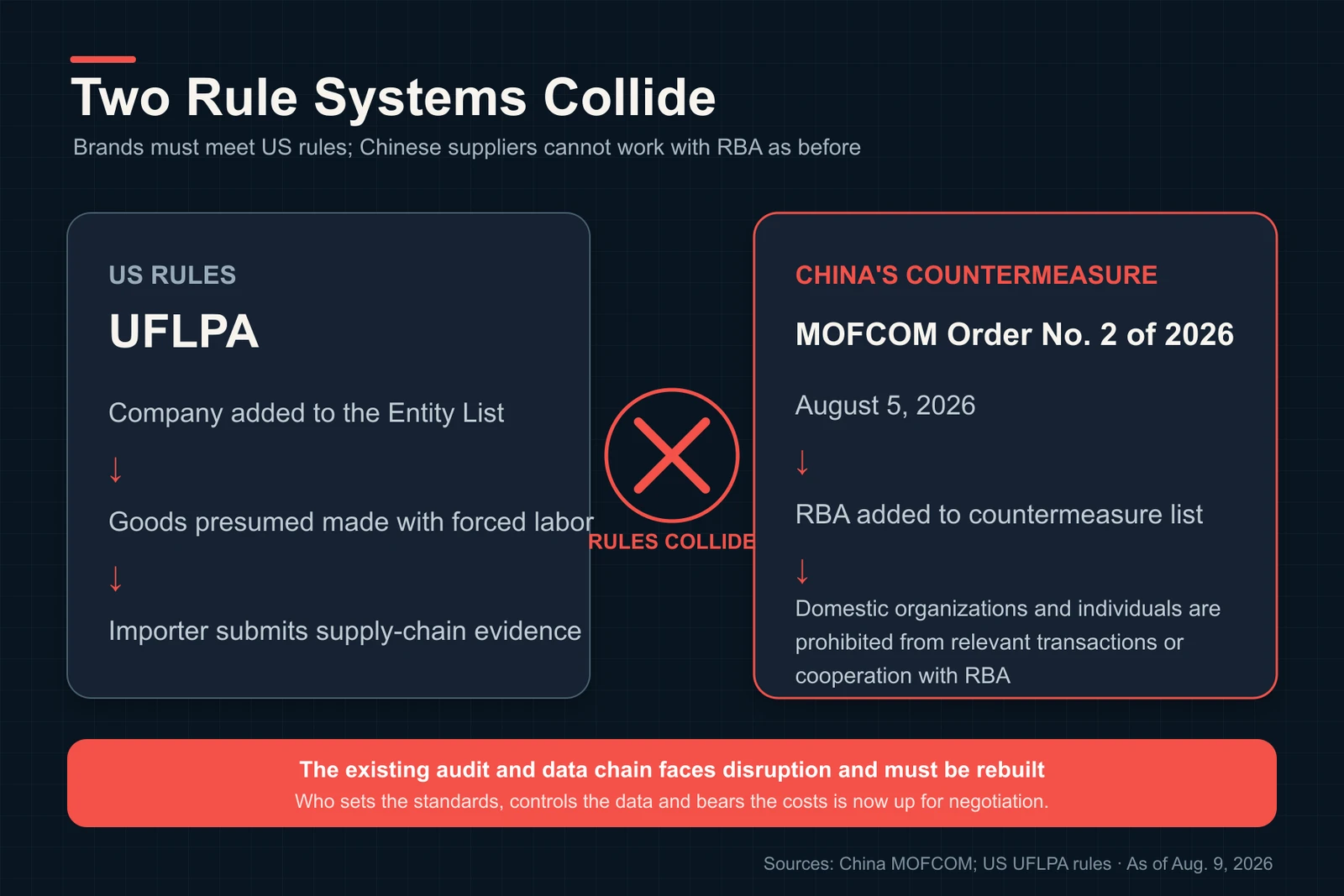
The United States does not first have to prove that a listed company uses forced labor. Under the UFLPA, goods produced by an entity on the list are presumed to have been made with forced labor. If an importer still wants to bring those products into the country, it must provide enough supply-chain evidence to rebut that presumption.
The accusation comes from Washington. The burden of proving innocence falls on the company.
Suppliers may have to provide the origin of their raw materials, employee records, production documents and information about companies further upstream. The US government can force Chinese companies and American importers to spend substantial time and money proving that there is no problem, while carrying very little of the investigative cost itself.
This has been happening for years. Chinese suppliers that wanted to keep overseas orders prepared documents, received audits and tried to demonstrate that their supply chains had no connection to Xinjiang. The United States kept widening the scope of its scrutiny, while Chinese companies kept paying the cost of proving themselves clean.
This time, China did not keep cooperating.
On August 5, China’s Ministry of Commerce announced countermeasures against six US entities, including Applied DNA Sciences, Altana Technologies and the Responsible Business Alliance. Chinese organizations and individuals are now prohibited from conducting relevant transactions or cooperation with the listed entities.
The most consequential name on the list is not a testing company or a data provider. It is the Responsible Business Alliance, better known as the RBA.
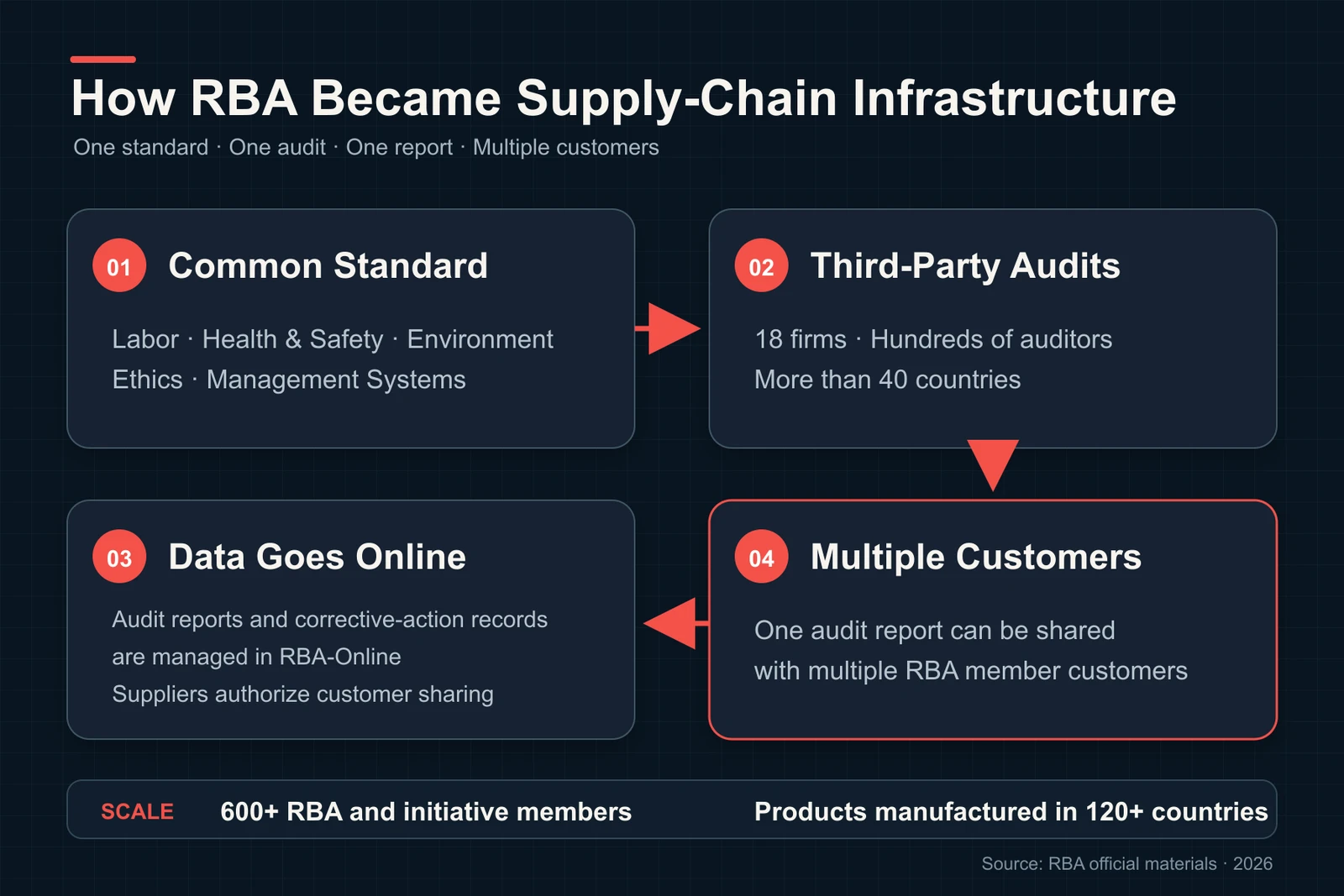
The RBA began in 2004 as the Electronic Industry Citizenship Coalition. It was founded by electronics companies including HP, Dell and IBM to establish a common standard for auditing suppliers. The organization changed its name to the RBA in 2017 as its reach expanded beyond electronics into industries including automotive, retail and toys.
Today, the RBA and its initiatives have more than 600 members, with products manufactured in more than 120 countries. Apple, Dell, HP, Intel, Microsoft and many other global technology companies have long used the system to manage their suppliers.
A Chinese company trying to enter one of these supply chains will often begin with a self-assessment and then undergo an audit by an RBA-approved third-party firm. Auditors enter the factory and review working hours, wages, occupational health and safety, environmental management and labor conditions. When they find problems, the supplier has to submit a corrective-action plan and face follow-up checks.
The RBA does not carry out every site visit itself. Its Validated Assessment Program uses hundreds of auditors from 18 independent firms across more than 40 countries. But the RBA writes the standards, manages the program, and puts audit reports and corrective-action records into RBA-Online.
Once a factory completes an audit, it can share the report with multiple customers. Global brands avoid sending separate teams to inspect the same supplier, and factories avoid undergoing the same audit again and again. Over time, the RBA has become more than an industry association. It has become part of the infrastructure of global manufacturing.
The system once looked like a way to improve efficiency. It has now exposed another side.
Western companies write labor, human-rights and supply-chain standards, requiring Chinese companies to accept audits and open their data. The US government then uses rules of its own making to judge and sanction Chinese companies. The standard setter, investigator and judge all come from the same side of the system.
Chinese suppliers accepted that arrangement because they wanted access to global orders. But once supply-chain audits started feeding directly into UFLPA enforcement and other Xinjiang-related measures, the system stopped being merely a tool for corporate responsibility. It became part of the machinery used to sanction Chinese companies.
Sanctioning the RBA is China’s rejection of that arrangement.
A Chinese company that continues to pay the RBA, register facilities on its platform, submit data or accept an RBA-managed audit may now run into the prohibition on transactions and cooperation. Even when the site visit is performed by a third-party audit firm, a Chinese company may still face compliance risk if the audit uses RBA standards and the final report enters the RBA platform.
Until the government provides more detailed implementation guidance, audit firms operating in China are likely to pause affected projects. The revenue from one more audit is not worth the risk of violating Chinese countermeasure rules.
The Responsible Minerals Initiative may face the same problem.
Companies around the world use RMI programs to trace tin, tantalum, tungsten, gold and cobalt, and to demonstrate that their mineral supply chains comply with European and US regulations. The RMI was not separately named in the Chinese countermeasure list, but it is an initiative of the RBA rather than a fully unrelated organization. Chinese companies will now have to reconsider whether they can continue participating in its programs and submitting mineral-sourcing information.
China did not sanction an ordinary audit provider. It sent a message to global companies: foreign organizations do not possess an automatic right to inspect Chinese supply chains, collect corporate data and then participate in measures used to sanction Chinese businesses.
Foreign brands can manage their suppliers. They can set requirements for quality, delivery, environmental performance and labor practices. But they cannot enter Chinese factories and collect extensive supply-chain information while allowing those standards and data to become evidence for US sanctions.
This is where China has stopped playing by the old rules.
Under the previous arrangement, a foreign brand made the demand while the Chinese supplier prepared the documents, paid the audit bill, completed the corrective actions and opened its data. Suppliers carried most of the cost. They had almost no voice in deciding how the rules were written.
American companies still have to comply with the UFLPA. Chinese companies now face a prohibition on continuing relevant transactions or cooperation with the RBA. When those two rule systems collide, Apple, Dell and other multinational companies have to find the solution themselves.
They are unlikely to abandon China’s supply chain, and they may not leave the RBA either. The more realistic response is to redesign how audits are carried out in China: build internal audit teams, adopt other standards, or work with Chinese institutions to establish a new local compliance system.
Every one of those options is more complicated than continuing with the RBA. They also raise the cost of supplier management. A report that used to be shared by several customers may have to be replaced by separate reviews for different brands. Multinational companies can no longer push every compliance obligation down to the supplier, nor can they collect and use Chinese supply-chain data in exactly the same way as before.
China is not setting out to reject all supply-chain audits.
Product safety, worker protection, environmental responsibility and mineral sourcing still require standards and credible verification. The problem is that these standards cannot continue to be written unilaterally by US companies and institutions, supply-chain data cannot be transferred abroad without limit, and audit results cannot automatically become grounds for sanctioning Chinese companies.
China is likely to build its own supply-chain audit standards, certification bodies and data platforms, and then push for recognition from more companies and countries. Foreign brands that continue to source from China will have to carry out their audits within the boundaries of Chinese law instead of expecting suppliers to accept US-designed rules without conditions.
The action against the RBA will not be an isolated event.
For decades, Europe and the United States wrote most of the rules of global trade. They set product standards and built labor, human-rights, environmental and mineral-sourcing requirements into access to global supply chains. Chinese companies accepted those rules because that was the price of reaching international markets.
As China’s power and its position in global supply chains continue to grow, the era of one side writing the rules is coming to an end.
When a system presented as responsible supply-chain governance is used to interfere in China’s affairs, extract data from Chinese supply chains and provide grounds for sanctioning Chinese companies, China will no longer remain at a table where somebody else writes the rules and also acts as the judge.
Sanctioning the RBA is only the beginning. China is moving from being a rule taker to a rule maker, and the old global rules built by Europe and the United States will be rewritten through more confrontations like this one.