STIHL and Kärcher recently announced a professional battery alliance.
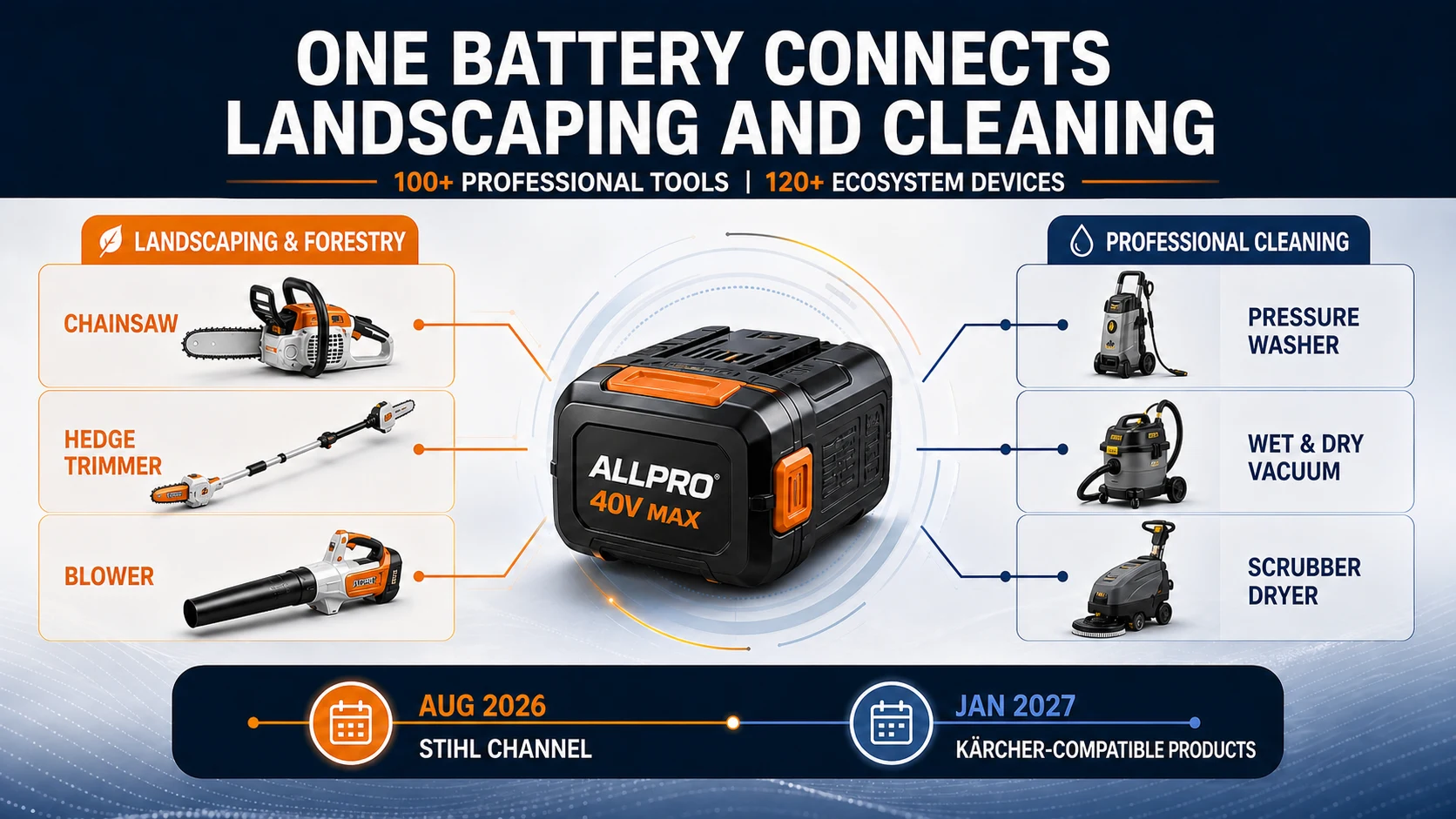
The platform is called ALLPRO and is built around a 40V MAX battery system. According to Kärcher's official information, ALLPRO will bring more than 100 professional tools from Kärcher and STIHL onto one battery platform. With other partners included, the ecosystem will cover more than 120 devices.
The timetable is also clear. New ALLPRO batteries will be sold through STIHL's professional retail channel from August 1, 2026. Kärcher's new compatible batteries and tools are scheduled for January 1, 2027.
STIHL is strong in chainsaws, brush cutters, blowers, landscaping and forestry equipment. Kärcher is strong in pressure washers, wet-and-dry vacuums, scrubber dryers and professional cleaning equipment. The two companies do not normally sit on the same retail shelf, but they serve the same professional users: landscaping crews, property-management companies, municipal service providers, factory maintenance departments, schools and commercial facility-service companies.
For a landscaping crew, property-management company or factory maintenance department, keeping equipment running matters more than the headline specification of one machine.
A landscaping team may need chainsaws, hedge trimmers, blowers and brush cutters. A property team may need pressure washers, vacuums, scrubber dryers and outdoor cleaning equipment. When every brand has its own battery system, purchasing, inventory, charging and maintenance all become more complicated.
ALLPRO is designed to solve that problem by bringing landscaping, forestry and professional cleaning onto one battery platform.
The difficult part is not the connector. It is migrating existing users, bringing dealers on board and making credible after-sales commitments.
For STIHL users, ALLPRO remains compatible with the existing AP system, and existing AP batteries can also be used with new Kärcher battery equipment. For existing Kärcher users, ALLPRO is a new platform, but Kärcher has promised continued service, spare-parts and battery support for products in its original Battery Universe.
For professional users, a common connector is only the first step. Whether old batteries remain usable, when new equipment arrives, and whether spare parts and service keep up will determine whether a team is willing to switch its fleet to a new platform.
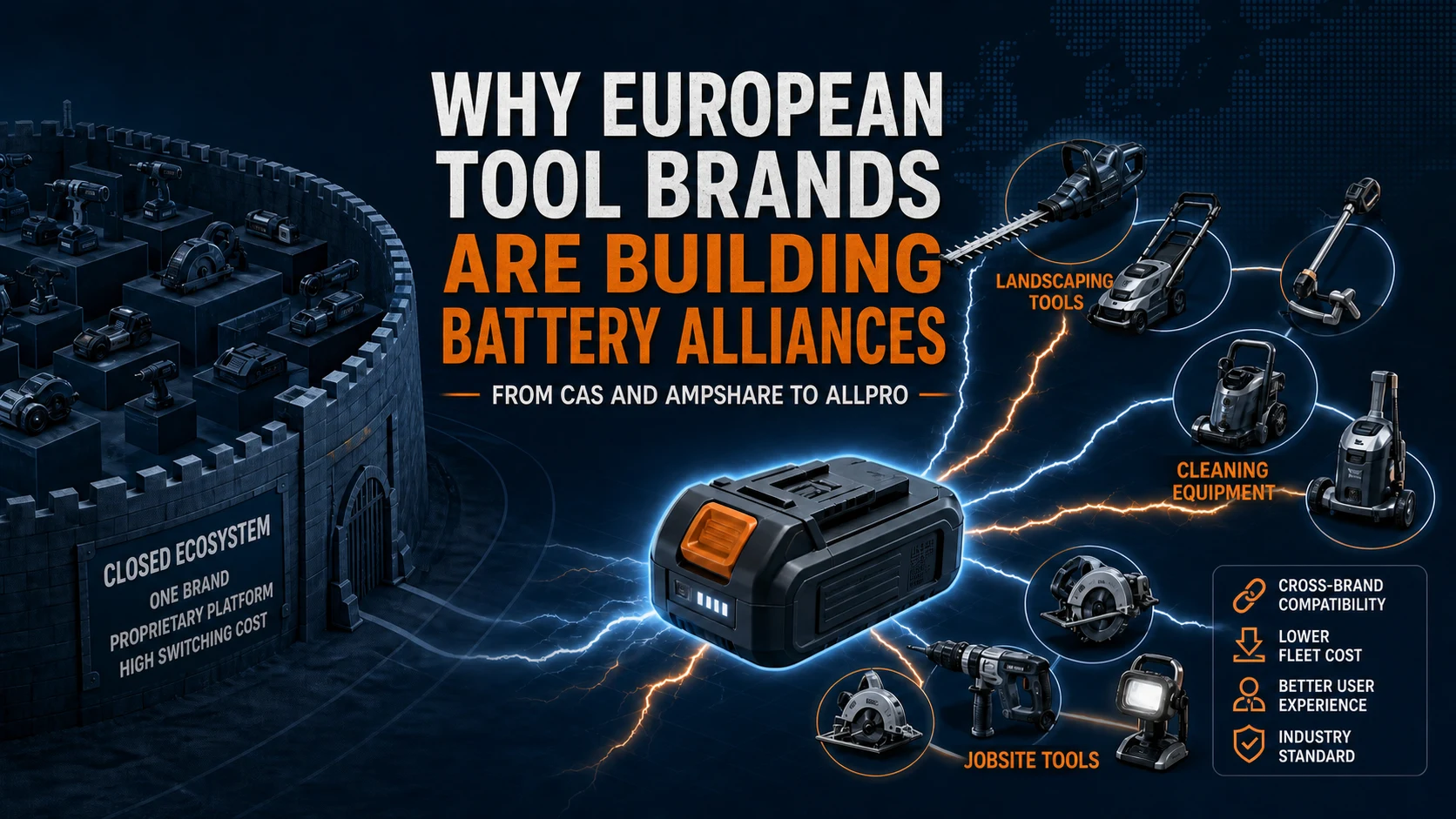
Several similar platforms have emerged in the European tool industry over the past few years. Metabo launched CAS, Bosch launched AMPShare, and now STIHL and Kärcher have launched ALLPRO. All of them allow multiple professional brands to share one battery system.
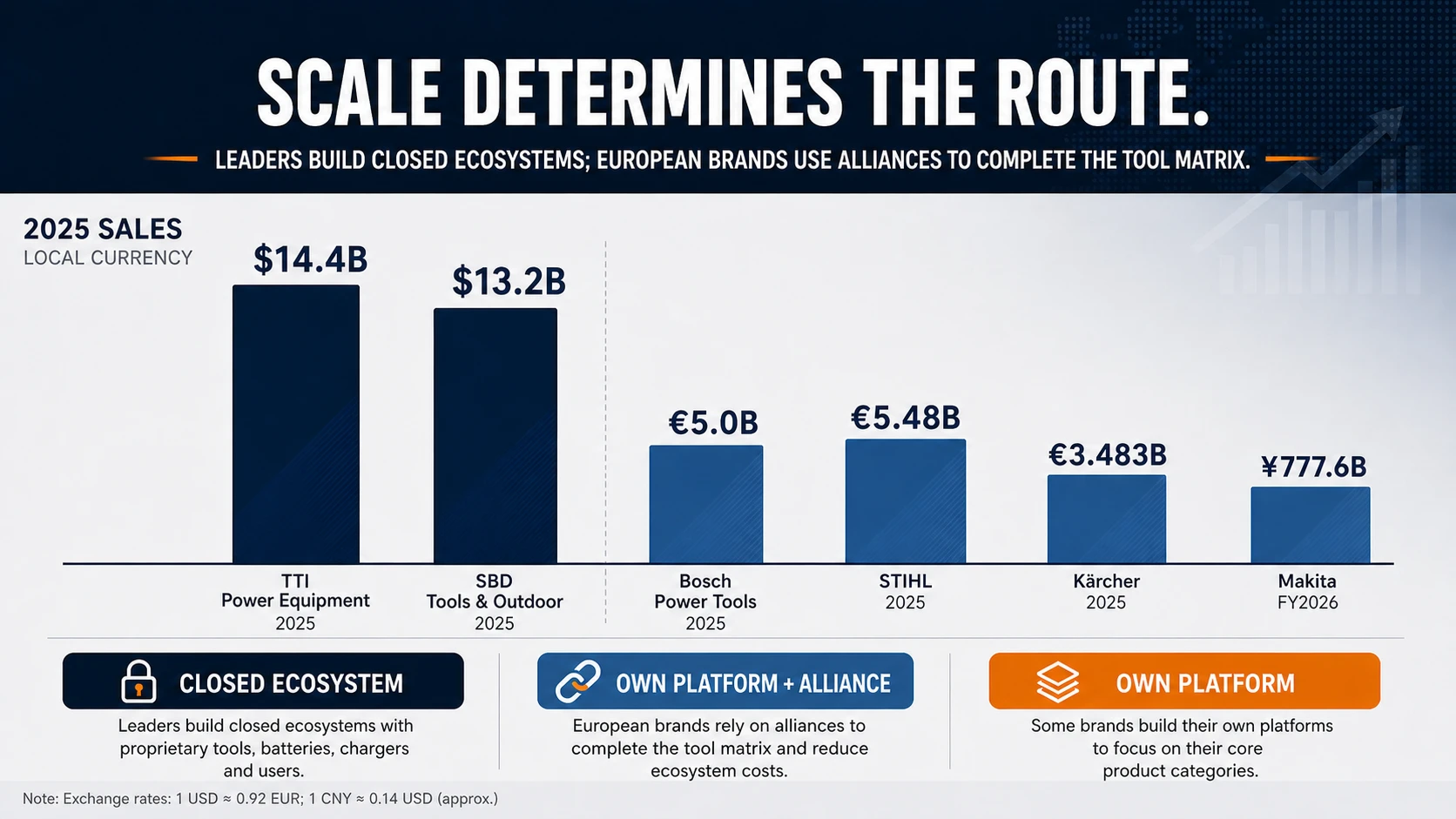
“Carrying fewer batteries” is only the surface benefit. Put the sales figures side by side and the competitive logic behind these alliances becomes clearer.
| Company / Platform | Latest Sales Scale | Battery Strategy |
|---|---|---|
| TTI Power Equipment | About $14.4 billion in 2025 | Closed ecosystems built around Milwaukee, Ryobi and Hart |
| Stanley Black & Decker Tools & Outdoor | About $13.2 billion in 2025 | Closed ecosystem built around DeWalt |
| Makita | About ¥777.6 billion in FY2026 | Proprietary LXT and XGT platforms |
| Bosch Power Tools | About €5.0 billion in 2025 | Proprietary platform + AMPShare |
| STIHL | About €5.48 billion in 2025 | Proprietary battery expansion + ALLPRO |
| Kärcher | About €3.483 billion in 2025 | Expanding its professional battery ecosystem through ALLPRO |
TTI and Stanley Black & Decker are unlikely to join someone else's battery alliance.
TTI owns Milwaukee, Ryobi and Hart. Milwaukee serves professional users, Ryobi targets DIY and household users, and Hart is tied closely to Walmart. In 2025, TTI's Power Equipment business generated about $14.4 billion in sales. Milwaukee continued to grow, and Ryobi grew as well. TTI is no longer a single tool brand. It is a multi-brand, multi-channel tool group built around multiple battery platforms.
Stanley Black & Decker is in a similar position. DeWalt already has 20V MAX, FLEXVOLT and POWERSHIFT. POWERSHIFT is also moving into jobsite electrification and heavy equipment. Even as SBD works through restructuring and profit recovery, DeWalt remains its most important asset.
For companies like these, opening their battery standard would mean giving away part of the repeat-purchase relationship.
Battery packs generate profit, but installed battery inventory also shapes the user's next purchase. The more batteries professional users own, the higher the cost of switching platforms.
Users compare price and performance when they buy their first tool. By the third or fifth purchase, the batteries and chargers they already own begin to influence the decision. Once a construction crew, landscaping team or cleaning company has accumulated dozens of batteries, switching platforms means replacing more than one tool. It means replacing inventory, chargers, maintenance systems and purchasing habits.
TTI and SBD are protecting future purchases of Milwaukee, Ryobi and DeWalt tools and batteries.
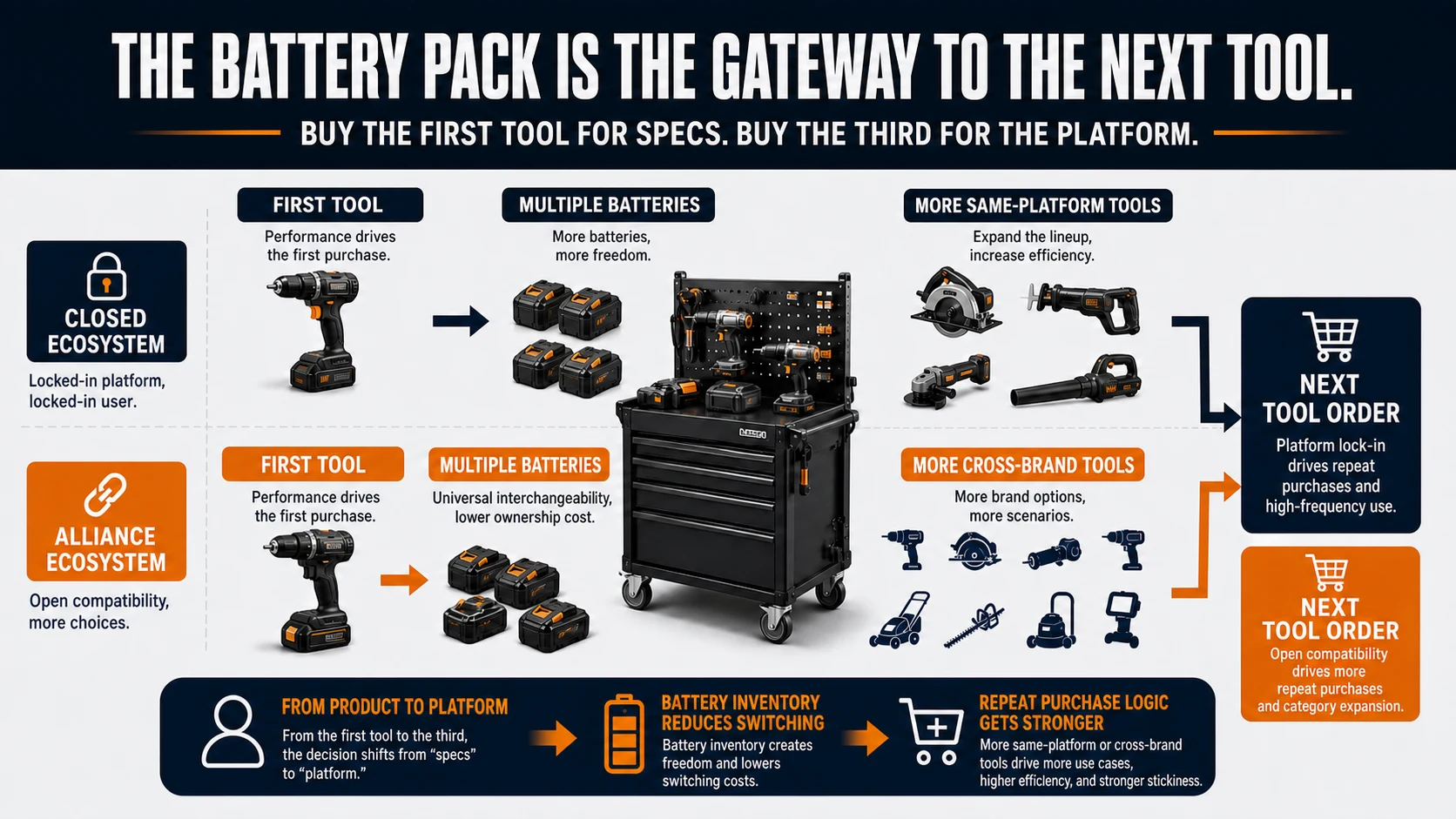
Bosch is strong in professional power tools, STIHL in landscaping, forestry and OPE, and Kärcher in professional cleaning equipment. All are strong brands, but each has a clear equipment boundary. No single one can easily cover power tools, landscaping tools, forestry equipment, cleaning machines and construction equipment across every professional setting.
When one brand cannot cover all the equipment, several brands can share a battery and increase the number of tools available on the platform.
Battery alliances have an open side, but they are first of all a competitive strategy. Brands behind the leaders need more brands and more equipment to compete with closed ecosystems such as Milwaukee and DeWalt.
CAS follows this logic. Metabo cannot cover every professional application on its own, so it brings multiple professional brands into one battery system. AMPShare follows the same logic. Bosch Professional's 18V platform is strong, but Bosch cannot build every type of professional equipment itself, so it opens the platform to more professional brands.
ALLPRO brings that logic across landscaping, forestry and professional cleaning.
STIHL and Kärcher are not weak companies. STIHL generated about €5.48 billion in sales in 2025, while Kärcher generated about €3.483 billion. Their equipment boundaries are different: one is strong in outdoor power equipment, the other in cleaning. Together, professional users no longer see only “a STIHL battery” or “a Kärcher battery,” but a professional equipment system covering more work situations.
That is why ALLPRO emphasizes more than 100 tools and more than 120 devices instead of talking only about battery capacity.
The most dangerous position in battery-platform competition is not having no battery. It is having a battery without enough tools for users to keep buying.
ALLPRO also uses STIHL's new high-performance batteries as its entry point. Official materials say the Performance range uses tabless cell technology. Taking the AP 300 P as an example, STIHL says peak power is 60% higher than with a conventional standard battery, runtime is 20% longer, full charging time is halved, and service life can reach up to 3,000 charging cycles.
Professional users will calculate those figures directly into operating cost.
Peak battery power affects whether equipment can handle heavy work. Runtime determines how many batteries a team must carry in a day. Charging time affects downtime, and cycle life affects total cost over several years. Professional users do not look only at the price of one battery. They look at whether the entire equipment system can keep working reliably.
This is where the contest takes place: whichever battery stays on the jobsite, in the landscaping truck or inside the cleaning vehicle is more likely to win the next equipment order.
Leading brands use closed ecosystems to keep users on their platforms. Once users own Milwaukee, DeWalt or Makita batteries, they naturally give priority to tools on the same platform. European alliances use multiple brands to expand a platform and convince users that they are not betting on a small system.
Both routes have the same objective: keep the user's next tool on the same battery platform.
Battery alliances will not rewrite the industry in the short term.
The tool industry still comes down to products, channels and brand execution. TTI and Stanley Black & Decker have remained in front because Milwaukee, Ryobi and DeWalt continue to deliver strong products. Battery platforms amplify that advantage; they cannot replace the products themselves.
For Europe's second-tier and specialized professional brands, alliances can complete the tool matrix and reduce users' concerns about adopting a small platform. But if the products are not good enough and service cannot keep up, users will not switch simply because the batteries are compatible.
Chinese brands will face the same question next.
Chinese companies have been better at breaking into markets with individual products, lower prices, faster launches and stronger supply chains. Once competition moves to the battery-platform level, they will have to answer how far a single-product advantage can carry them.
Build a platform, join an alliance, or remain a lower-priced alternative?
That question will become increasingly real over the next few years.