- Robot lawn mowers are moving from product validation to supply, channel and service competition.
- The next market leader may come from old outdoor power equipment leaders, Chinese challengers, listed robot companies or well-funded outdoor robot startups.
- Europe has produced the first wave of leaders, but the United States may decide the global ranking.
The robot lawn mower industry is entering the period before a new leader is crowned.
This is not a new king emerging from an empty market. It is a transition in which old leaders defend, new forces attack, listed companies enter and well-funded startups try to survive the proof stage.
In the past few years, robot lawn mowers were often discussed as a niche category inside the European garden equipment market. Industry conversations focused on wire-free systems, RTK, vision recognition, LiDAR and mapping.
Now the more important question is changing. The market is no longer asking only whether the category can be established. It is asking who can lead it.

Demand is stronger than expected
This year, orders for robot lawn mowers have exceeded many industry expectations. In some market conversations, distributors have been calling brands and hearing the same answer: inventory is tight.
This shortage is not only a single-brand issue. It reflects a shift in supply and demand after wire-free robotic mowers started to gain wider acceptance.
The market has moved from asking whether consumers will accept wire-free robotic mowing to asking who has inventory, who has channels and who can deliver consistently.
That is why the category now has stronger capital market imagination. Some leading players are approaching meaningful revenue scale, and the category is no longer only a small robotics niche. It may become one of the consumer robot tracks capable of producing listed companies.
The robot vacuum analogy is useful, but limited
The robot vacuum industry offers a useful historical reference.
Roborock was not the first company to build a robot vacuum. iRobot, Ecovacs and many others were earlier. But Roborock helped change the Chinese market when the Xiaomi robot vacuum brought laser navigation, path planning, cleaning performance and price into a combination that consumers could not ignore.
The lesson is not that robot lawn mowers will produce another Roborock. The lesson is that when a new category truly breaks out, the leading company does more than sell more units. It changes consumer expectations, price structure and industry thresholds.
Robot lawn mowers are waiting for that kind of restructuring.
Old leaders still matter
Husqvarna and Positec remain important because they represent the previous generation of category capability.
Husqvarna built deep experience in outdoor power equipment and robotic mowing. Positec became one of the strongest Chinese examples of branded overseas expansion in power tools and garden equipment.
As wire-free robotic mowers grow, the basis of competition is changing. Traditional mowing equipment emphasized mechanical structure, blades, motors, dealers and outdoor power equipment channels. Wire-free robotic mowers add positioning, mapping, obstacle avoidance, algorithms, software iteration, supply chain speed and cost control.
These are capabilities Chinese robotics, cleaning appliance and consumer hardware companies have been training for more than a decade.
The old leaders are not leaving the table. But the rules are changing.
Chinese challengers are moving quickly
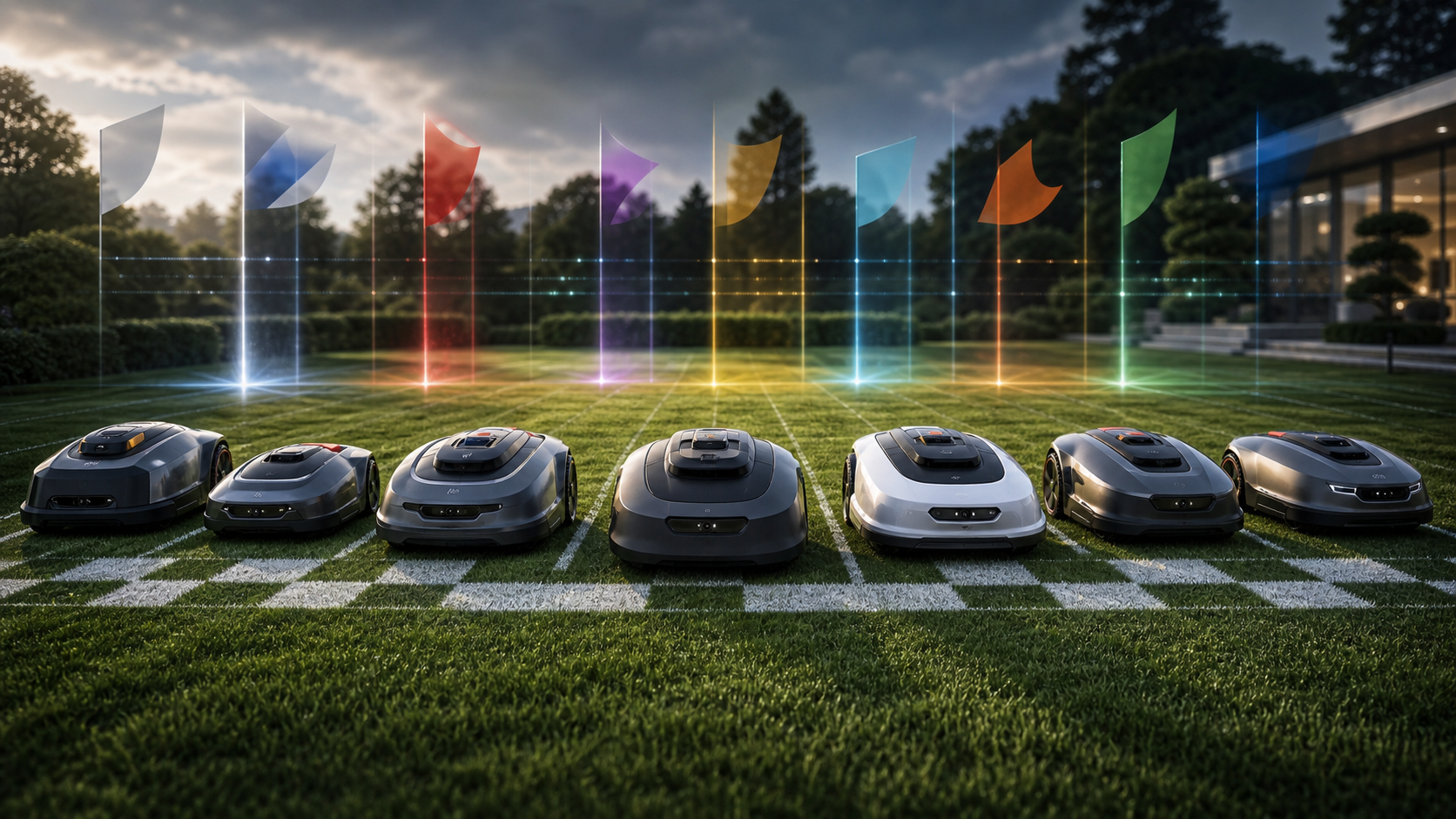
The current group of challengers includes Segway Navimow, Mammotion, MOVA/Dreame, Ecovacs, Roborock and other companies watching the same opportunity from different angles.
Segway Navimow is worth watching because of stability. Backed by Ninebot, it has experience in overseas consumer hardware, electric scooters and scaled global operations. In a category that will depend heavily on European and American channels, that operating base matters.
Mammotion represents another path: fast category focus and founder-led product execution. It has shown that a startup can reach real scale in a new outdoor robot category. The long-term test will be whether speed can become global service capability.
MOVA and Dreame are among the most aggressive variables. Their product strategy often starts by lifting user experience, then using scale and supply chain strength to absorb cost. In robotic mowers, that may mean accepting higher component cost if it creates a stronger product experience.
Listed companies such as Ecovacs and Roborock bring different strengths. They already understand consumer robotics, supply chains, software, app experience and overseas distribution. Their challenge is timing: the market is no longer empty, and several earlier players already have channel positions.
The United States may decide the final ranking
Europe is the current main battlefield because adoption started earlier and channel systems are more mature.
But the United States may become the market that changes the final ranking. U.S. penetration remains much lower than Europe, while detached homes, lawn size and garden maintenance needs are substantial.
The United States is not simply a larger version of Europe. It has different lawn conditions, retail channels, service expectations and regional climates. A brand that leads in Europe may not automatically lead in the U.S.
For Segway Navimow, Mammotion, MOVA/Dreame and other early leaders, the U.S. is a second battlefield to consolidate position. For Roborock, Ecovacs and other later entrants, it may be the largest chance to catch up. For pool robot companies expanding into yard robots, it may become a broader outdoor robotics entry point.

The winner will need more than technology
It is too early to name the final winner.
Robot lawn mowers are not a market decided only by RTK, vision or LiDAR. Technology matters, but it is not enough.
The real threshold is whether the product can work reliably in complex outdoor environments, whether the cost can reach a large enough consumer base, whether overseas channels and local service can support scale, and whether the organization can handle growth from hundreds of thousands of units to millions.
The industry is no longer only validating demand. It has not yet reached a final order.
The company that turns outdoor robot complexity into a product ordinary homeowners are willing to buy, use and recommend will have the best chance to lead the next phase.